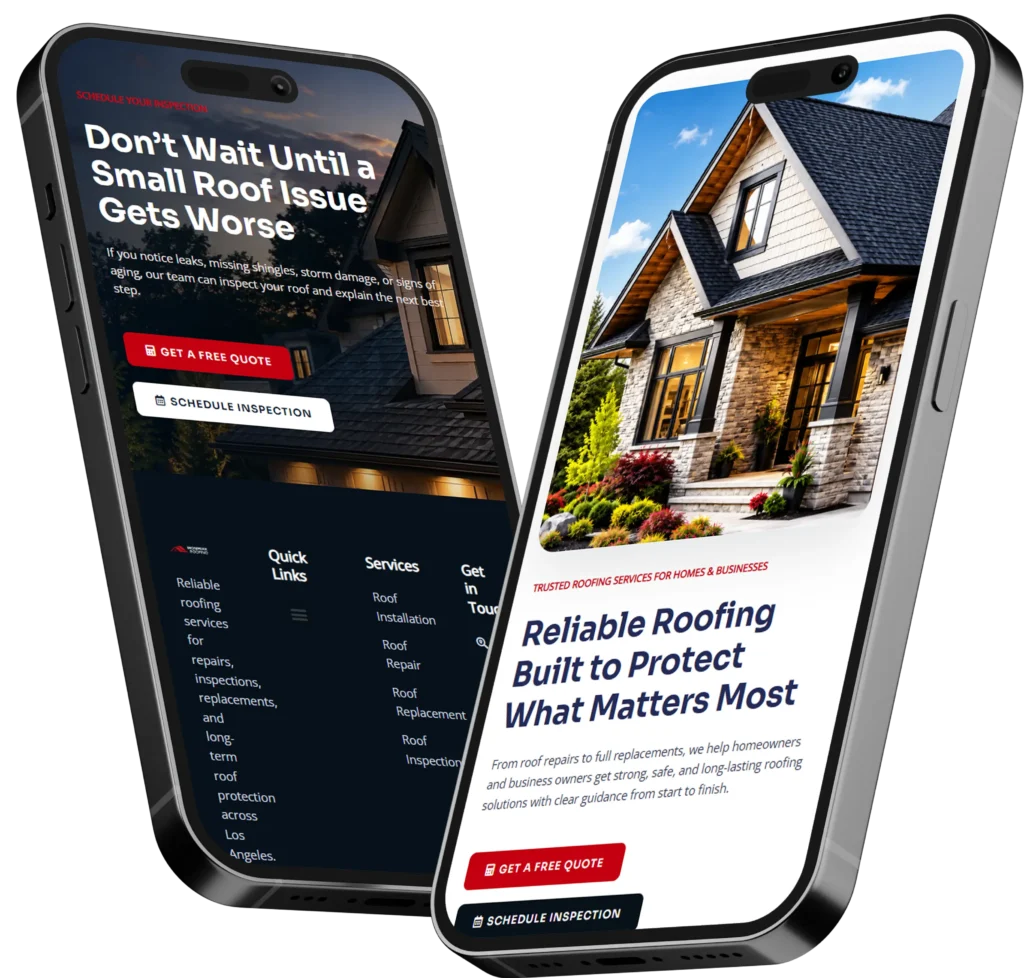
Landing page for small business owners helps turn visitors into real inquiries, calls, and sales. Landing page for small business success comes from a clear offer, fast loading time, and one strong call to action.A landing page helps a small business turn visitors into real inquiries, calls, or sales by focusing attention on one offer and one action. A strong page is clear, mobile-friendly, fast, and built around what your customer needs to do next.
If you run a local company, service brand, or home-based business, your website should not send everyone to a cluttered homepage and hope for the best. A focused page gives you a better chance to convert traffic from Google, ads, social media, email, and referrals into something measurable. That is exactly why a landing page for a small business matters.

What Is a Landing Page and Why Does It Matter for a Small Business?
A landing page is a standalone page built around one goal. That goal might be booking a call, requesting a quote, claiming a free audit, buying one product, or signing up for a service. Unlike a homepage, which usually introduces the full business, a landing page removes distractions and keeps the visitor moving toward one decision.
For a small business, that focus is valuable because traffic is expensive. Whether it comes from SEO, Google Ads, social posts, or word of mouth, every visit counts. If a visitor arrives and sees too many menu options, too much text, or no obvious next step, they leave. A focused landing page reduces that friction.
Google also recommends building pages that work well on mobile, since the mobile version of a site is used for indexing, and page experience elements such as HTTPS and Core Web Vitals are part of the overall search experience signals site owners should improve.
That means a small business page needs more than nice visuals. It needs clarity, speed, trust, and relevance.
Why a Small Business in the USA Benefits From a Dedicated Landing Page
Many small businesses in the USA compete in crowded local and regional markets. In that setting, a generic website often underperforms because it speaks too broadly. A landing page lets you match the message to the search intent.
For example:
- A plumber can create a page for emergency pipe repair
- A law office can create a page for free consultation requests
- A local bakery can create a page for custom cake orders
- A web design company can create a page for small business website redesigns
This matters because people do not search in broad terms all the time. They search with urgency, location, and intent. They want the answer fast. A landing page gives them that answer faster than a multipurpose website page usually can.
A good example of a clean service-first approach can be seen in small business web design experts, and a more conversion-oriented service breakdown like website design & development services. These pages work well because they reduce guesswork and push visitors toward a specific next step.
What a High-Converting Small Business Landing Page Should Include
The best landing pages are not complicated. They are well-structured. They guide the eye, answer objections early, and make the next action feel easy.
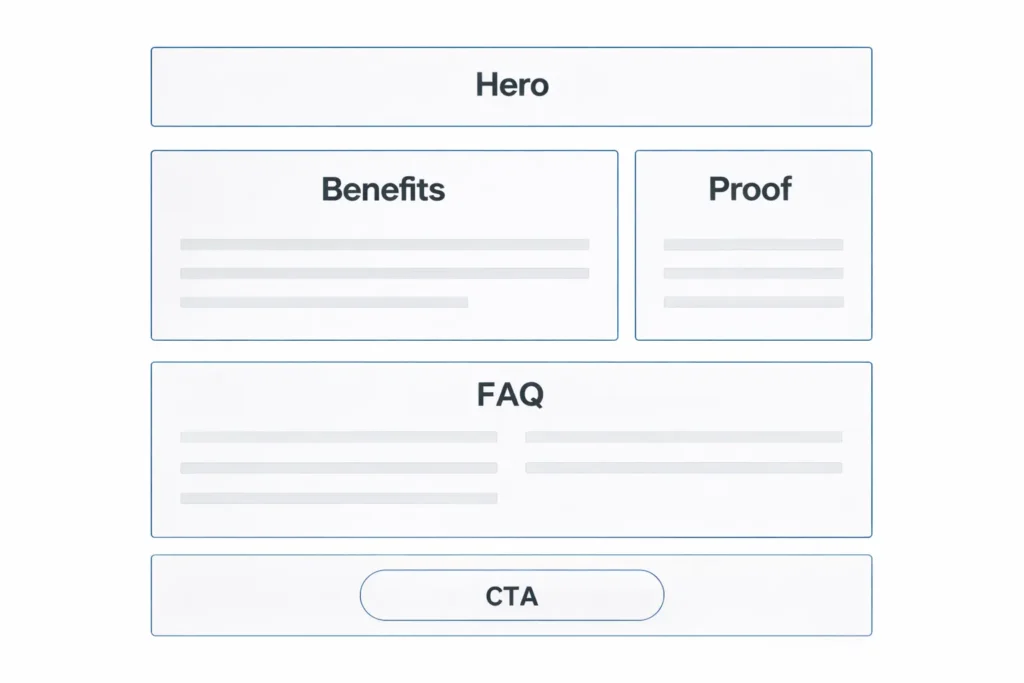
Here is the core structure that works well for most small business websites.
| Section | What It Should Do | Why It Matters |
| Hero section | Explain the offer fast | Visitors decide quickly whether to stay |
| Supporting copy | Clarify who it is for | Helps qualified leads self-identify |
| Benefits | Show value in plain language | Moves beyond features |
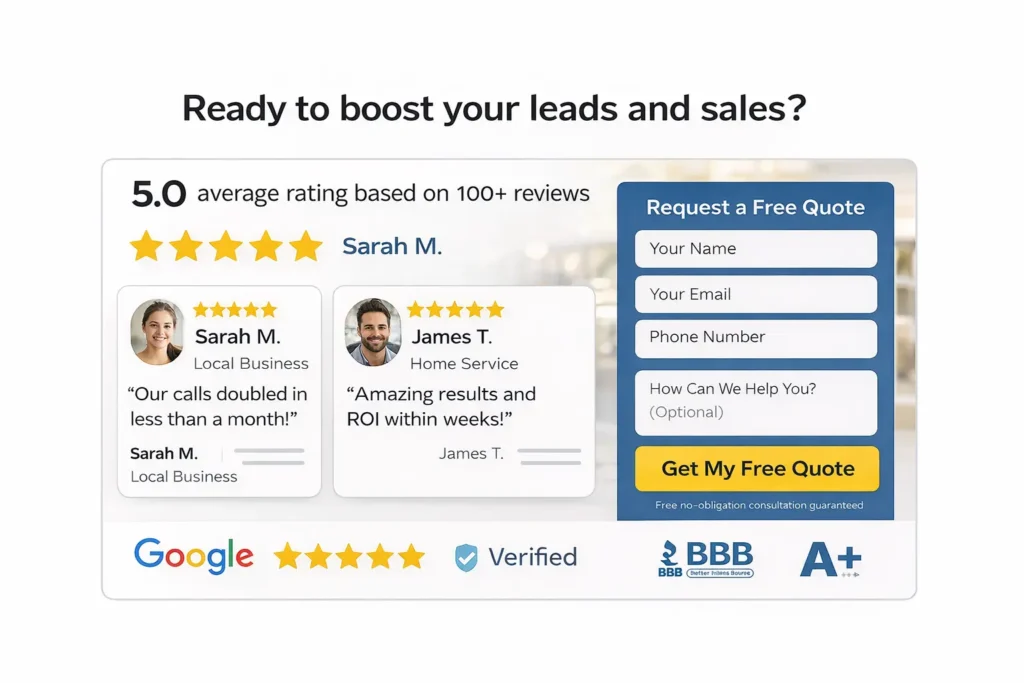
| Trust signals | Add proof, reviews, or results | Reduces hesitation |
| CTA | Give one clear next step | Prevents confusion |
| FAQs | Handle objections | Supports conversion without pressure |
1. A headline that says exactly what you offer
Your headline should tell visitors what they can get and who it is for. Clever headlines are usually weaker than clear ones. A small business landing page should sound direct, useful, and easy to understand.
Bad example:
“Helping You Reach the Next Level”
Better example:
“Custom Website Design for Local Service Businesses That Need More Leads”
2. A short subheading that adds context
This is where you explain the benefit, the turnaround, or the result. Keep it grounded in what your audience wants.
Example:
“Get a fast, mobile-friendly website page built to turn local traffic into booked calls and quote requests.”
3. One clear CTA
Do not ask visitors to do five different things. Choose one main action such as:
- Request a quote
- Book a strategy call
- Get a free audit
- See pricing
- Start your project
The button text should match the user’s stage. For a warm lead, “Book a Call” works. For a colder lead, “Get a Free Audit” may convert better because it feels lower risk.
4. Proof that builds trust
Trust can come from testimonials, a short case study, logos, guarantees, certifications, years in business, or examples of work. If you have visual proof, use it.
A page like portfolio highlights can strengthen confidence because visitors can quickly see whether your work matches the quality they want.
Which Type of Landing Page Is Best for a Small Business?
The best option depends on the offer and where the traffic is coming from. Not every business needs the same page structure.
| Landing Page Type | Best For | Main Goal |
| Lead generation page | Service businesses | Form fills, calls, consultations |
| Click-through page | Product or offer warm-up | Move users to next sales step |
| Local service page | City or area-based services | Rank and convert nearby searches |
| Promo page | Seasonal offers or campaigns | Fast action on one limited offer |
| Portfolio-led page | Creative and design services | Build trust before inquiry |
Lead generation page
This is usually the best fit for coaches, agencies, contractors, clinics, consultants, and most service brands. It includes a headline, benefits, proof, and a short form. If your goal is inquiries, this is often the strongest option.
Local service page
This works well if you want to target a city, neighborhood, or service area. It should mention the location naturally, explain the service clearly, and make contact easy.
Promo or seasonal page
Perfect for limited-time campaigns. Think tax season, holiday offers, a summer cleanup package, or a launch promo. These pages should move fast and remove unnecessary detail.
Portfolio-led page
Best for design, photography, branding, interiors, and similar visual services. You still need a CTA, but the work samples do more of the selling.
For many owners, the right answer is not just “build a landing page.” It is “build the right landing page for the right traffic source.” That is where strategy beats decoration.
How to Make the Page Convert Better
This is where many small businesses miss easy wins. They build the page, but they do not shape it for behavior.
Keep the message consistent from ad, search, or link to the page
If someone clicks a link about website redesign, the page should lead with website redesign. If they searched for mobile-friendly web design, that message should appear near the top. Message match reduces bounce and confusion.
This is also why related content matters. If your visitors are still diagnosing the problem before they buy, supporting articles such as why an outdated website hurts conversions or signs your website does not rank can help move them toward the landing page with better intent.
Make mobile usability a priority
Google recommends that websites provide a strong mobile-first indexing experience, especially since mobile-first indexing affects how content is evaluated.
Google states that it primarily uses the mobile version of content for indexing, so your page cannot be built desktop-first and treated as “good enough” on phones. Content should fit the screen, text should be easy to read, and buttons should be easy to tap.
Improve speed before adding more design elements
Google also explains that improving page experience and usability can support better overall website performance.
A slow page can waste good traffic. Clean layouts, compressed images, and lighter design choices often outperform flashy pages that load poorly. Google also recommends improving page experience, including Core Web Vitals and HTTPS, because these contribute to a more satisfying experience for users.
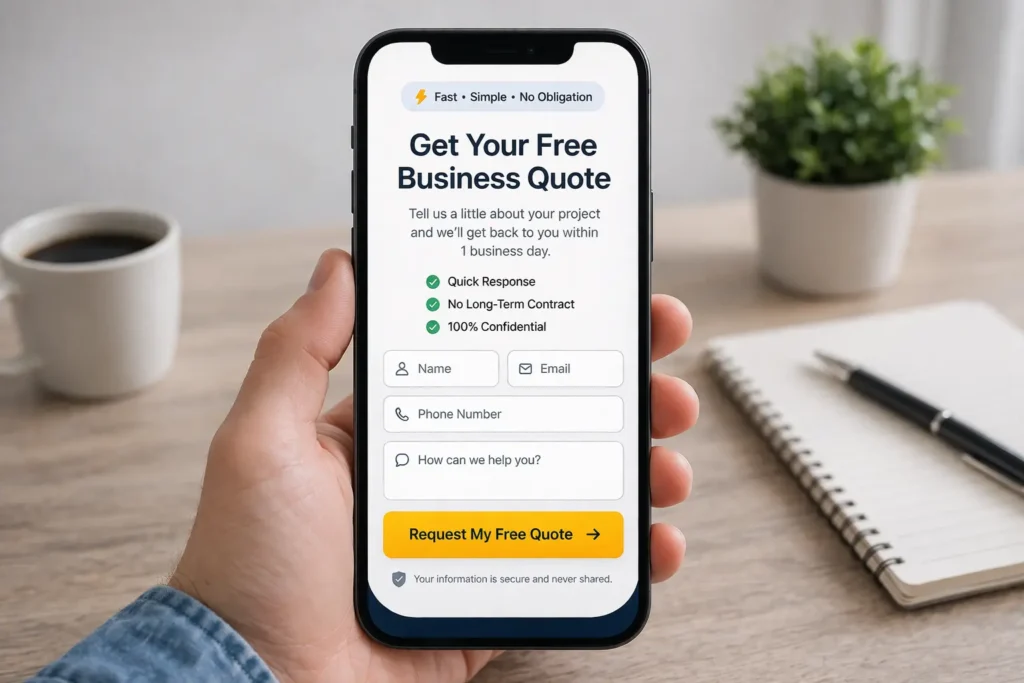
Reduce form friction
If your form asks for too much too soon, users abandon it. For most small businesses, name, email, phone, and one short message field are enough. Every extra field should earn its place.
Answer objections near the CTA
A visitor often hesitates right before action. Add reassurance near the button, such as:
- No long-term contract
- Free consultation
- Response within 1 business day
- No obligation quote
- Custom plan for your budget
Use external sources where helpful
Authoritative references can make your content stronger when used naturally. Google’s SEO Starter Guide is useful for understanding search visibility basics, while Google’s mobile landing page advice is especially relevant if you want better performance from ad and mobile traffic.
Common Mistakes That Hurt Landing Page Performance
The biggest problem is usually not a lack of effort. It is a lack of focus.
A small business landing page tends to underperform when it includes too many offers, weak headlines, stock copy, generic calls to action, or no proof. Another common issue is building the page around the business instead of the customer. Visitors care about their problem first. Your credentials matter after they feel understood.
Other mistakes include:
- Sending ad traffic to a homepage instead of a focused page
- Writing headlines that sound polished but say nothing
- Burying the CTA too far down the page
- Using walls of text with no scanning structure
- Ignoring mobile layout and button spacing
- Forgetting to show what happens after the form is submitted
One useful checkpoint is this: can a visitor understand the offer, trust the business, and know the next step within a few seconds? If not, the page still needs work.
A Simple Page Framework Small Businesses Can Follow
A practical structure often works better than trying to reinvent the page every time.
- Headline with offer and audience
- Subheading with one clear benefit
- Primary CTA button
- Social proof or quick credibility line
- Benefits section with outcome-focused copy
- Short process section
- Testimonial or mini case study
- FAQ section
- Final CTA with reassurance
That framework is effective because it supports both human readers and modern search behavior. The opening gives direct answers, the body explains why and how, and the FAQ section improves clarity for users comparing options.
Final Take on Choosing the Right Landing Page for Small Business
A landing page for a small business works best when it is built around one audience, one offer, and one action. It should answer the visitor’s main question fast, prove that your business is credible, and remove the friction that stops people from contacting you.
If you want better results, do not start with a trendy design. Start with message clarity, strong structure, trust signals, and mobile usability. Then improve from there. That is usually the difference between a page that looks nice and a page that actually produces leads.
Frequently Asked Questions
What is a landing page for a small business?
A landing page for a small business is a focused web page built for one specific goal, such as getting inquiries, quote requests, bookings, or sales. Unlike a homepage, it is not meant to explain everything about the company. It is meant to guide a visitor toward one action. That focus makes it useful for SEO, paid traffic, social campaigns, and local service promotions because the message stays clear from start to finish.
Why does a small business in the USA need a landing page?
A small business in the USA needs a landing page because local competition is strong and website visitors often decide very quickly whether to stay or leave. A focused page helps match your offer to what people are searching for, especially on mobile. It also gives you a better way to track conversions, test calls to action, and improve lead quality instead of sending every visitor to a general website page that tries to do too much.
What should a small business landing page include?
A small business landing page should include a clear headline, a short benefit-driven subheading, one main call to action, trust signals, and answers to common objections. It should also be easy to scan, fast to load, and simple to use on mobile devices. If possible, add testimonials, results, service details, and a short FAQ section. These elements help visitors feel informed without overwhelming them, which usually leads to better conversion performance.
How do I make my small business landing page convert better?
To make your small business landing page convert better, improve clarity before you add more design or more content. Match the page to the search intent or campaign message, reduce distractions, simplify the form, and keep the CTA easy to find. Strong proof also matters, so include reviews, examples, or short case studies where possible. On top of that, make sure the page is mobile-friendly and loads quickly, because poor usability can cost conversions even when the offer is good.