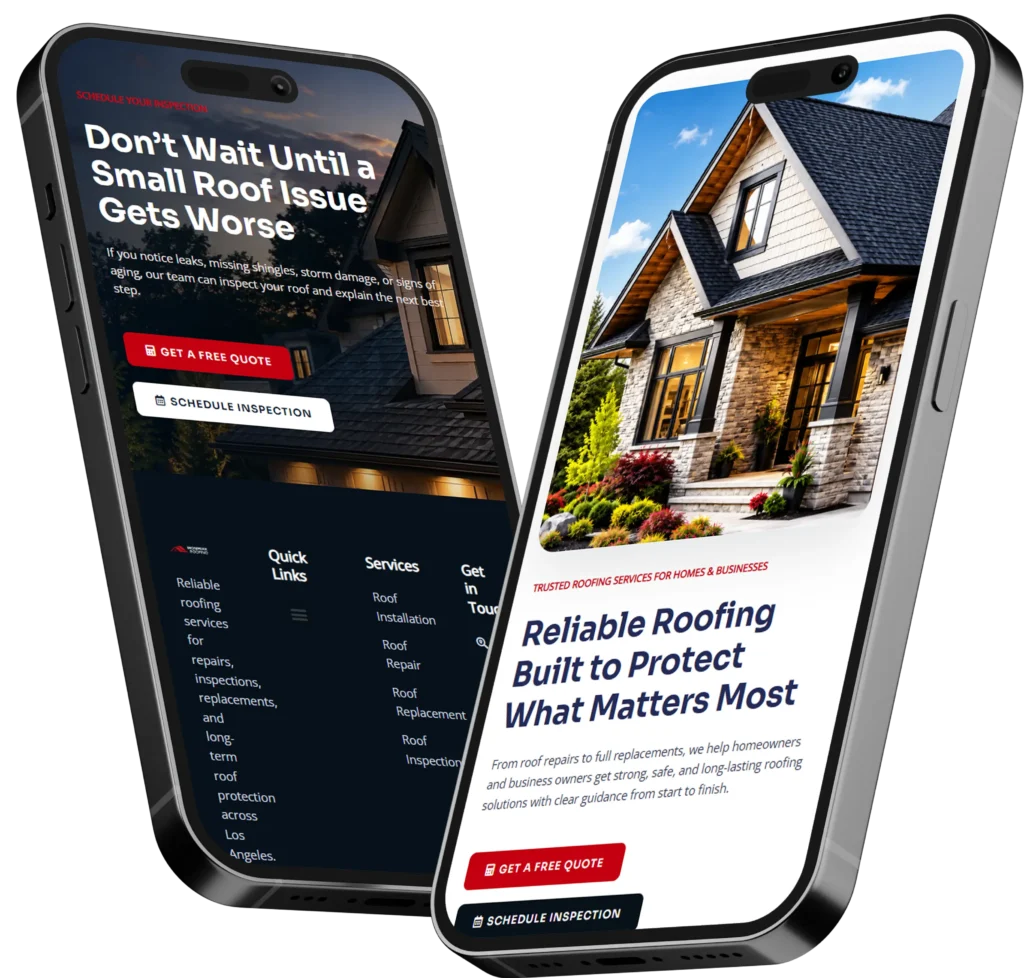
Website SEO for local business works best when the site is built around clear services, real locations, fast pages, and simple paths to contact. When design and SEO support each other, local companies earn stronger visibility, better trust, and more leads from the same traffic.
A lot of business owners still treat SEO, web design, and conversion as three separate jobs. They are not. Google’s own documentation keeps pointing back to the same fundamentals: make pages easy to crawl, easy to understand, and useful for real people. For local companies, that means your site needs to explain what you do, where you do it, and why someone should choose you instead of the next result. See Google’s SEO Starter Guide and Google’s local ranking guidance.
If you want a benchmark for what that positioning looks like, compare your current site to small business web design experts and then review the flow behind the website design & development services page. The strongest local sites do not try to say everything at once. They guide the visitor to the next right step.

Why design and local SEO need to work together
Google says local results are mainly based on relevance, distance, and popularity. Your website cannot control distance, but it can absolutely improve relevance and support popularity signals by making your services, locations, business details, and proof easier to understand. Google also recommends establishing accurate business details and claiming your Business Profile, so your official site, location, and contact information are connected across Search and Maps.
That is why a local business website should not feel like a digital brochure. It should act like a decision-making tool. A nearby customer lands on your page with a practical question: Can you solve my problem? Do you serve my area? Can I trust you enough to contact you right now? If the answer is buried under vague copy, cluttered layouts, or slow pages, the visit is wasted.
This is also where web design becomes a ranking asset rather than just a visual layer. Clean heading structure, readable page titles, service-specific copy, consistent business info, internal links, and mobile-friendly layouts help Google understand the page and help the visitor move. That overlap is what makes a smart local website outperform a prettier but less focused one.
What local customers need to see in the first few seconds
A strong local homepage should reduce uncertainty fast. Instead of a clever tagline that could belong to any company, the headline should name the service, the customer type, and the area when relevant. A plumbing company in Tampa, a dental clinic in Austin, and a cleaning service in Phoenix each need different wording, even if they all want more calls.
The first screen also needs one clear action. That might be “Get a Quote,” “Book a Call,” or “Request a Free Audit.” Too many buttons weaken momentum. One primary CTA, supported by trust cues like review ratings, years in business, licenses, or sample work, usually creates a better path.
Here is a practical way to think about the homepage:
| Homepage section | What it should communicate | Why it matters |
|---|---|---|
| Hero section | What you do, who you help, where you work | Improves clarity for both visitors and search engines |
| Primary CTA | One obvious next step | Reduces hesitation and boosts conversions |
| Service preview | Main offers with short descriptions | Helps users self-select quickly |
| Trust section | Reviews, badges, guarantees, photos | Builds confidence before contact |
| Local proof | City names, map, service area, nearby jobs | Reinforces local relevance |
| Internal links | Paths to service pages and supporting content | Strengthens crawlability and user flow |
This is also a good place to link to deeper pages naturally. If a visitor needs more detail, send them to helpful resources like local SEO for small business website or how to rank small business website instead of leaving them to guess where to go next.
How to structure pages so they rank and convert better
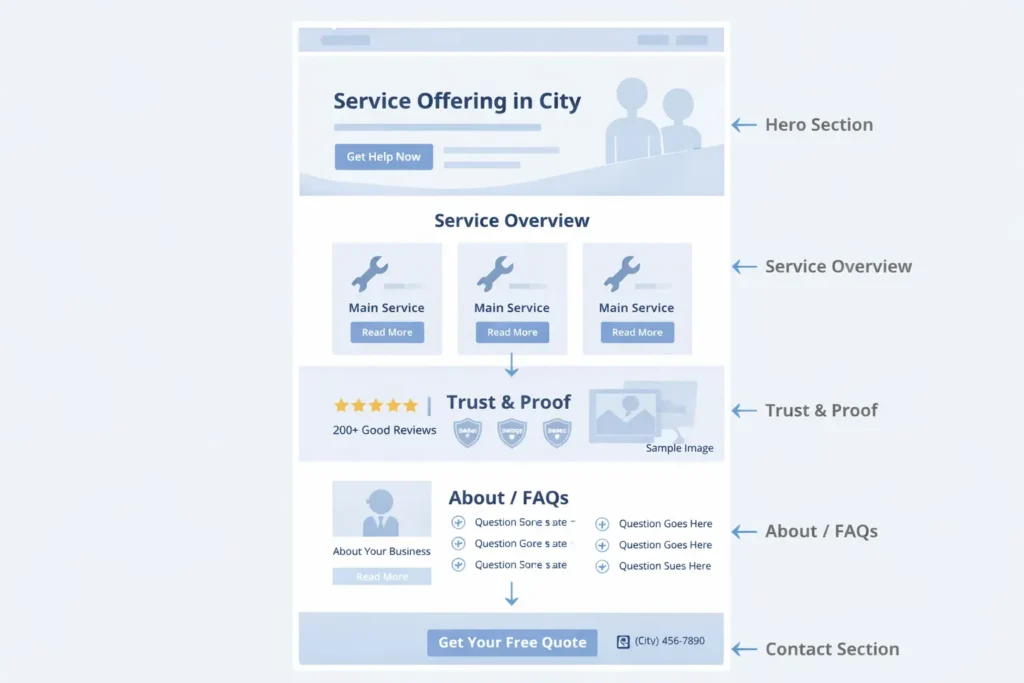
Most local businesses need fewer pages than they think, but those pages need clearer jobs. In many cases, the best setup is a homepage, individual service pages, a contact page, an about page, one proof-rich sample work or case study area, and blog content that answers real buyer questions. That is why showing your portfolio highlights matters. It gives visitors visual proof that your work is real, current, and relevant.
Service pages are especially important. A visitor searching for “roof repair,” “emergency plumber,” or “website redesign for local service business” is usually further along than someone searching a broad category. A focused service page lets you match that intent with tighter copy, stronger trust signals, and a more specific CTA.
Location relevance also matters, but it needs to be handled carefully. If you truly work in multiple cities, build out location-supporting content only when you have enough substance to make each page useful. That can include local project examples, service differences, travel coverage, or testimonials from that area. Thin pages that swap only the city name rarely help long-term.
A strong local structure usually looks like this:
| Page type | Best use | What to include | Common mistake |
|---|---|---|---|
| Homepage | Broad brand and service overview | Core services, main CTA, trust cues, location context | Generic headline with no service or area |
| Service page | Intent-focused ranking and conversions | Service details, FAQs, proof, CTA | One page trying to cover every service |
| About page | Trust and differentiation | Team story, process, credentials, photos | Writing only about yourself instead of customer value |
| Contact page | Lead capture | Form, phone, hours, area served, map or service area info | Hiding contact info in the footer only |
| Blog post | Top-of-funnel education | Helpful answers, internal links, examples | Publishing content with no conversion path |
| Sample work page | Social proof | Before and after, outcomes, screenshots | Showing visuals without a business context |
When this structure is paired with thoughtful internal linking, the site becomes easier to navigate and easier to understand. That is one reason content clusters work so well. A homepage supports service pages, service pages support trust and conversion pages, and blog posts support earlier-stage searches.
Why service pages usually beat one generic page
A common mistake on local business websites is trying to place every service on one page. It feels simpler to manage, but it often weakens both SEO and conversion. A generic page cannot fully answer what makes one service different from another, which means the visitor gets less confidence and Google gets less context.
Think of a local cleaning company. Residential cleaning, move-out cleaning, and office cleaning are related, but they are not the same purchase. Each one comes with different customer questions, service expectations, pricing cues, and urgency levels. That is why a focused structure like the one behind local cleaning business websites tends to perform better than a single page that blends everything together.
The same logic applies to web design clients. A homepage can introduce the offer, but a separate redesign page, landing page, service page, maintenance page, or local SEO support page creates sharper relevance. It also gives you better anchor text options internally, which helps users and search engines understand the relationship between pages.
Technical choices that affect ranking more than most businesses realize
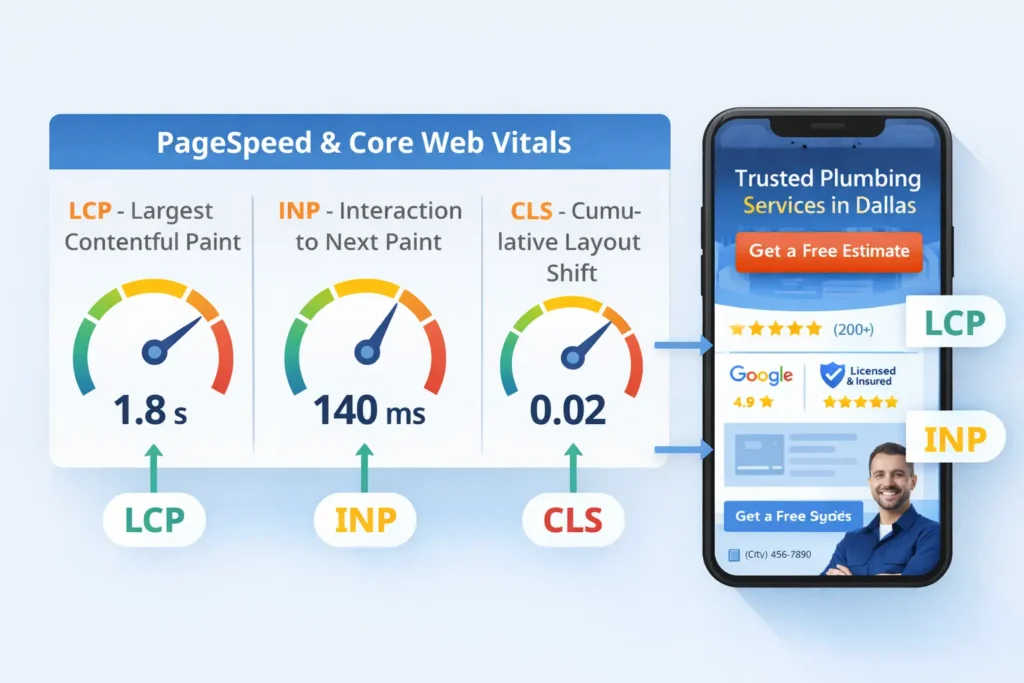
A local website should feel fast, stable, and easy to use on a phone. Google uses the mobile version of a site for indexing and ranking, which means the mobile experience is not secondary. It is the version that matters most in Search.
Google also says Core Web Vitals measure real-world user experience for loading, responsiveness, and visual stability. The current targets it recommends are LCP within 2.5 seconds, INP under 200 milliseconds, and CLS below 0.1. Those numbers are technical, but the outcome is simple: faster, steadier pages reduce friction and usually create stronger conversion conditions.
For a local business site, that usually means compressing large images, limiting heavy scripts, avoiding flashy layout shifts, using readable type sizes, and keeping forms simple. A quote request form with six useful fields often performs better than a giant form asking for everything. A click-to-call button on mobile is also one of the easiest UX wins for service businesses.
Titles and meta descriptions matter too, not because they guarantee rankings, but because they shape how your page is presented in search. Google says a quality meta description can help improve the snippet shown to users, and title links are often the main cue people use to decide what to click. So each service page should have a plain-English title and a meta description that sounds helpful, not stuffed.
Trust signals that make a local business website feel credible
People do not judge trust only by what you say. They judge it by how complete, current, and believable the whole experience feels. Nielsen Norman Group’s long-running research on trustworthy design points to four durable credibility factors: design quality, upfront disclosure, comprehensive and current content, and connection to the rest of the web. That maps almost perfectly to what local business sites need.
In practice, that means real team photos instead of random stock images, honest service descriptions instead of inflated promises, visible business details, current reviews, and clear contact options. It also means proof that your company exists beyond its own claims. Google’s business details and local business documentation support this idea by encouraging accurate contact information, official site connections, and structured business data where appropriate.
A local site also benefits from looking human. Recent NN/G research notes that AI-fatigued users increasingly respond to designs that feel made by a person rather than generated from a pattern. For local service brands, that usually means using original language, believable visuals, and layout choices that feel deliberate instead of overproduced.
Which option is best for your type of local business
For a single-location service business, the best option is usually a lean site with a strong homepage, separate service pages, one trust-rich proof area, and a contact path that is visible everywhere. This works especially well for plumbers, cleaners, dentists, roofers, and home service brands that need more calls than content volume.
For a business serving multiple nearby cities, the best option is often a service-led structure first, then selective location pages only where you can add real value. Build service depth before building dozens of city URLs. That keeps the site more useful and easier to maintain.
For an established business with traffic but weak leads, the best option is usually a redesign focused on message clarity, better internal linking, stronger CTA placement, and mobile cleanup. In that case, starting with website design & development services and comparing your site against small business web design experts is often more useful than chasing another round of random SEO tweaks.
Simple mistakes that quietly hurt local performance
Most weak local sites do not fail because of one big technical problem. They lose ground because of repeated small misses.
✅ A homepage headline that never says what the company does
✅ Service pages that are too thin to answer buyer questions
✅ No visible service area or location context
✅ Slow mobile pages with oversized images
✅ Weak trust signals or outdated reviews
✅ Internal links that do not guide visitors deeper into the site
Fixing those basics usually does more than adding another plugin, animation, or trendy section.
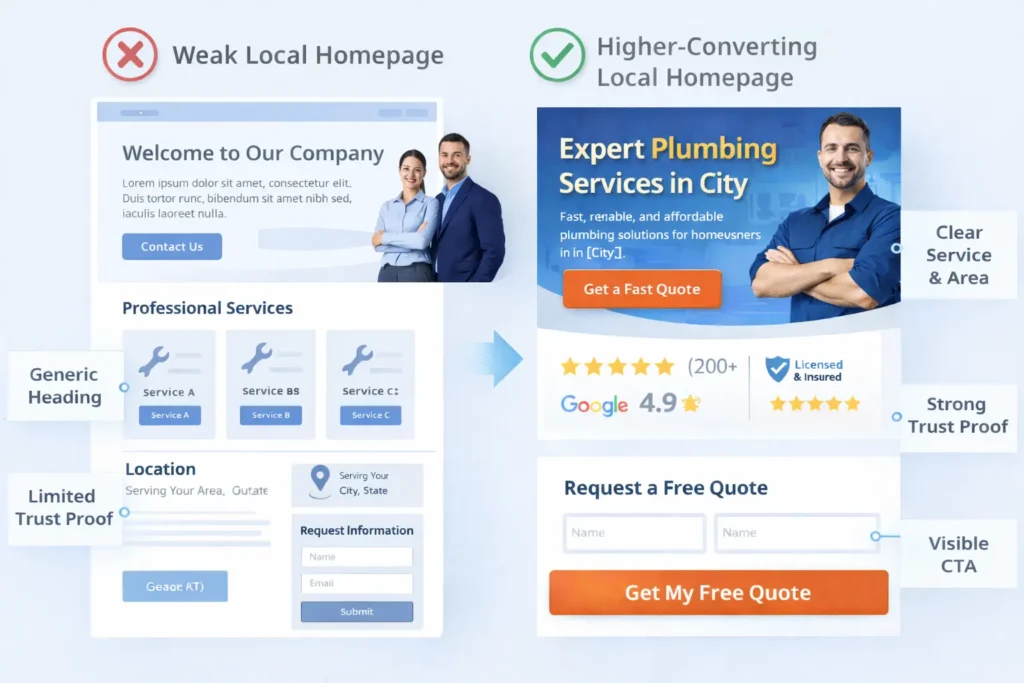
Better Results from website SEO for local business
The local websites that win are usually not the flashiest ones. They are the clearest, fastest, and most trustworthy. They make it easy for Google to understand the business and easy for real people to take action.
If your goal is more qualified leads, better rankings, and a site that actually supports sales, the right move is not adding more clutter. It is building a website around search intent, local relevance, trust, and conversion flow from the start.
Frequently Asked Questions
1. Does website design really affect local SEO?
Yes, website design affects local SEO because design controls clarity, structure, speed, and trust. A local business can have the right keywords and still underperform if the site is hard to use, slow on mobile, or vague about services and locations. Good design helps search engines understand page purpose and helps visitors move from the search result to action. That is why strong local websites usually feel easier to scan, easier to trust, and easier to contact.
2. What pages should a local business website include to rank better?
The best local business websites usually need a focused set of pages, not a huge site. In most cases, that means a clear homepage, separate service pages, an about page, a contact page, and some supporting blog content. If relevant, a sample work or case study section adds proof. This structure gives each page a clear job, which makes ranking potential stronger and user flow much easier for a web designer to optimize.
3. Should I create a separate page for every city I serve?
Only create separate city pages when you can make each one genuinely useful. If every location page says the same thing with only the city name changed, it usually adds little value. A stronger approach is to build service pages first, then add location-focused pages only where you have real examples, service differences, testimonials, or useful local details. A web designer can help map this out so the site stays clean and strategic instead of bloated.
4. Is it better to redesign my current website or build a new one?
The best choice depends on what is broken in the current site. If the site already has useful pages, some rankings, and a workable foundation, a redesign may be enough. If the structure is messy, the mobile experience is weak, and the messaging no longer fits the business, a rebuild can be the smarter move. A web designer should review page quality, internal links, speed, and conversion flow before recommending either path.