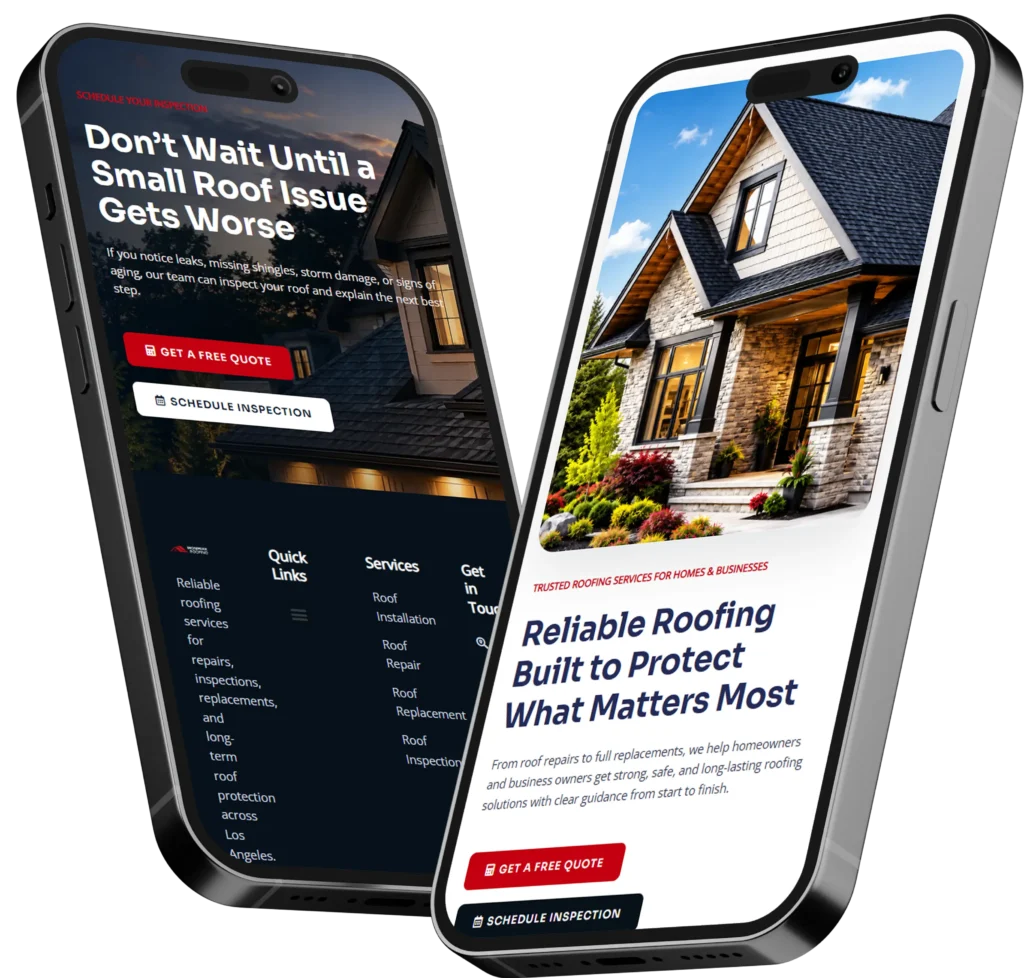
A website designer for US small business helps you create a professional site that builds trust, explains your offer clearly, and turns visitors into calls, bookings, and leads. The best choice is a designer who understands local service pages, landing pages, SEO basics, speed, and conversion-focused layouts.
For many small business owners, a website is not just an online brochure. It is often the first place a customer checks before calling, booking, requesting a quote, or visiting your store.
If your site looks outdated, loads slowly, or does not explain what you do in a few seconds, people may leave before you ever get a chance to earn their trust. A good designer helps fix that by making your site clear, easy to use, and built around your real business goals.
In this guide, you’ll learn why website design matters, how to choose the right designer, and which option is best for your type of business.
Need help building a website that looks clean and works harder for your business? Start with small business web design experts who understand trust, leads, and growth.
Why Small Businesses Need a Professional Website
A professional website helps people decide if they can trust your business. Before a customer fills out a form, calls your office, or books an appointment, they usually want answers to simple questions.
They want to know:
✅ What do you offer?
✅ Where do you serve customers?
✅ Are you a real and reliable business?
✅ What makes you different?
✅ How can they contact you quickly?
If your website does not answer these questions clearly, visitors may go back to Google and choose another company. This is why design is not only about colors and photos. It is about helping people feel confident enough to take the next step.
A strong website can support:
✅ More phone calls
✅ More form submissions
✅ More appointment bookings
✅ Better local trust
✅ Better SEO structure
✅ More professional brand perception
Google’s SEO Starter Guide explains that SEO helps search engines understand your content and helps users decide whether they should visit your site. That means your design, content, page structure, and navigation all work together. You can learn more from the Google Search Central SEO Starter Guide.
What a Website Designer Actually Does
A website designer plans how your site looks, feels, and guides visitors. The job is not only to make the site attractive. The bigger goal is to make the website easy to understand and easy to act on.
A good designer usually helps with:
✅ Website layout and page structure
✅ Mobile-friendly design
✅ Calls to action
✅ Landing page design
✅ Brand colors and typography
✅ Trust sections, reviews, and portfolio placement
✅ Contact forms and booking flow
✅ Basic SEO layout
✅ Speed and user experience improvements
For a small business, this matters because visitors often make fast decisions. If they cannot find your services, location, pricing clues, reviews, or contact button, they may leave.
The best designer thinks like your customer. They ask what visitors need to know before contacting you. Then they organize your website around those questions.
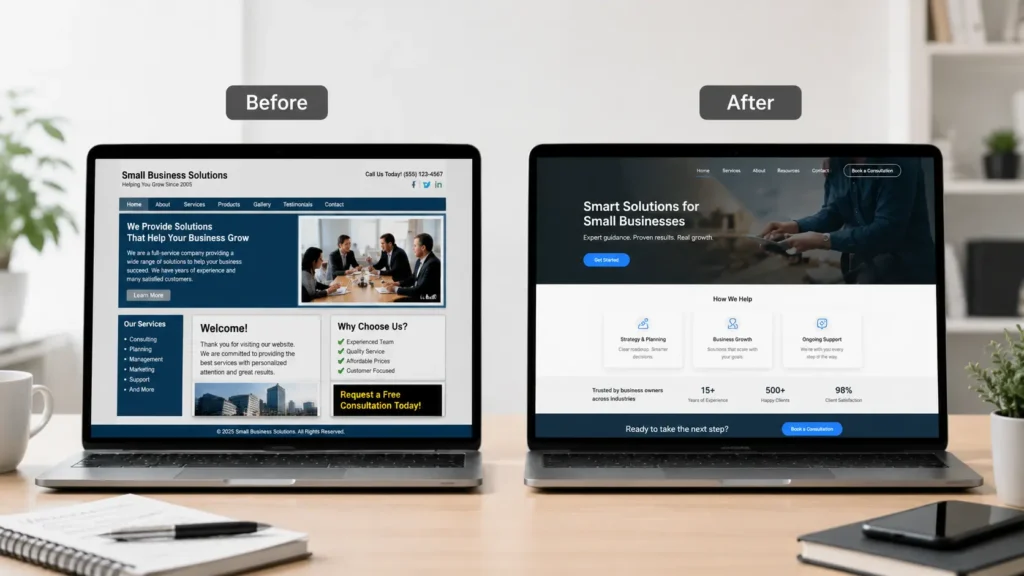
If your current site feels confusing, outdated, or hard to update, explore website redesign that converts before losing more potential leads.
How a Website Designer Helps Build Trust
Trust is one of the biggest reasons small businesses need better websites. Customers may not know you yet, so your website has to do some of the early relationship-building.
A trustworthy website usually includes:
✅ Clear business name and location
✅ Real photos or strong brand visuals
✅ Reviews or testimonials
✅ Service details written in simple language
✅ Before-and-after examples or project samples
✅ Easy contact options
✅ Secure website setup
✅ Fast mobile experience
Think about a local roofing company, med spa, plumber, accountant, or cleaning service. A visitor may compare three or four businesses in one search session. If one site looks polished, shows proof, explains services clearly, and makes booking simple, that business has a better chance of winning the lead.
Trust also comes from consistency. Your homepage, service pages, contact page, and landing pages should all feel like they belong to the same business. If every page looks different or has outdated information, customers may hesitate.
Want to show visitors what your business can do? Add strong visuals and proof by reviewing portfolio highlights for layout inspiration.
Website Design Options for Small Business Owners
Not every business needs the same design solution. The best option depends on your budget, timeline, goals, and how important your website is for generating revenue.
Some owners only need a simple online presence. Others need a full website redesign, SEO-ready service pages, booking features, landing pages, and ongoing support.
Here is a helpful comparison:
| Website Option | Best For | Pros | Limits |
|---|---|---|---|
| DIY website builder | Very new businesses with low budget | Affordable and quick to start | Can look generic and may lack SEO structure |
| Freelancer | Small projects with clear instructions | Flexible and often cost-effective | Skill level and support can vary |
| Professional web design studio | Businesses that need trust, leads, SEO, and growth | Strategy, design, structure, and support | Usually costs more upfront |
| Full agency | Larger campaigns with ads, branding, and marketing | More services under one roof | May be too expensive for smaller local businesses |
For most service-based businesses, the best option is usually a professional web design studio that understands small business goals. You get more than a nice-looking website. You get a site built to guide visitors toward calls, quotes, bookings, or purchases.
Which Website Design Option Is Best?
The best website option is the one that fits your stage of business and your growth goals.
If you are just testing a new idea, a DIY site may be enough for now. It can help you get online quickly while you learn your offer and audience.
If you already have paying customers and your website brings in leads, a professional redesign is usually better. At that stage, small improvements in clarity, speed, trust, and calls to action can create better results.
If you run ads, offer services in multiple cities, or rely on bookings, you should avoid a basic template-only site. You need landing pages, service pages, tracking, and a design that supports conversion.
A good rule is simple: if your website affects your revenue, treat it like a sales asset, not a side project.
What Pages Should a Small Business Website Have?
A small business website does not need dozens of pages to work well. It needs the right pages with the right information.
Here is a practical page guide:
| Page | Purpose | What to Include |
|---|---|---|
| Homepage | Gives a quick overview of the business | Main offer, trust proof, service summary, CTA |
| About Page | Builds connection and credibility | Story, values, team, location, experience |
| Services Page | Explains what you provide | Service list, benefits, process, CTA |
| Service Detail Pages | Helps rank for specific services | One focused service, FAQs, proof, location signals |
| Landing Page | Converts ad or campaign traffic | One offer, strong CTA, short form, proof |
| Portfolio or Work Page | Shows proof of quality | Project examples, results, visuals |
| Contact Page | Makes action easy | Phone, form, booking link, map, hours |
The homepage should answer the big question: “Is this business right for me?” Service pages should answer: “Can they solve my exact problem?” Contact pages should make the next step easy.
If you want help planning your site pages correctly, review website design & development services for a clearer starting point.
How Website Design Supports SEO
Website design and SEO are connected. A beautiful website can still perform poorly if search engines and users cannot understand it.
Good SEO-friendly design includes:
✅ Clear page titles
✅ Helpful headings
✅ Fast loading pages
✅ Mobile-friendly layouts
✅ Internal links
✅ Location and service signals
✅ Easy navigation
✅ Helpful content that answers real questions
For example, a dentist in Texas should not only have a homepage. They may need separate pages for teeth whitening, emergency dental care, dental implants, and the areas they serve. This helps both users and search engines understand what the business offers.
Google does not need a fancy site to understand your business. It needs a clear site. Your designer should help organize your content so every important page has a purpose.
This is also where internal links matter. A blog post about hiring a designer can link to a service page. A service page can link to a portfolio. A homepage can guide visitors to your best offer. These links help users move naturally through your site.
For more context on hiring online design help, read this guide on an online web designer for small business.
Landing Pages for Leads, Calls, and Bookings
A landing page is different from a normal website page. It is usually built for one goal, such as booking a consultation, requesting a quote, signing up, or calling your business.
Landing pages are useful for:
✅ Google Ads
✅ Facebook Ads
✅ Local service campaigns
✅ Seasonal offers
✅ Free consultations
✅ Special promotions
✅ New service launches
A strong landing page removes distractions. It focuses on one offer, one audience, and one action.
For example, a home remodeling business may create a landing page for “kitchen remodeling consultations.” Instead of sending ad traffic to the homepage, the business sends people to a page that talks only about kitchen remodeling, project examples, benefits, FAQs, and booking.
This usually works better because the visitor gets exactly what they expected.
A good landing page should include a strong headline, clear benefit, short form, trust proof, service details, and a visible call button. It should also be fast on mobile because many visitors will come from phones.
Website Redesign: When Is It Time?
A website redesign is worth considering when your current site no longer matches your business, your customers, or your goals.
Common signs include:
✅ Your site looks outdated
✅ It loads slowly
✅ It is hard to use on mobile
✅ You are not getting enough leads
✅ Your services have changed
✅ Your competitors look more professional
✅ Your content is thin or unclear
✅ Your site is hard to update
✅ Visitors leave without contacting you
A redesign should not only change the look. It should improve the strategy. That means better messaging, stronger calls to action, clearer service pages, stronger trust signals, and better SEO structure.
Before redesigning, look at what is currently working. Some pages may already bring traffic or leads. A smart designer will protect those pages and improve them instead of deleting everything without a plan.
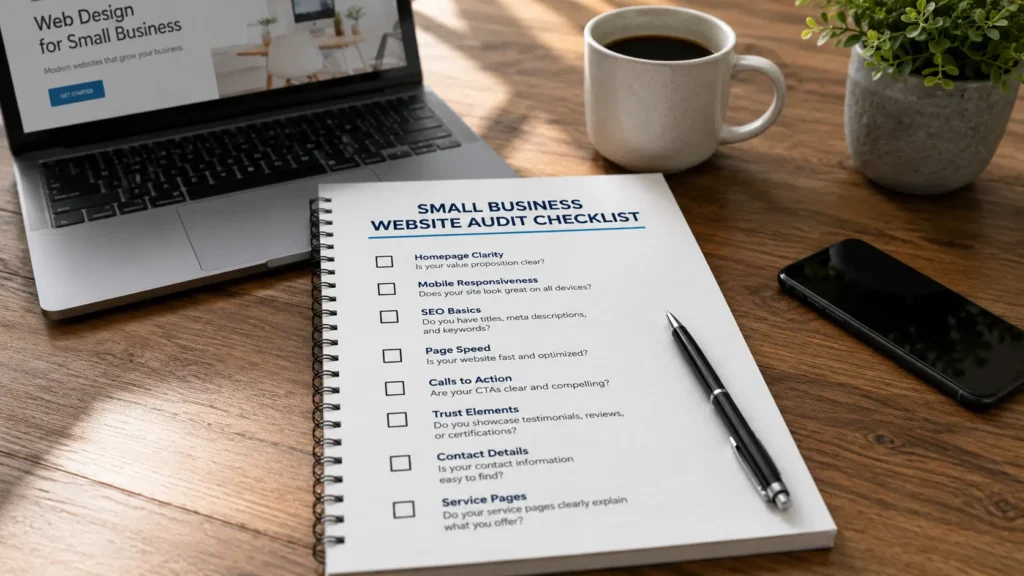
The U.S. Small Business Administration recommends having a marketing plan that turns strategy into action. Your website should fit inside that plan, not sit apart from it. You can read more from the SBA marketing and sales guide.
How to Hire the Right Web Designer
Hiring the right designer starts with asking better questions. Do not only ask, “Can you make it look good?” Ask how they plan, structure, and measure the website.
Helpful questions include:
✅ Have you designed websites for small businesses before?
✅ Will the site be mobile-friendly?
✅ Do you help with service page structure?
✅ Can you improve calls to action?
✅ Will I be able to update the website?
✅ Do you include basic SEO setup?
✅ Can you show sample work?
✅ What happens after launch?
The right designer should be able to explain their process in simple terms. They should ask about your services, customers, locations, goals, and current pain points.
Be careful with designers who only talk about trends. Trends can be useful, but your website should first be clear, fast, trustworthy, and easy to use.
Also, check if their previous work matches the level of quality you want. A strong portfolio can help you see if the designer understands layout, spacing, content flow, and conversion.
To compare remote hiring options, read this guide on how to hire a remote web designer.
Practical Tips Before Starting Your Website Project
Before you hire someone, prepare the basics. This saves time and helps your designer create a better result.
Start with your main offer. Write down your top services, best customers, service locations, and the action you want visitors to take. Do you want more calls, quote requests, bookings, or online purchases?
Next, gather trust proof. This can include reviews, testimonials, certifications, project photos, case studies, awards, and client logos. These details help your site feel real and reliable.
Then review competitor websites. Do not copy them, but notice what they explain well and what they miss. This helps you find ways to stand out.
Finally, decide what your website must do. A local restaurant may need menus and directions. A consultant may need booking and case studies. A contractor may need project photos and quote forms. A med spa may need service pages, before-and-after sections, and appointment booking.
A website is easier to design when the goal is clear.
Common Website Design Mistakes to Avoid
Many small business websites lose leads because of simple mistakes. These issues are common, but they are also fixable.
One mistake is using vague headlines. A homepage that only says “Welcome to our website” does not tell people what you do. A better headline clearly explains your service and who it helps.
Another mistake is hiding contact information. Phone numbers, forms, and booking buttons should be easy to find. If visitors have to search for them, some will leave.
Thin service pages are also a problem. A page with only a short paragraph may not give users enough confidence. Add benefits, process details, FAQs, photos, and trust proof.
Slow loading speed can also hurt the experience. People are impatient online. If your page takes too long, they may not wait.
The last mistake is designing for desktop only. Many small business searches happen on mobile. Your site should be easy to read, tap, and contact from a phone.
Final Thoughts: website designer for US small business
Choosing the right designer can help your business look more credible, explain your services better, and turn more visitors into real leads. A good website should not confuse people. It should guide them from interest to action with clear content, strong design, and simple next steps.
If your current site is outdated, hard to use, or not bringing enough calls, a redesign may be one of the most practical upgrades you can make. Focus on trust, speed, mobile experience, landing pages, SEO structure, and clear calls to action. That is how your website becomes more than a digital business card. It becomes a tool for growth.
Frequently Asked Questions
1. How much does a small business website designer cost in the US?
Small business website design cost depends on the project size, features, and level of strategy needed. A simple starter website may cost less than a full redesign with service pages, landing pages, SEO structure, copywriting, and booking features. Small business owners should not choose based on price alone. The better question is whether the website can help build trust, explain the offer clearly, and turn visitors into calls or leads.
2. Should I redesign my small business website or build a new one?
A website redesign is best when your current site has value but needs better design, content, speed, or conversion flow. Building a completely new site makes sense when the old website is difficult to manage, poorly structured, or no longer matches your business. Before deciding, review your traffic, leads, service pages, and branding. A good designer can help protect what works while improving what holds the site back.
3. Can a website designer help my business get more leads?
A conversion-focused website designer can help improve leads by making your site clearer, faster, and easier to act on. Design alone does not guarantee results, but better structure can make a big difference. Strong calls to action, trust sections, service pages, landing pages, mobile-friendly layouts, and simple contact forms all help visitors move closer to calling, booking, or requesting a quote.
4. What should I look for when hiring a web designer for my small business?
The best web designer for a small business should understand design, user experience, SEO basics, and lead generation. Look for someone who asks about your goals, services, customers, location, and current website problems. Review their portfolio, process, communication style, and post-launch support. A good designer should not only make the site attractive. They should help make it useful for real customers.