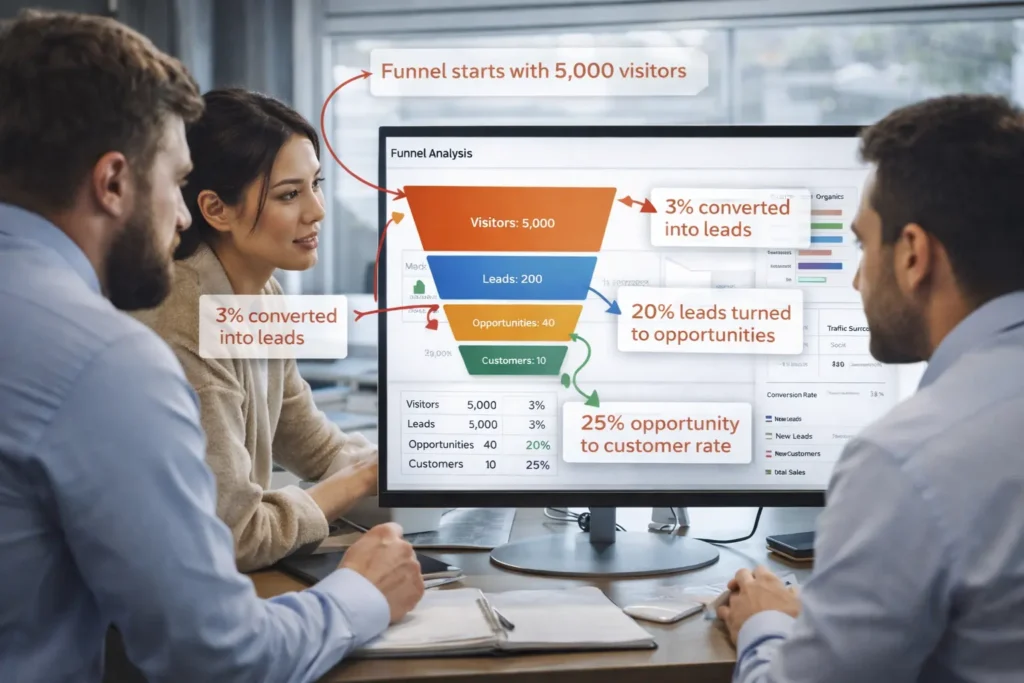
If your website looks professional but no leads are coming in, the issue is rarely the visuals. The bottleneck is usually messaging–offer–friction, not your color palette.
Beautiful doesn’t equal believable or buyable. Conversions depend on clarity, motivation, and a path with minimal friction. When those are weak, a glossy interface can actually hide problems that keep visitors from taking action. Below is a fast diagnostic to see where the leak lives.
| Funnel Stage | What To Check In 5 Minutes | Red Flag | Fix You Can Ship Today |
| Attention → Interest | Above-the-fold value proposition | Jargon or “we do everything” headline | Rewrite with “For [who], we [do X], so you get [Y result].” |
| Interest → Evaluation | Proof and risk reducers | Missing case studies, guarantees, or FAQs | Add 3 concrete proof points and 1 risk reversal |
| Evaluation → Action | Calls-to-action and forms | One generic CTA or long form | Create 2 intent CTAs and trim fields to essentials |
| Action → Follow-up | Speed to lead | Replies in hours or days | Enable instant email + SMS alert and first-touch reply template |
👉 Want a partner to audit and implement fixes? Start with our conversion lift programs.
The Big Three: Why, How, and Which Fix Works Best
This framework helps you decide what to change first and which tactic is right for your situation.
WHY you’re not getting leads
- Misaligned message
Visitors cannot instantly answer: “Is this for me?” “What will I get?” “Why you versus others?” If your top section is all aesthetics and no outcomes, motivation dies. - Offer friction
Unclear pricing or next steps, no social proof, long forms, and slow response times create anxiety. Shoppers instinctively avoid uncertain or risky choices. - Technical drag
Slow pages, vague CTAs, weak mobile layouts, and accessibility misses punish completion rates. Speed also influences perceived trust.
For deeper reading on trust and clarity, see Nielsen Norman Group’s guidelines on credibility and UX heuristics and Google’s research connecting mobile speed to business outcomes. Both reinforce that clarity plus speed drives action.
HOW to fix it fast (then deepen)
Start with changes that produce the biggest lift with the least effort.
1. Rewrite the value proposition above the fold
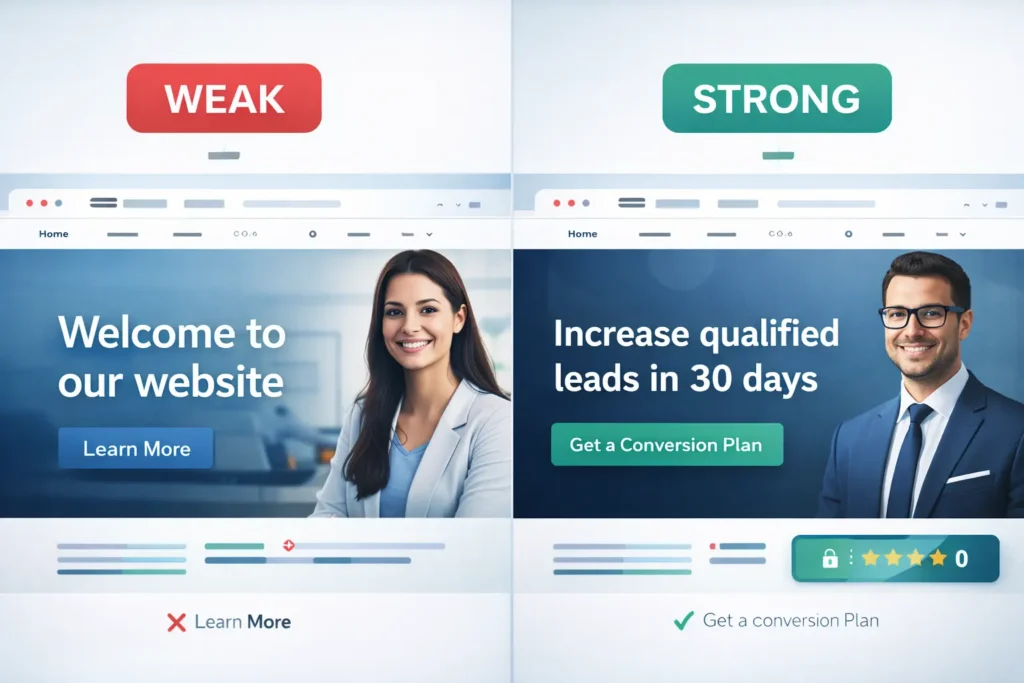
Use this 3-part line: For [ICP], we [deliver outcome] in [timeframe or proof], so you get [business result]. Add one sentence of differentiator and a single primary CTA.
2. Add proof where doubts occur
Place 3 specific proof points near your CTAs: quantified results, recognizable logos, or brief testimonials. Avoid generic praise. Link to case studies with numbers so prospects can verify.
3. Fix CTAs and pathways
Every page needs one primary task and one secondary task. Example: “Get pricing” and “See case studies.” Avoid competing buttons with the same visual weight.
4. Shorten forms and make intent-based
Use fewer than 6 fields for initial contact. If you need a qualification, split it: quick contact now, deeper discovery after engagement.
5. Remove deliverability and response delays
Route inquiries to the right person instantly via email + Slack, or SMS. Prepare a first-touch template that acknowledges the context and proposes a next step.
6. Tighten mobile UX
Check tap targets, scannable sections, sticky CTA bars, and autofill. Most B2B research starts on mobile.
7. Improve speed and stability
Compress images, lazy-load below-the-fold assets, preconnect to critical domains, and ship a CDN. Even small speed gains compound trust.
When you are ready to go deeper, our growth-driven web design approach layers CRO and UX sprints over time, not just a one-off facelift.
Before chasing more traffic, fix credibility gaps. Start with SSL, display real reviews, add recognizable trust badges, and make contact info obvious using this trust checklist for SSL, badges, and reviews.
WHICH fix is best for you right now
Pick based on your current symptom:
- Traffic is fine, conversions are low
Focus on copy, proof, and CTAs. Ship the above-the-fold rewrite, add proof blocks, and cut form fields. - High bounce on key pages
Your message is unclear, or your promise is weak. Test headline variants and simplify the hero section. - Plenty of demo requests, few qualified
Adjust your CTAs to attract intent. Change “Contact us” to “Book a 15-minute scope call” and ask 2 qualifying questions after the click. - Lead replies are slow
Automate routing and enforce speed-to-lead targets.
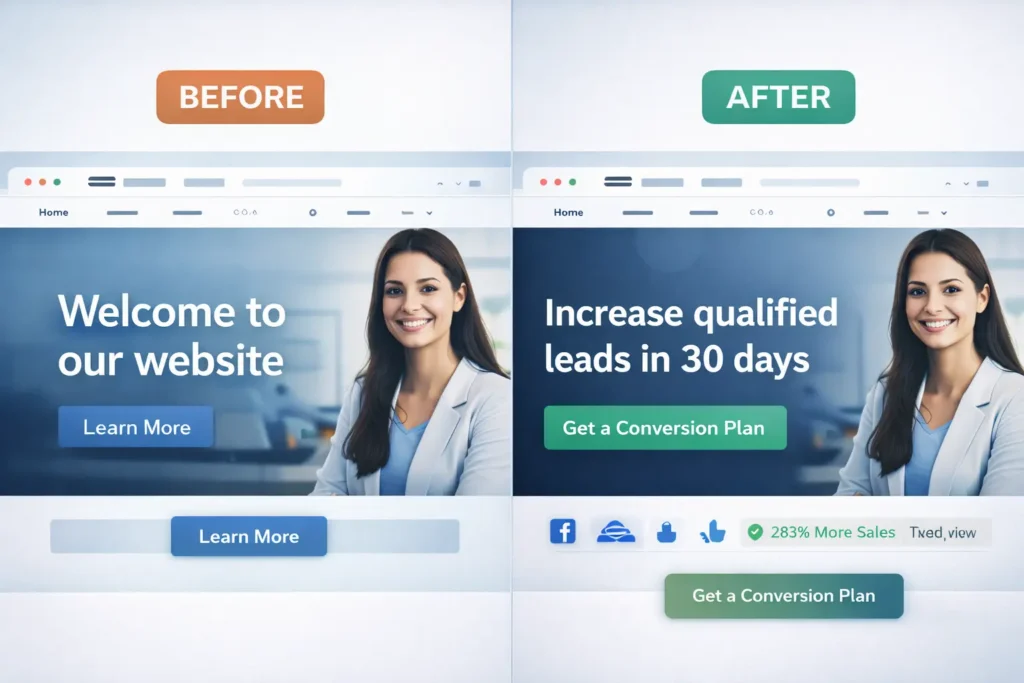
From “Looks Great” to “Generates Leads”: The Playbook
Below is a focused sequence you can run in one week. It balances quick wins with the data you need for longer-term optimization.
Day 1–2: Clarity Sprint
- Interview 2 customers and 1 lost prospect. Extract the value language they used to justify or reject the purchase.
- Rewrite your hero with the ICP-Outcome-Proof formula. Add a short differentiator and a single primary CTA.
Day 3: Proof and Risk Reduction
- Add a proof bar under the hero: 3 metrics or logos.
- Insert 2 micro-testimonials near the form.
- Offer a low-risk step such as “free website audit” or “pilot roadmap.” The risk reversal reduces anxiety.
Day 4: Form and CTA Pass
- Replace generic CTAs with intent-based labels like “Get a conversion plan.”
- Trim your initial form to name, email, website, and goal. Use progressive profiling later.
Day 5: Speed, Mobile, and Accessibility
- Run PageSpeed for top pages and compress images.
- Implement sticky mobile CTAs and confirm 44 px tap targets.
- Check color contrast and keyboard navigation for accessibility.
Day 6–7: Speed-to-Lead and Follow-ups
- Pipe form submissions to Slack or SMS.
- Implement a 5-minute first response target with a friendly template that proposes a time slot.
- Add a nurture micro-sequence for unbooked leads: Day 0 confirmation, Day 2 case study, Day 5 objection handling.
If you want a done-with-you engagement that follows this rhythm, talk to our team via conversion lift programs.
Traffic With No Sales? Here’s the Usual Pattern
It often looks like this: content wins clicks, the landing page looks modern, yet users cannot connect your features to a concrete win. If your brand voice uses impressive terms without outcomes, your readers must translate your pitch into value on their own. Most will not. That is why pages that “feel premium” still underperform.
For a complementary perspective on common lead gaps and content cues, review our guide on why my website is not getting leads, then map those points to your top-traffic pages.
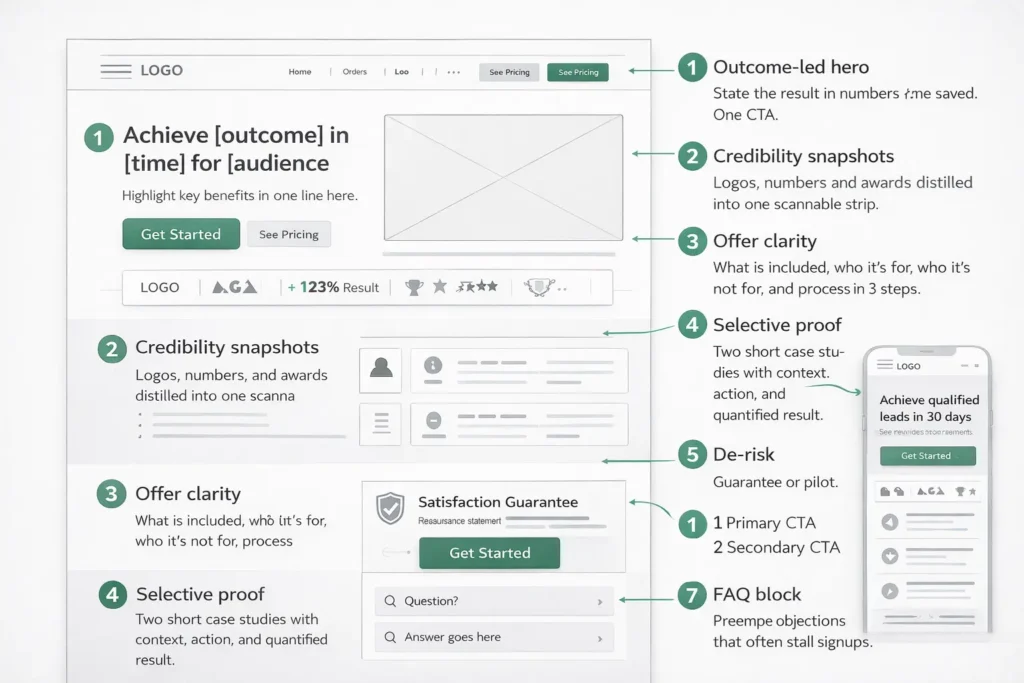
Anatomy of a High-Converting Service Page
Use this structure on your highest-value offer.
- Outcome-led hero
State the result in numbers or time saved. One CTA. - Credibility snapshots
Logos, numbers, and awards distilled into one scannable strip. - Offer clarity
What is included, who it is for, who it is not for, and the process in 3 steps. - Selective proof
Two short case studies with context, action, and quantified results. Link to case studies with numbers. - De-risk
Guarantee or pilot. - Action
Primary CTA and secondary “See pricing” or “Book a 15-minute scope call.” - FAQ block
Preempt objections that often stall signups.
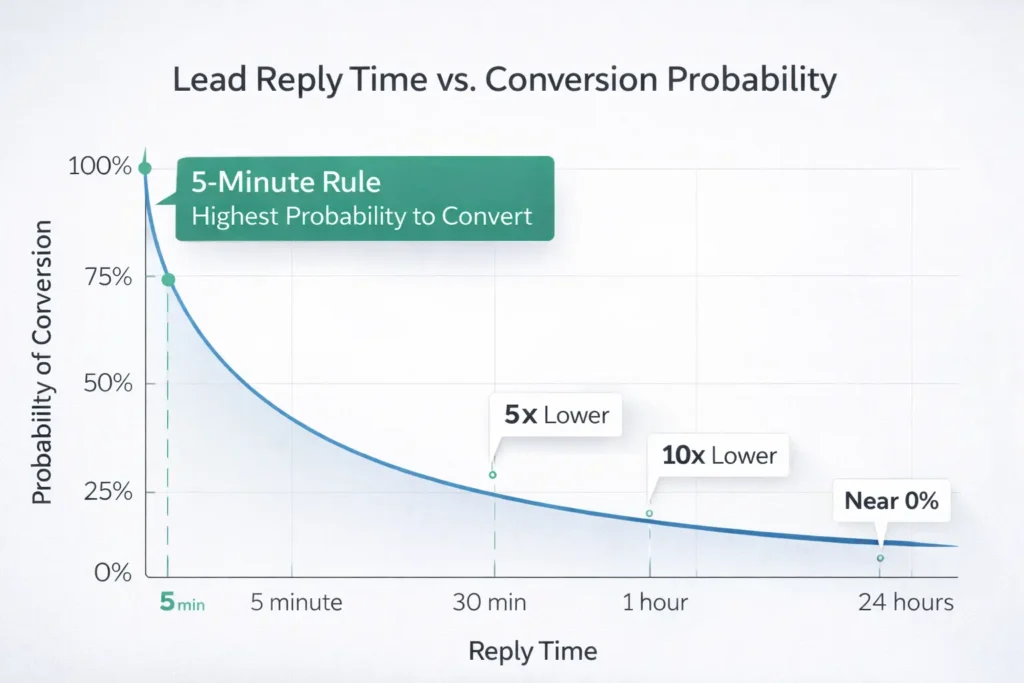
Response Time Matters More Than You Think
Sales teams often fixate on page tweaks but ignore reply speed. The first vendor to respond sets the bar for competence and wins the conversation.
| First Response Time | Typical Impact On Lead Win Rate | What To Automate |
| Under 5 minutes | Highest connect and book rate | SMS or Slack alerts, prewritten reply, meeting link |
| 10–60 minutes | Sharp drop-off in connect rate | Calendar snippet, reminder in CRM |
| 1–24 hours | Very low connect rate | Escalation to backup responder |
| Over 24 hours | Near zero or lost | Weekly report to leadership |
Two strong, widely cited principles back this: users trust fast, clear experiences that reduce uncertainty, and speed strongly correlates with conversion on mobile. Linking to established resources like the Nielsen Norman Group and Google’s mobile research helps you align with best practices while earning topical authority for RankMath.
Practical Tips You Can Use Today
- Make your CTA copy carry the value. Swap “Submit” for “Get a conversion plan in 24 hours.”
- Use a proof bar. 3 data points beat paragraphs of claims.
- Show the process. A simple 3-step roadmap reduces fear of the unknown.
- Offer a pilot. Fixed-scope micro-engagements convert fence-sitters.
- Follow up twice. Day 2 with a case study and Day 5 with an objection buster.
- Measure what matters. Track hero scroll depth, form starts, and first response time.
If you would like an expert pair of eyes, you can always start your project here with our local website design team. We’ll benchmark your funnel and prioritize high-leverage fixes first.
FAQs
Why is my website not generating leads?
The most common reason is a mismatch between message, offer, and friction. A polished layout cannot compensate for unclear outcomes, weak proof, long forms, or slow response. Start by rewriting your value proposition to promise a business result for a specific audience, then add quantified proof near your CTAs and trim your form to the essentials. Finally, enforce a sub-5-minute first reply. These three changes often produce the first meaningful lift.
What is the 3-3-3 rule in sales?
Use three points of value, three points of proof, and follow up within three days. In practice, this means your pitch should contain three outcome statements, three credible evidence pieces, and a three-touch cadence in the first 72 hours. The rule keeps messages memorable without overwhelming the buyer. Pair it with clear CTAs and a pilot offer, and you will reduce indecision while sustaining momentum from first touch to booked call.
Why is my website getting traffic but no sales?
Your pages are attracting curiosity, not commitment, because they lack intent signals and conversion scaffolding. Traffic sources that are too top-of-funnel, generic headlines that do not promise outcomes, and missing risk-reducers keep visitors from acting. Shift to intent-based CTAs, insert proof where hesitation occurs, and split your forms so the first step is easy. Then retarget visitors who engaged but did not convert with a case study and a calendar link to close the loop.
What is the 5-minute rule for leads?
Respond to new inquiries within five minutes to maximize connect rates and meetings booked. The first reply sets expectations for competence and care, and it catches prospects while the problem is still salient. Automate routing to Slack or SMS, include a short empathy-driven template, and offer a ready-to-book link. Teams that live by the five-minute rule typically see higher qualification rates, shorter sales cycles, and stronger close-won percentages compared to slower competitors.
Next Steps: Turn a Nice Site Into a Lead Engine
Your design might be on-brand, yet your website looks professional, but no leads will continue until your message is outcome-led, your proof is visible, your friction is low, and your response is fast. Start with the clarity sprint, layer proof, fix CTAs, and enforce the 5-minute rule. If you want expert help, our conversion lift programs prioritize the exact sequence that generates qualified conversations fastest.
Helpful internal resources:
- Strategy and implementation with our conversion lift programs
- See real outcomes in our case studies with numbers
- Learn more in why my website is not getting leads
- Plan a roadmap with our growth-driven web design
Authoritative external resources:
- Nielsen Norman Group on trust, credibility, and UX heuristics: https://www.nngroup.com/
- Google’s research on page speed and mobile conversions: https://web.dev/fast/