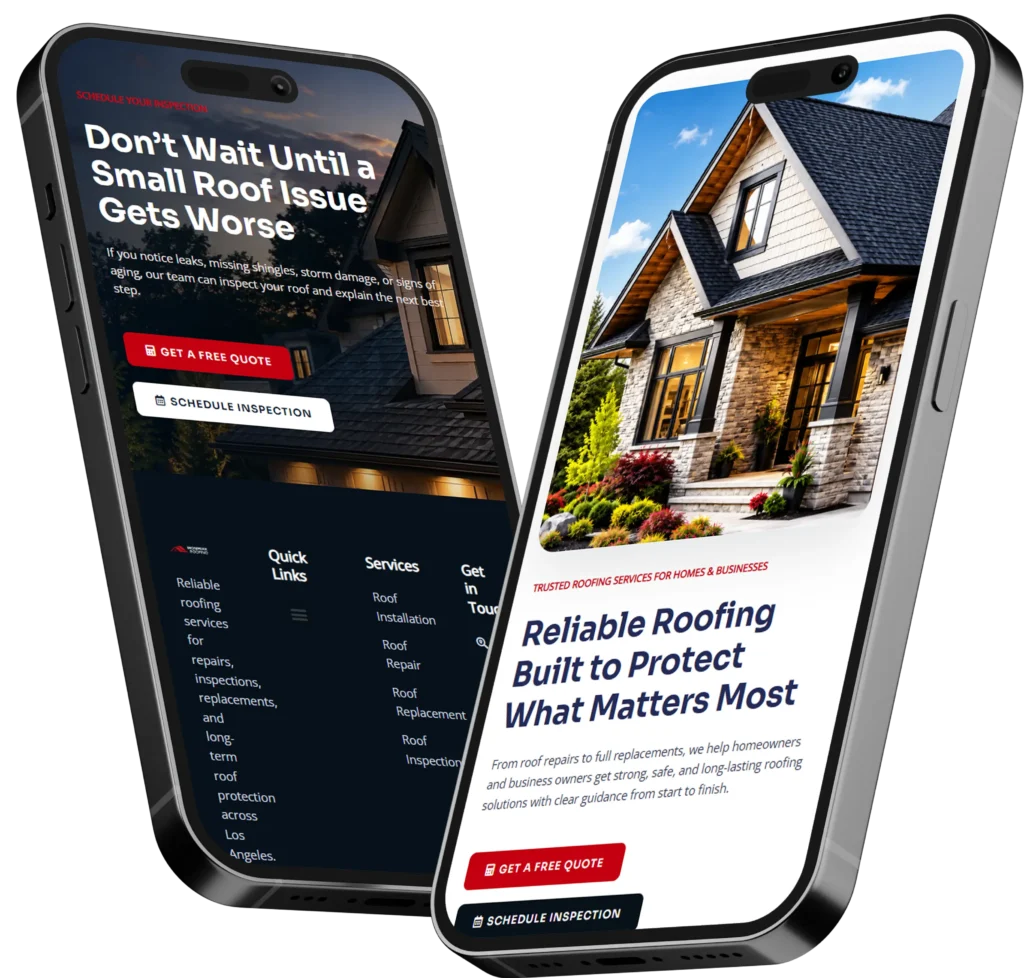
Roof repair website design should make it easy for homeowners to trust you, call you, and request an estimate. The best roofing pages combine clear service messaging, local proof, and fast contact options.
Homeowners dealing with a leak, missing shingles, or storm damage want fast answers, not a confusing homepage. The best roofing websites make it obvious what you do, where you work, and how someone can reach you in seconds.
That is what turns a casual visitor into a booked estimate. It also gives search engines and AI-driven results clearer signals about your services, location, and credibility.
If your site looks decent but still does not bring enough calls, the issue is usually not just traffic. It is structure, messaging, trust, and speed working together, or working against you.
Why Many Roofing Websites Underperform
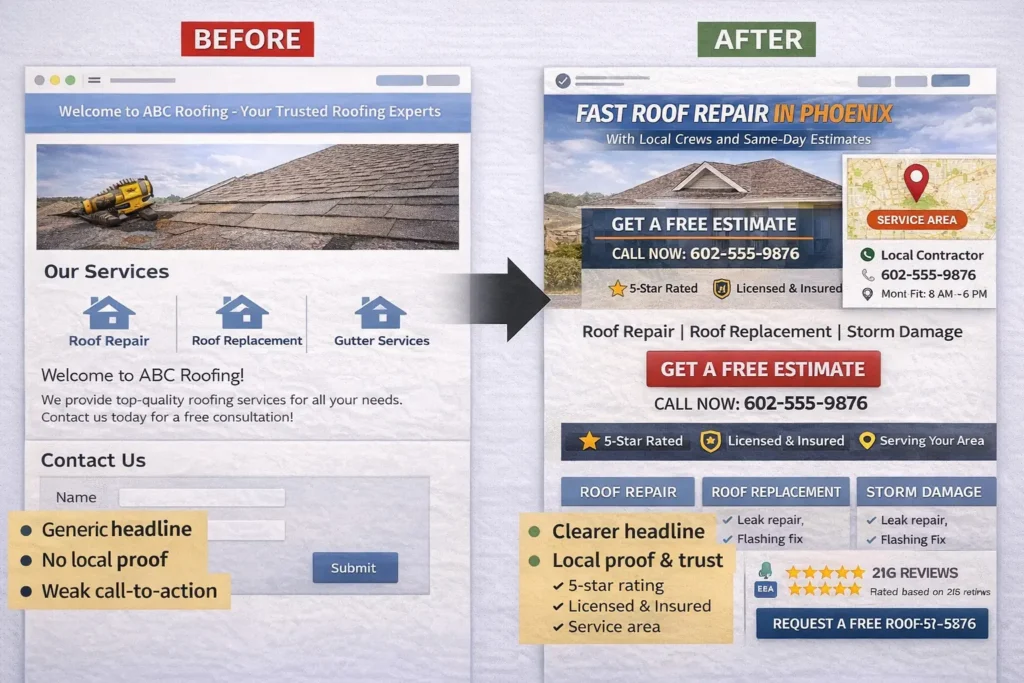
A lot of roofing sites are built like digital brochures. They have a slider, a stock photo, a general “welcome” paragraph, and a contact form hidden near the footer. That may look fine on launch day, but it usually does a poor job of helping a stressed homeowner choose you.
A roofing prospect often lands on a site with urgency. They are comparing three to five companies, scanning quickly, and looking for proof. If they cannot confirm you serve their city, offer the exact service they need, or seem easy to contact, they leave.
This is why roofing web design should focus less on decoration and more on decision-making. A strong site removes friction. It answers the next question before the visitor has to ask it.
That means your homepage should quickly show service types, local coverage, reputation, financing, or estimate information if relevant, and a visible call-to-action. It should also connect cleanly to deeper pages that explain repairs, replacements, storm damage, gutters, insurance help, or emergency service.
If you want to see how service businesses improve lead flow with better structure, study a few examples in this project gallery. Looking at real layouts makes it much easier to spot what is missing on your own site.
What a High-Converting Roofing Site Should Show First
The first screen matters more than most owners realize. Before a visitor scrolls, they should know four things:
✅ what service you provide
✅ what locations you cover
✅ why they should trust you
✅ what action to take now
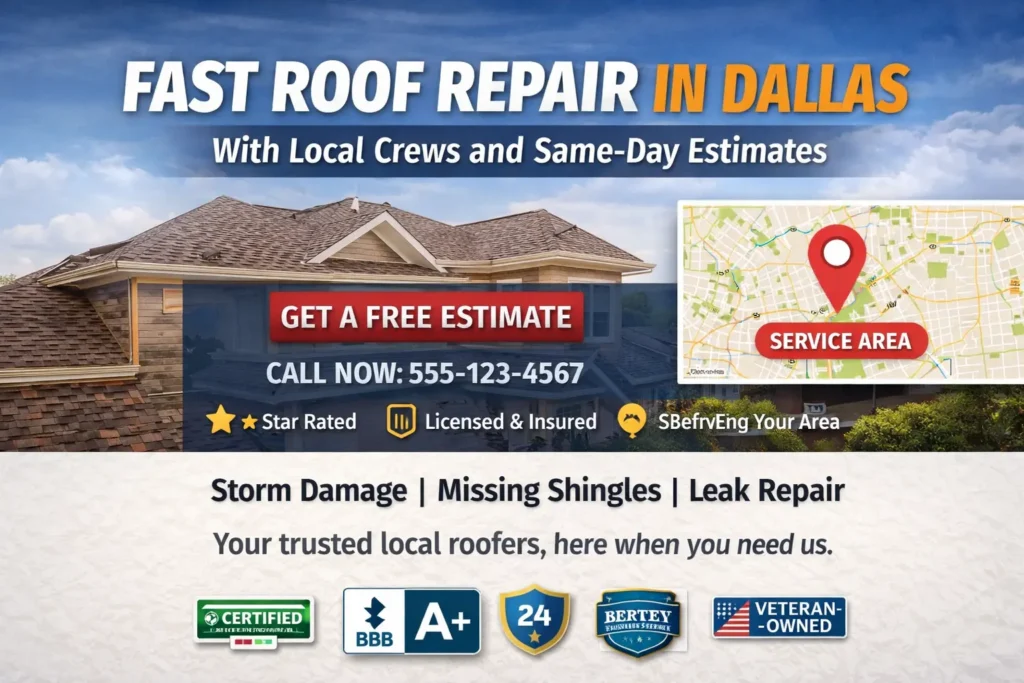
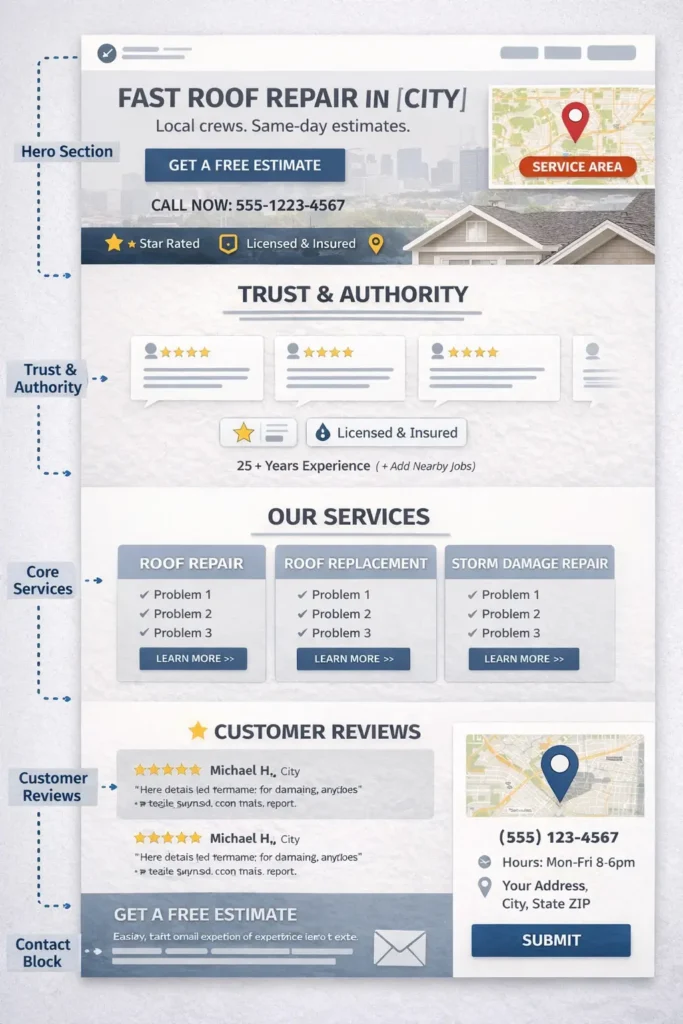
A simple, strong hero section often outperforms a flashy one. For example, a headline like “Fast Roof Repair in Dallas With Local Crews and Same-Day Estimates” says far more than “Quality Roofing Solutions for Your Home.”
Under that headline, the page should support the claim. Add a short line about experience, warranty coverage, financing, emergency response, or insurance claim support. Then place a primary button for estimates and a tap-to-call option for mobile users.
The next block should continue the proof. Show review snippets, manufacturer certifications, license and insurance notes, recent job photos, or service-area references. Do not wait until the bottom of the page to prove you are legitimate.
Essential Pages and What They Should Do
| Page | Main Goal | What It Should Include |
|---|---|---|
| Homepage | Turn cold traffic into calls or estimate requests | Service headline, service area, trust signals, CTA, key services |
| Roof Repair Page | Capture urgent intent | Leak repair, flashing issues, storm damage, emergency options, CTA |
| Roof Replacement Page | Support higher-value estimates | Material options, process, financing, warranty, before/after photos |
| Service Area Pages | Rank locally and convert city-specific traffic | City name, local proof, nearby jobs, tailored CTA |
| About Page | Build trust | Team story, years in business, credentials, photos |
| Reviews Page | Reduce hesitation | Real testimonials, star ratings, project context |
| Contact Page | Remove friction | Phone, form, hours, map, service area, response expectations |
This is where many roofers leave rankings on the table. Instead of one generic services page, create focused pages for the work homeowners actually search. Your site becomes more useful, more relevant, and easier to understand.
For a deeper look at service-page architecture, this contractor website design guide and this local service website strategy both align closely with what works for roofers.
How to Design for Emergency Leads and Planned Estimates
Roofing traffic is not all the same. Some visitors are in panic mode because water is coming through the ceiling. Others are planning a replacement months ahead. Your site should speak to both without mixing the message.
Urgent visitors need reassurance and speed. They want to know that you answer the phone, cover their area, and can inspect the issue quickly. Planned buyers need a process, budget clarity, material guidance, and proof that your company is organized.
A smart layout gives each audience its own path. On the homepage, keep your primary call-to-action broad, like “Request a Free Estimate.” Then add a secondary CTA for urgent needs, such as “Need Help Fast? Call Now.” That small distinction helps qualify leads without confusing the page.
You can also separate intent through your navigation and service blocks. A visitor looking for storm response should land on a page built around fast action, insurance documentation, and emergency tarping. A homeowner researching replacement should land on content about lifespan, materials, warranties, and project timelines.
This matters because the design itself influences lead quality. When a site speaks clearly to intent, more visitors self-select into the right offer. That usually means fewer weak inquiries and better conversations for your sales team.
The Trust Signals Homeowners Actually Notice
Trust online is rarely built with one thing. It is the stack of signals that makes the difference.
Homeowners are not just checking whether your site looks good. They are quietly asking:
Can I verify this business?
Do they seem established?
Have they done this work before?
Will they stand behind the job?
The National Roofing Contractors Association advises homeowners to look for basics like a permanent place of business, a phone number, a business license where required, liability insurance, workers’ compensation coverage, client references, and a written proposal with project details. That is exactly why those trust signals should be easy to find on your site, not buried in a sales call.
That means your site should include real project photography, named service areas, warranties explained in plain language, review highlights, manufacturer badges only if they are valid, and staff or crew photos where possible. Even something as simple as “Serving homeowners in Phoenix, Mesa, Chandler, and nearby areas” can make the business feel more concrete.
Be careful with testimonials, too. The FTC’s consumer reviews rule, effective October 21, 2024, targets deceptive reviews and testimonials, so your site should only use real customer feedback and honest claims. That is not just a compliance issue. It is a branding issue. The minute trust feels manufactured, conversions drop.
A practical tip here is to pair every review with context. Instead of posting a generic five-star line, attach a city, service type, or short project note. “Storm damage repair in Tampa after a hail event” is stronger than “Great service.”
Want help shaping those proof points into a cleaner brand? That is where small business web design experts can help turn scattered assets into a site that feels more established from the first visit.
How to Make the Site Stronger for SEO, GEO, and AEO
To rank better today, your roofing site has to work for both search engines and fast-answer experiences. That means being easy to crawl, easy to understand, and easy to trust.
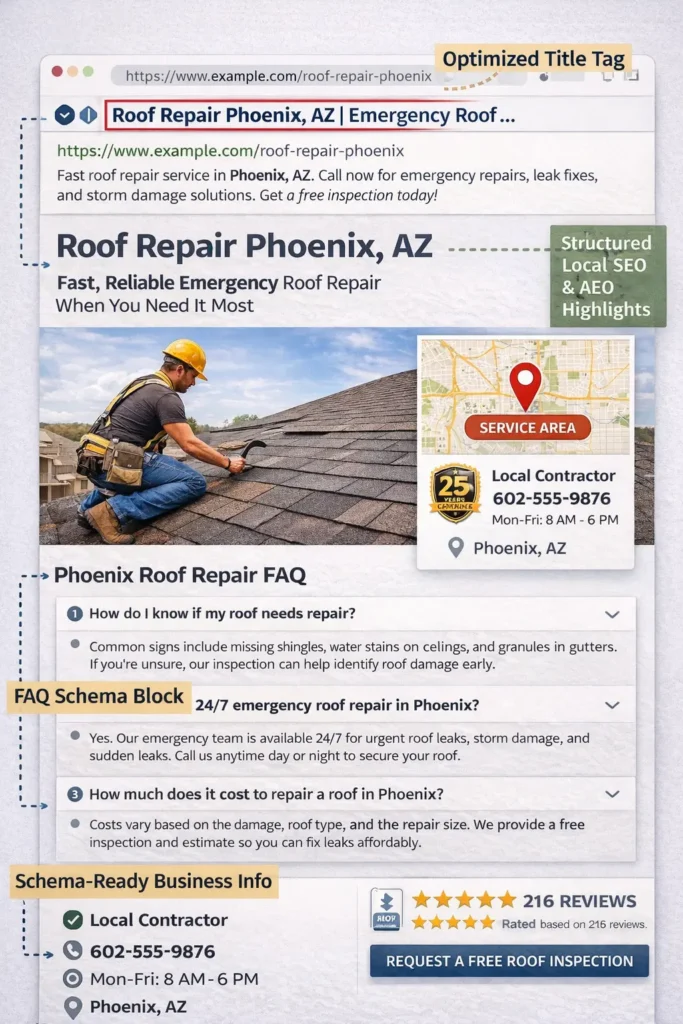
Google’s Search Essentials recommends using the words people search for in important places like titles, main headings, alt text, and link text. It also recommends crawlable internal links so Google can discover more of your pages. Google’s documentation on business details says local businesses should establish their official presence by claiming a Business Profile, verifying website ownership, and adding structured data where appropriate.
That translates into a very clear action plan for roofers. Use service-specific titles. Use city-specific pages where they make sense. Link related pages together. Add FAQs that answer real pre-sale questions. Keep the company name, phone, and service area consistent across the site.
Just as important, your content should sound like it came from someone who understands roofing customers, not from a generic template. Google says its systems are designed to prioritize helpful, reliable, people-first content and reward a good overall page experience.
For that reason, your pages should include practical details such as what causes leaks, when a repair is realistic, what happens during an inspection, how long emergency tarping lasts, or what photos a homeowner should take before an insurance call. Those are the kinds of specifics that improve both trust and answer quality.
Speed matters too. Google says Core Web Vitals measure loading performance, responsiveness, and visual stability, and recommends strong performance for search success and user experience. Its guidance specifically points to targets such as LCP within 2.5 seconds, INP under 200 milliseconds, and CLS under 0.1. If you want to study the official references, the two best external resources to blend into this topic are Google’s guide to business details in Search and Core Web Vitals.
Which Website Option Is Best for Most Roofing Businesses?
Not every company needs the same build. A solo roofer in one city has different needs than a multi-crew contractor covering several suburbs.
The mistake is choosing based only on budget instead of the growth stage. A very cheap site can cost more over time if it fails to rank, convert, or expand with your services.
Best Fit by Business Stage
| Website Option | Best For | Strengths | Weaknesses | Best Choice? |
|---|---|---|---|---|
| One-page starter site | Brand-new operator with almost no assets | Fast launch, low complexity | Weak SEO depth, hard to scale, limited trust-building | Only as a temporary option |
| Basic 5-page brochure site | Small local roofing company | Better trust, clear navigation, easier lead flow | Can still be too generic without service and city depth | Good if the budget is tight |
| Custom multi-page service site | Established roofing business or growth-focused company | Best for local SEO, service targeting, and stronger conversion paths | Takes more planning and content | Best option for most serious roofers |
| Custom site with ongoing optimization | Competitive markets or multi-location brands | Strongest long-term lead generation, testing, and content expansion | Higher investment | Best if growth is the priority |
For most roofing companies that want qualified leads, the best option is a custom multi-page site with room for ongoing optimization. It gives you a real homepage, dedicated service pages, city pages where needed, review proof, and a better structure for SEO and AI answers.
It also lets you improve over time. You can add seasonal landing pages, storm response content, financing pages, or commercial service sections without rebuilding everything from scratch.
If your market is competitive, a cheap site usually becomes a bottleneck. A stronger build from the start gives you more control over messaging, search visibility, and conversion testing. That is why many owners end up moving from a basic brochure site into more focused website design & development services once they realize they need more than an online business card.
Common Design Mistakes That Quietly Kill Leads
Some problems are obvious, like a broken form. Others are subtle but just as expensive.
One of the biggest mistakes is using vague copy. If every roofer in your area says “quality workmanship” and “customer satisfaction,” none of you stand out. Your copy should sound specific to your service model, your service area, and your homeowner concerns.
Another weak point is cluttered navigation. Too many menu items make the site feel harder to use. Keep the path simple. Home, services, service areas, reviews, about, contact. That is usually enough.
Many roofing sites also hide the phone number on mobile or bury the form after long blocks of text. That works against urgent lead behavior. On mobile, especially, the call button should stay easy to find.
Stock photography can hurt, too. A few polished stock images are fine, but if every image looks generic, the business feels generic. Even smartphone photos from real jobs can outperform overused stock photos because they create specificity.
Last, many sites fail to guide the next step. Every major page should end with a clear offer. Book an estimate. Request a roof inspection. Ask about storm damage. See recent work. A page without direction often becomes a dead end.
Closing Thoughts on Your Roof Repair Website
A strong roof repair website is not just about looking modern. It is about helping the right homeowner trust you quickly, understand your offer clearly, and take the next step without friction.
When your site combines local relevance, focused service pages, real proof, strong calls-to-action, and a better user experience, it becomes a lead tool instead of a placeholder. That is the difference between a site people visit and a site that helps your business grow.
Frequently Asked Questions
1. How many pages should a roofing company website have?
The best starting range for most roofing companies is around 8 to 20 focused pages. That usually includes a homepage, contact page, about page, review page, separate service pages, and a few service-area pages if you work across multiple cities. Fewer than that can make the site feel thin and generic. More than that is fine when the pages are useful, distinct, and built around real services and local intent, not filler.
2. What matters more for a roofing website, design or SEO?
The right answer is both, but conversion-focused design should work together with local SEO from day one. SEO helps people find you. Design helps them trust you and contact you. If your site ranks but looks outdated, loads slowly, or hides the CTA, traffic will not turn into leads. If the site looks polished but has weak page targeting and thin content, it may not get enough visibility. The strongest results come when structure, content, trust, and speed are planned as one system.
3. Should a roofer use one homepage for all cities or make separate location pages?
Separate location pages are usually the better option when each page offers real local value. A single homepage can mention your broader service area, but dedicated city pages often do a better job of matching local searches and answering local concerns. The key is to avoid duplicate text. Each page should include city-specific messaging, nearby projects, local proof, and a clear next step. Done well, this improves both rankings and conversions without making the site feel repetitive.
4. What should a web designer include to help a roofer get more calls?
The most important elements are a clear offer, visible trust signals, and easy contact paths. A roofing company site should make the phone number, estimate form, and service area obvious from the start. It should also include review proof, recent work, service details, and strong page hierarchy. For many roofers, the biggest lift comes from simplifying the top of the homepage, tightening the copy, and adding dedicated pages for high-intent services like leak repair, storm response, and replacement estimates.