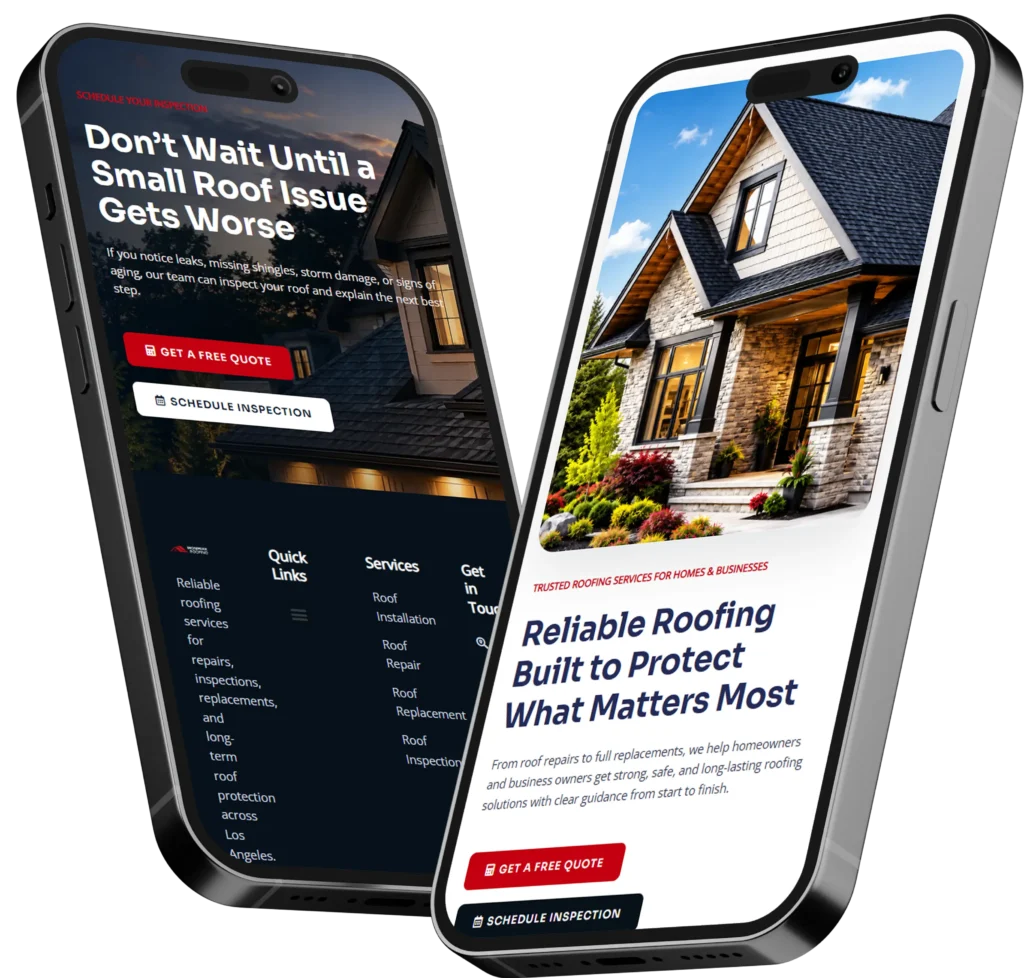
Trade business website design should make your services clear, build trust fast, and turn local visitors into quote requests. A strong trade business website helps customers understand what you do, where you work, and why they should contact you today.
A good website for a trade company should explain what you do, where you work, and how to request a quote in seconds. When the layout is clear, mobile-friendly, and built around trust, it can turn local visitors into real calls and inquiries.
Most trade business owners do not need a flashy design first. They need a site that removes doubt fast, answers the right questions, and makes the next step feel easy.
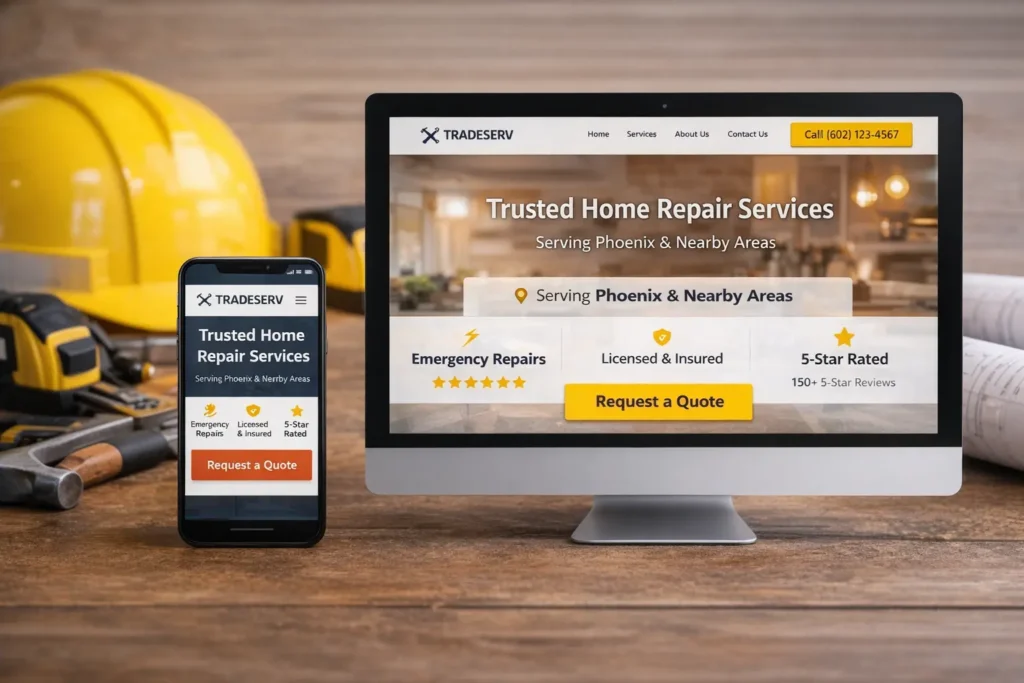
Why the right website matters for trade businesses
When someone needs a plumber, electrician, roofer, HVAC company, or general contractor, they usually are not browsing for fun. They are looking for a business they can trust quickly. That means your website has a small window to do a big job.
It has to answer the practical questions first.
✅ What do you do?
✅ Where do you work?
✅ Why should they trust you?
✅ What should they do next?
If any of those answers are missing, the site starts leaking leads. Visitors may still like your business, but they will not always stay long enough to call.
That is why a well-planned site does more than look professional. It guides the visitor from curiosity to confidence. It reduces friction. It makes your services feel easy to understand. It also gives your photos, testimonials, and service pages a clear place to do their job.
For many trade businesses, the biggest problem is not traffic. It is that the traffic lands on a homepage that feels too broad, too generic, or too slow to build trust. A great website fixes that by making the message obvious above the fold, supporting it with proof, and giving people one clear action to take.
If you want a site built around clarity, proof, and better inquiries, review these website design & development services to see how the structure can support conversions.
What pages matter most on a trades website
A strong trade website does not need dozens of pages. It needs the right ones.
The homepage should be the fastest overview of your business. It should tell visitors your main service, your service area, and your next step. Think of it as the page that gets people oriented.
Then come the service pages. These pages are often where conversions happen because they match what people are actually searching for. Someone looking for panel upgrades, roof leak repair, or drain cleaning wants a page that speaks directly to that problem. A vague “Services” page is rarely enough on its own.
Your contact page matters too, but it should not do all the heavy lifting. People should be able to call, message, or request a quote from several key sections of the site, not only from one page buried in the menu.
A trust-building site for a trade business usually includes these core pages:
| Page | What it should do | What to include |
|---|---|---|
| Homepage | Explain the business fast | Main service, area served, CTA, trust signals |
| Main service page | Give a full overview of services | Problems solved, process, FAQs, proof |
| Individual service pages | Match specific search intent | Detailed service copy, local relevance, CTA |
| About page | Build trust | Experience, values, owner story, credentials |
| Sample work or gallery | Show real proof | Before and after photos, captions, results |
| Contact or quote page | Remove friction | Short form, call button, response expectation |
This is where a lot of trades websites start improving quickly. Once the structure matches how customers search, the content becomes easier to write, and the design becomes easier to guide.
A good example of this broader approach is seen in home service website design, where the site needs to serve local intent, trust, and conversion at the same time.
Which website option is best for your business stage
This is where many owners get stuck. They know they need a better website, but they are not sure what kind of build makes sense.
The truth is, not every trade business needs the same setup.
A solo operator who offers one main service in one city may do well with a small but focused site. A growing company with several services, crews, and service areas usually needs a more structured build. A larger company that wants stronger SEO, lead tracking, and multiple location targets needs a site planned for expansion.
Here is the simplest way to look at it:
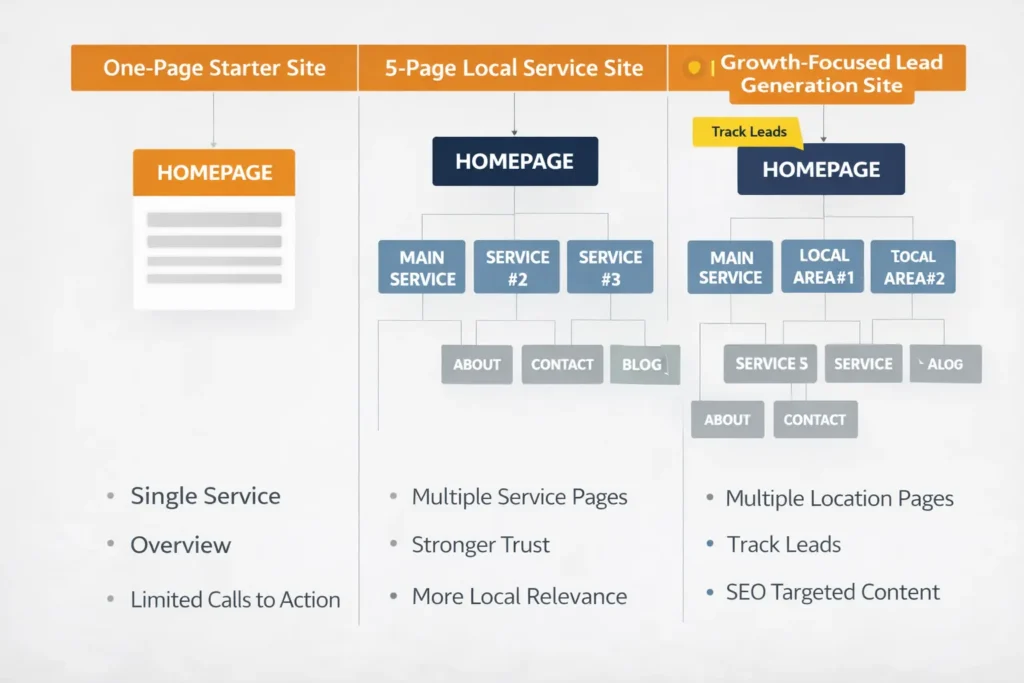
| Website option | Best for | What it includes | Main limitation |
|---|---|---|---|
| One-page starter site | New businesses with one service | Hero, services summary, reviews, contact form | Limited SEO depth |
| 5 to 8 page local service site | Most small trade businesses | Homepage, service pages, about, gallery, contact | Needs clear content planning |
| Growth-focused lead generation site | Established businesses ready to scale | Multiple service pages, local pages, stronger trust and tracking | Higher scope and strategy required |
For most trade businesses, the best option is the middle one.
A 5 to 8-page local service site usually gives you the best balance of clarity, trust, and growth potential. It gives each core service room to rank and convert, while still staying easy to manage. It also prevents the common problem of trying to stuff everything onto one long homepage.
How do you know this is the right option for you?
If you want more than referrals, if you want Google search visibility, and if you offer more than one service, you usually need more than a one-page site. On the other hand, if your business is still validating its offer, a lean starter site may be enough to begin collecting calls and building proof.
If you want to compare layouts and see how this looks in practice, the project gallery is useful because it shows what a more conversion-focused structure can look like.
How better design turns traffic into calls
Many trade sites lose leads because they treat design like decoration. Good design should not just make the site prettier. It should make decisions easier.
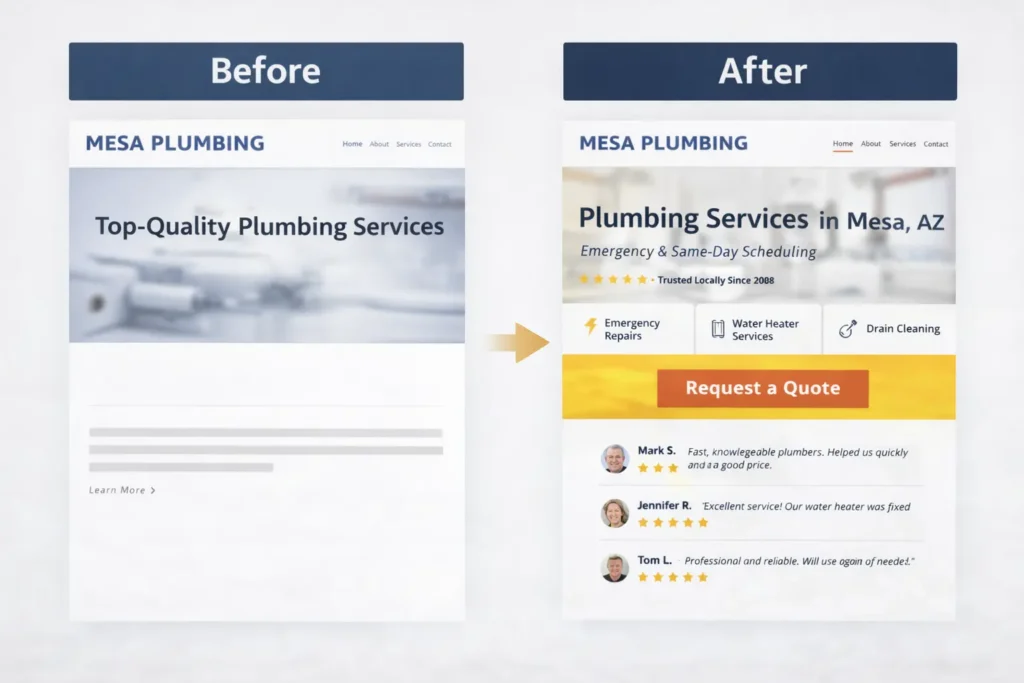
That starts with the hero section. The first screen should tell people exactly what the business does and what to do next. “We help homeowners in Phoenix with same-day electrical repairs” is stronger than “Quality solutions for your needs.” Specific beats generic almost every time.
Then there is the mobile layout. This matters a lot for trades because many searches happen on a phone. The call button needs to be easy to tap. The page should load quickly. Forms should be short. Photos should support the message instead of pushing the CTA too far down.
Trust also needs to show up early. Reviews, license details, years in business, response times, financing, warranties, or service guarantees all reduce hesitation. Homeowners do not want to guess whether you are credible. They want proof before they commit.
Google’s Search Essentials recommends people-first content, using words searchers actually use in important places like titles and headings, and making links crawlable so Google can discover your other pages. That is one reason clear service pages and clean internal linking matter so much for local service businesses.
It also helps to support the site with a complete Google Business Profile so your business can appear on Google Search and Maps, while your website gives visitors the details and confidence to contact you. Google notes that a Business Profile lets eligible businesses manage how they show up on Search and Maps.
A useful reference for content and site structure is Google Search Essentials, especially if you want your pages to stay helpful, clear, and easy to understand.
Here is a practical example.
Imagine a roofing company homepage with a stock image, a vague headline, and one small contact link in the menu. Now compare that with a homepage that says “Roof Repair and Replacement in Tampa,” shows recent project photos, adds review highlights, lists the service area, and includes a quote button right away. The second page gives people fewer reasons to hesitate.
That is what good web design does. It removes confusion before it costs you the lead.
Why some trade websites still underperform
A site can look modern and still fail to bring in calls. Usually, the issue comes down to one of these problems.
First, the message is too broad. If a visitor cannot tell what you actually do in five seconds, the site already has a conversion problem.
Second, the site hides its proof. Trade businesses live on trust. If your testimonials, work photos, service area details, and credentials are missing or hard to find, the design is asking visitors to believe you without enough support.
Third, the navigation feels heavy. Too many options can make a site feel harder to use. A cleaner path often works better than a bigger one.
Fourth, the CTA is weak. “Learn more” is rarely strong enough for local service intent. A trade website usually performs better with actions like “Request a Quote,” “Book an Estimate,” or “Call Now.”
Fifth, the page content sounds like every competitor. Generic copy is one of the biggest reasons sites blend together. Practical specificity wins more trust. For example, “Water heater repair in Mesa with same-day scheduling” is more convincing than “Top-quality plumbing services.”
This is why niche examples matter. If you want to see how urgency changes structure and messaging, emergency plumbing website design is a good reminder that different service types need different conversion priorities.
How to plan a website design project that actually helps your business
A better website starts before design. It starts with better inputs.
If you hire a web designer without clear materials, the project often becomes slower, more expensive, and more generic. If you show up with the right information, the site becomes easier to position and easier to convert.
Start with these essentials:
- Your highest-value services
Choose the services you most want to promote. These should become dedicated pages or at least distinct sections. - Your real service area
Do not make the service area vague. List the towns, cities, or neighborhoods you actually want to target. - Your best proof
Gather testimonials, project photos, certifications, supplier relationships, and anything else that reduces doubt. - Your preferred call to action
Decide whether the next main step is a phone call, quote request, booking form, or audit request. - Your brand voice
Trade businesses do not need fancy language. They need language that sounds confident, clear, and real.
One practical tip that helps immediately is to replace generic headlines with problem-based ones. Here are a few examples:
- “Expert Craftsmanship You Can Trust” becomes “Kitchen Remodeling for Homeowners in Gilbert.”
- “Reliable Service Since 2012” becomes “Licensed HVAC Repair and Installation in Chandler.”
- “We Put Customers First” becomes “Fast Drain Cleaning and Sewer Line Help Without the Runaround.”
This is also where photography matters more than many owners think. Real work photos, team shots, vans, tools, jobsite images, and before-and-after comparisons usually do more for trust than polished stock photography.
When the site is built around your actual services and proof, it feels less like a brochure and more like a sales tool.
A simple structure that usually works best
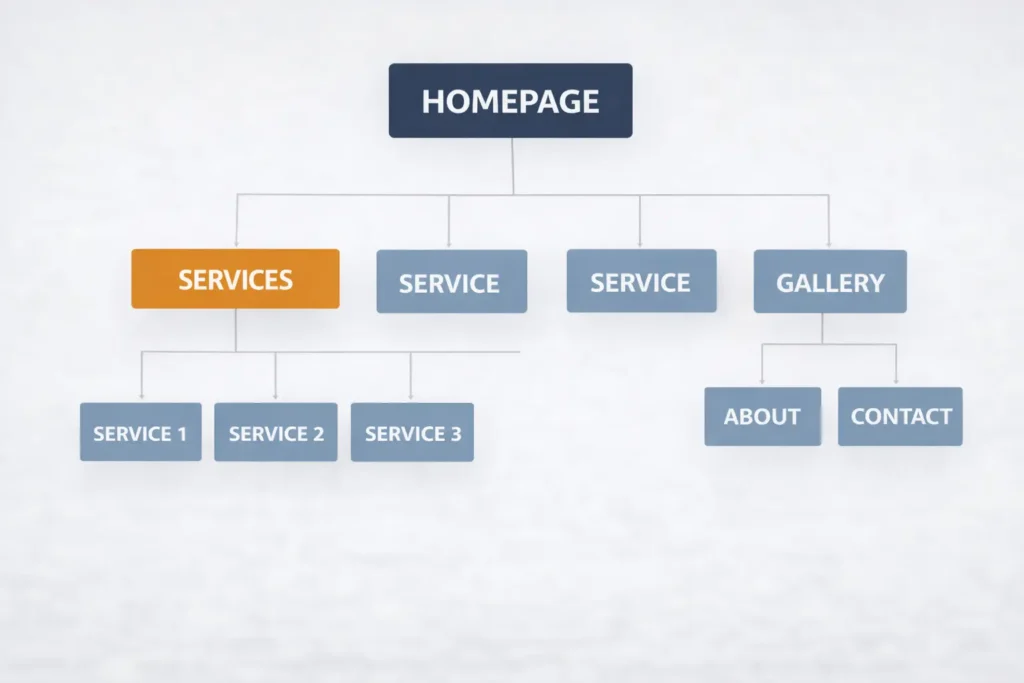
If you want a starting point that fits most small trade businesses, this structure is usually the most practical:
Homepage
Primary service page
Two to four individual service pages
About page
Sample work or gallery
Contact page
That is enough depth to rank for useful service terms, enough room to build trust, and enough clarity to keep the site manageable.
You can always grow from there.
What matters most is that every page has a job. If a page does not clarify the offer, build trust, or move the visitor toward action, it probably needs to be improved or removed.
Final Take: Why a trade business website should bring you real inquiries
The best websites for trades are not built around trends. They are built around trust, clarity, and action. If your current site is too broad, too thin, or too passive, better structure and stronger messaging can make a noticeable difference in the quality of your leads.
A strong site should help people understand your offer fast, believe in you quickly, and contact you without friction. When that happens, your website stops being an online placeholder and starts working like a real part of your sales process.
Frequently Asked Questions
1. What pages should a website for a trades business include?
The right page structure matters more than adding extra pages. A strong trades website usually needs a homepage, a clear service overview, a few individual service pages, an about page, a proof-focused gallery or sample work page, and a contact page with a short form. This setup gives visitors enough detail to trust the business and gives Google enough context to understand what the company actually offers in a local market.
2. How much should a professional trades website cost?
The cost depends on scope, not just design. A simple starter build may work for a solo trade business with one main service, but a more serious lead-generation site needs strategy, page structure, copy, mobile planning, and trust-focused design. If you want a site that can support SEO and bring qualified leads, you are usually paying for clearer messaging, stronger page flow, and a setup that can grow with the business.
3. Is a one-page website enough for a local trade company?
A one-page site can work, but only in limited situations. It is often enough for a very new business, one core service, or a brand that still depends mainly on referrals. Once a company offers multiple services, targets several locations, or wants to rank for more than one search intent, a one-page site usually becomes too thin. Most growing trades businesses do better with a small multi-page structure.
4. Can web design really help a trade business get more calls?
Yes, because better web design reduces hesitation and improves the path to action. A site that explains the service clearly, shows proof early, works well on mobile, and keeps the next step simple can convert more of the traffic you already get. Design alone is not magic, but when message, trust, and CTA placement are handled well, it often has a direct effect on inquiries and quote requests.