
Improving your business website ranking on Google comes down to clear service pages, strong local trust signals, and content that answers what customers are already searching for. For businesses targeting google ranking for business website, the best results usually come from combining organic SEO, Google Business Profile optimization, and better internal linking instead of relying on one tactic alone.
Many small business websites stay invisible because they try to rank a homepage for every service, every city, and every keyword at once. The sites that move up are usually the ones that make each important page easy to understand, easy to crawl, and clearly useful for real customers. Google’s own guidance still centers on helpful, reliable, people-first content, and the same SEO fundamentals continue to matter for AI Overviews and AI Mode too.
Why Some Business Websites Struggle to Rank
A business website usually fails to rank for one of three reasons. First, the page does not match the search intent. Second, Google cannot clearly understand what the business offers and where it serves customers. Third, the site has weak trust and weak internal structure.
This is why a thin homepage rarely ranks well for competitive service terms. A cleaner setup is to give every core service its own page, support those pages with related blog content, and connect them with descriptive internal links. Google recommends using words people actually search for in important places such as titles, headings, alt text, and link text, and it also emphasizes crawlable links that help Google discover more pages on your site.
For a stronger service-page foundation, point readers naturally toward your commercial pages like website design & development services and portfolio highlights. Those links are not just for conversion. They also help show Google which pages matter most on the site. Internal links are still one of the simplest ways to strengthen topical relationships across your content.
What Google Actually Rewards in 2026
Google has been very clear on one point: it wants content created to help people, not content built only to manipulate rankings. That matters for classic search and for AI-driven search experiences. Google also says there are no extra technical requirements to appear in AI Overviews or AI Mode beyond being eligible in Search generally. In practical terms, that means SEO is not dead. It is being filtered harder. Thin pages, copycat pages, and generic AI copy are weaker. Clear, expert, useful pages are stronger.
For local businesses, Google Business Profile is still a major visibility layer. Google says local results are mainly based on relevance, distance, and popularity, and it also notes that complete, accurate business information makes a profile more likely to show in relevant local results. Your chosen business categories also affect local ranking, which is why the primary category should be specific and accurate rather than broad.
That is the core takeaway for 2026. Ranking comes from clarity. A clear service page, a clear location signal, a clear category, a clear internal link path, and a clear user experience.
Which Ranking Option Is Best for Your Business?
Not every business should chase the same SEO playbook. The best option depends on how customers search for you.
| Business type | Best ranking focus | Why it works |
|---|---|---|
| Local storefront | Google Business Profile + service pages + review strategy | Helps you appear in map results and local organic results together |
| Service area business | City/service pages + proof of work + GBP optimization | Builds relevance for service terms in real locations |
| Multi-service business | Separate pages for each core service | Prevents one page from trying to rank for everything |
| Content-led brand | Blog clusters linked to money pages | Captures informational searches and passes authority internally |
| Portfolio-driven business | Case studies + sample work + commercial links | Builds trust and improves conversion after the click |
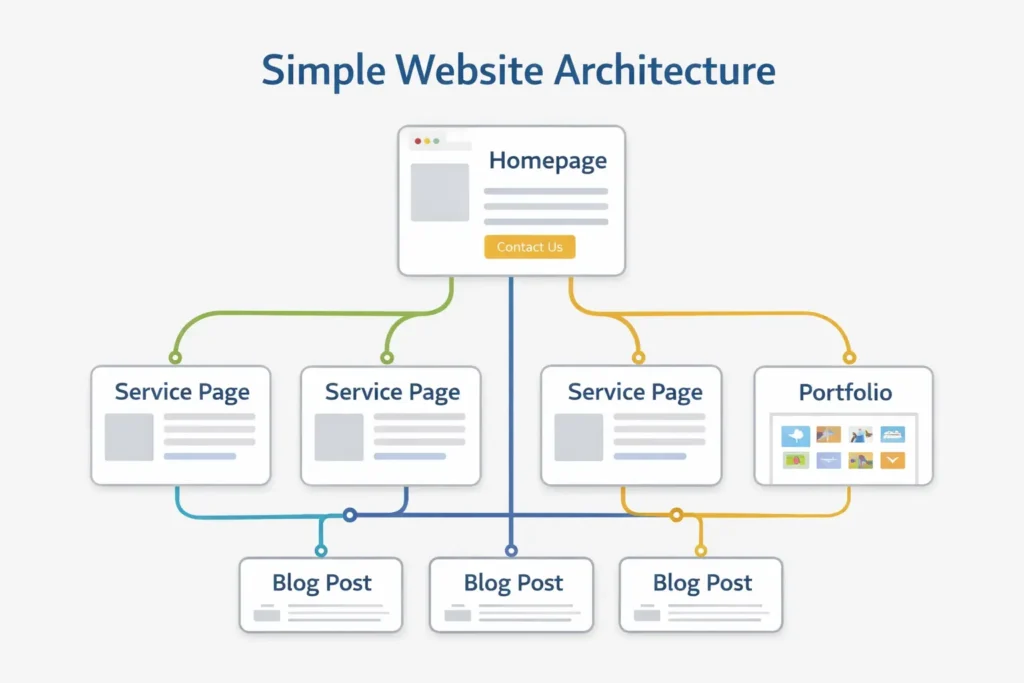
For most small businesses, the strongest option is not “blog only” and not “homepage SEO.” It is a hybrid structure:
- A focused service page for each main offer
- A supporting blog post for each related question
- A visible trust layer through reviews, examples, and real business details
- A Google Business Profile that matches the website information
That is why linking to educational content, like local SEO for small business websites and how to rank a small business website can support both users and rankings. These posts help Google understand topical depth while also moving readers toward your higher-intent service pages.
How to Improve Your Rankings Step by Step
1. Build pages around customer intent, not just keywords
A visitor searching “web design for contractors” does not want a vague agency page. They want proof, pricing clues, service details, and examples. A visitor searching “why is my website not ranking?” wants an explanation before a sales pitch.
That means each page should do one job well. A service page should sell a service. A blog post should answer a question. A portfolio page should show outcomes. When pages try to do all three, they often do none of them well.
A practical structure for each service page looks like this:
- clear H1 based on the service
- short answer-first intro
- who the service is for
- what is included
- proof or examples
- FAQs
- CTA
This structure helps both readers and AI extraction systems because the answer appears early and the page stays easy to scan.
2. Make your internal links pull real weight
Internal linking is often treated as an afterthought, but it helps Google discover pages and understand how your content is related. Google explicitly recommends making content easy to find through internal links.
A better internal link strategy looks like this in practice:
A blog about local SEO should link to a relevant service page.
A service page should link to proof, examples, or case studies.
A related blog should link back to the main service page with descriptive anchor text.
This makes the whole site more usable and gives your high-value pages more support. It also helps distribute attention away from just the homepage.
3. Strengthen local trust signals
When a business depends on local leads, your website and your Google Business Profile should reinforce each other. Your business name, phone number, location details, hours, and category should stay consistent and complete. Google says complete and accurate business information improves your chance of appearing in relevant local search, and verified businesses are more likely to show in results. Responding to reviews and adding photos also helps your business stand out.
A simple example:
A local web design studio in Tampa should not rely only on a homepage saying “we build websites.” It should also have a specific services page, visible service area references, real project samples, and a fully updated business profile with the right category.
4. Use content that answers real buying questions
Some of the best blog topics are not broad education posts. They are decision-stage questions your prospects already ask:
- how much does a website redesign cost
- when should you redesign a small business website
- local SEO vs website SEO
- how to tell if your site is hurting lead generation
These topics do two things well. They rank for practical searches, and they pre-qualify leads before the inquiry. That is stronger than publishing random traffic posts that never connect back to your services.
A helpful external reference here is Google’s own guide to improving local ranking, which reinforces the importance of profile completeness, reviews, verification, and local relevance.
5. Give Google a clean technical path
Google Search is automated. Its crawlers discover pages, process them, and add them to the index when possible. Most sites do not need to manually submit every page, but they do need clean discovery paths through internal links, proper indexing conditions, and a stable site structure. Google also notes that similar pages grouped into directories can help it learn how sections of a site change over time.
That means your site should avoid:
- duplicate versions of the same page
- thin city pages with almost no unique value
- broken internal links
- unclear navigation
- service pages buried too deep in the site
The Best Practical Setup for a Small Business Website
A lot of ranking problems are really structural problems. Here is a simple model that fits most service businesses well.
| Page type | Main job | Best keyword angle | Internal link target |
|---|---|---|---|
| Homepage | Brand clarity and trust | Branded and broad category terms | Core services, about, contact |
| Service page | Convert high-intent traffic | Service-specific terms | Contact, portfolio, related blog |
| Location page | Capture local service demand | Service + city terms | Main service page, contact |
| Blog post | Answer questions and build topical depth | Informational long-tail terms | Service page, related blog |
| Portfolio/case study | Build proof | Industry and outcome-driven terms | Service page, inquiry page |
This is also where your commercial and blog links should support each other naturally. A visitor who reads a blog post should not hit a dead end. They should have an obvious next step.
How to Check Google Business Page Ranking
Checking your Google Business page ranking is different from checking your website’s organic ranking. Local visibility can change based on location, device, query wording, and search history. Google’s documentation for Search Console also reminds site owners that results can differ depending on the time, place, device, and recent history of the person searching.
The smartest way to evaluate your Business Profile is to look at visibility patterns, not just one manual search. Focus on:
- whether your profile appears for your main service terms
- whether you show in the local pack for your target area
- whether calls, clicks, and direction requests are improving
- whether your categories, hours, and reviews are complete and current
Google also provides profile performance insights, which are more useful than guessing based on one search from your own office location. For local SEO, ranking should always be judged in context.
How to Check Google Ranking for a Website
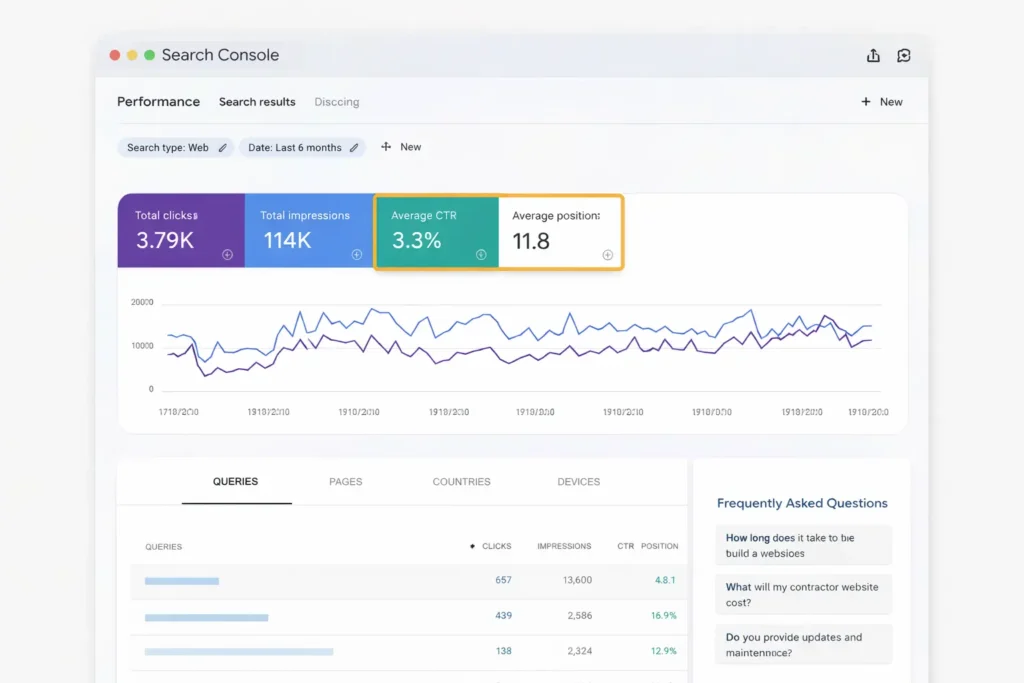
For website rankings, the best first stop is Google Search Console. Google says the Performance report shows clicks, impressions, CTR, and average position, plus the queries and pages bringing traffic. That makes it far more useful than relying on random incognito searches.
Use Search Console to answer four questions:
- Which queries already show your site?
- Which pages are earning impressions but have weak CTR?
- Which pages have average positions close to page one?
- Which services need stronger internal and content support?
A page sitting in position 11 to 18 is often a better opportunity than a page buried at position 54. That page may only need better title writing, stronger internal links, fresher supporting content, or tighter intent matching.
For hands-on tracking, Google’s Search Console Performance report is the cleanest external resource to include with this topic.
Common Mistakes That Keep Rankings Flat
The most common problem is trying to rank a single homepage for every service. The second is publishing blog posts that never link to money pages. The third is having a Google Business Profile and a website that tell slightly different stories.
Another major issue is assuming SEO stopped mattering because AI search features exist now. Google’s own documentation says the same foundational SEO best practices remain relevant for AI features, and there are no extra special requirements just to appear in those experiences.
That is why the winning move is still the same at its core: create pages that deserve to be chosen.
Final Thoughts
A better google ranking for business website strategy is usually less about hacks and more about alignment. When your service pages, blog content, internal links, business profile, and proof all support the same message, rankings become easier to grow and easier to keep.
Small businesses do not need the biggest site on the internet. They need the clearest one. Start with the pages that drive revenue, support them with useful blog content, strengthen your local trust signals, and track progress in Search Console instead of guessing.
Frequently Asked Questions
1. How to rank a business website on Google?
The best way to rank a business website on Google is to match each page to a clear customer intent. Build a separate page for each core service, make sure the page answers the searcher’s question quickly, and connect it to related blog content and proof pages. For local businesses, keep your Google Business Profile accurate and consistent with your site. Strong internal linking, real examples, helpful FAQs, and a cleaner page structure usually outperform keyword stuffing or generic content.
2. Is SEO dead or evolving in 2026?
SEO is evolving in 2026, not dying. Google has stated that the same foundational SEO best practices still apply for AI Overviews and AI Mode, which means useful content, technical accessibility, strong internal linking, and trust still matter. What is fading is low-value SEO: thin articles, repetitive pages, and content made only to chase rankings. Businesses that publish useful, experience-backed pages are still in a strong position to earn visibility.
3. How to check Google business page ranking?
The most reliable way to check a Google business page ranking is to review local visibility patterns, not a single manual search. Your profile can appear differently based on distance, device, and search history. Check whether you appear in local pack results for your main service terms, watch your profile performance data, and monitor actions like calls, clicks, and direction requests. Also review your categories, photos, reviews, hours, and verification status because those details directly support local visibility.
4. How to check Google ranking for a website?
The best way to check Google ranking for a website is through Google Search Console. The Performance report shows clicks, impressions, CTR, average position, top queries, and top pages, which gives you a much more realistic picture than searching your own keywords manually. Look for pages with good impressions but weak CTR, or pages ranking just off page one. Those are often your fastest SEO wins because they already have visibility and only need stronger optimization.