The best vet websites in the USA make it easy to book, call, find urgent care details, and trust the team before a pet owner ever visits. They perform better when they combine clear service pages, strong local SEO signals, fast mobile design, and real proof that the clinic is reliable.
If a pet owner lands on your site and has to guess where to click, wonder whether you treat their animal, or scroll too long to find your phone number, you are losing both trust and appointments. A great clinic site should answer basic questions quickly, guide people to the next step, and support local search visibility at the same time.
That is why many practices invest in strategy first, not just visuals. A polished homepage is helpful, but results usually come from structure, clarity, and local intent. The strongest builds are designed around how real pet owners search, compare, and decide.
A clinic owner also needs to remember something simple. People are not browsing casually when they visit a vet website. They are often trying to solve a problem right now. They may need vaccines, dental care, surgery, diagnostics, or same-day help. Your site has to reduce friction from the first second.
If your current site looks dated or feels hard to update, it helps to review what a growth-driven web design approach looks like before making changes. Many clinics also benefit from reviewing website design & development services that focus on speed, clarity, and lead generation rather than design alone.

Why a strong clinic site matters more than ever
Pet owners compare quickly. They open multiple tabs, scan reviews, check location details, and look for signs that your team is credible. If another clinic explains services more clearly, shows better proof, or makes booking simpler, that clinic often gets the appointment.
This is also where SEO and trust overlap. A site that is organized for humans usually performs better for search engines, too. Clear service pages, local relevance, accurate business information, and strong internal linking all help search engines understand what you offer and where you offer it.
For local clinics in the USA, the website is not just a brochure. It is the central hub that connects your Google Business Profile, reviews, location pages, blog content, forms, and calls. Google’s official guidance also stresses that business details such as address, hours, contact information, and photos should stay accurate on a Business Profile, which makes website consistency even more important.
The right website can also shorten the decision cycle. A nervous pet owner may feel ready to call when they see your doctor bios, emergency process, accepted payment options, and realistic photos of your clinic. Small details build confidence.
What pet owners look for first when they land on a vet site
A pet owner usually wants reassurance before anything else. They want to know they are in the right place and that your team can help.
That means your homepage should communicate these things almost immediately:
✅ What animals do you treat
✅ Where are you located
✅ How to book
✅ Whether you handle urgent cases
✅ What services do you offer
✅ Why your clinic is trustworthy
That information should not be buried halfway down the page. It should appear above the fold or very close to it, especially on mobile.
The tone also matters. Clinics that rank and convert well usually sound calm, practical, and helpful. They do not rely on vague claims like “we care deeply” without showing proof. They back up trust with visible credentials, testimonials, photos, service explanations, and simple next steps.
Here is how priorities often break down for pet owners.
| What the pet owner wants to know | Why it matters |
|---|---|
| Can this clinic help my pet? | Relevance decides whether they stay or bounce |
| Is this location close and easy to contact? | Local convenience affects calls and map actions |
| Do I trust the team? | Credibility drives appointment decisions |
| Can I book fast? | Reduced friction increases conversions |
| What happens in urgent situations? | Clarity matters when emotions are high |
A surprising number of clinic websites miss one of these basics. They may look modern, but they do not answer common questions quickly enough.
The pages that usually matter most
Not every clinic needs dozens of pages at launch, but the structure should cover the topics both users and search engines expect.
A homepage should set direction. It introduces the clinic, highlights core services, and funnels visitors toward appointments, calls, and key pages. It should not try to explain everything in one long wall of text.
A dedicated About page builds trust. This is where you show your doctors, team experience, clinic philosophy, equipment, and what makes your care experience different. It is one of the most visited pages on many service websites because pet owners want to know who will handle their animal.
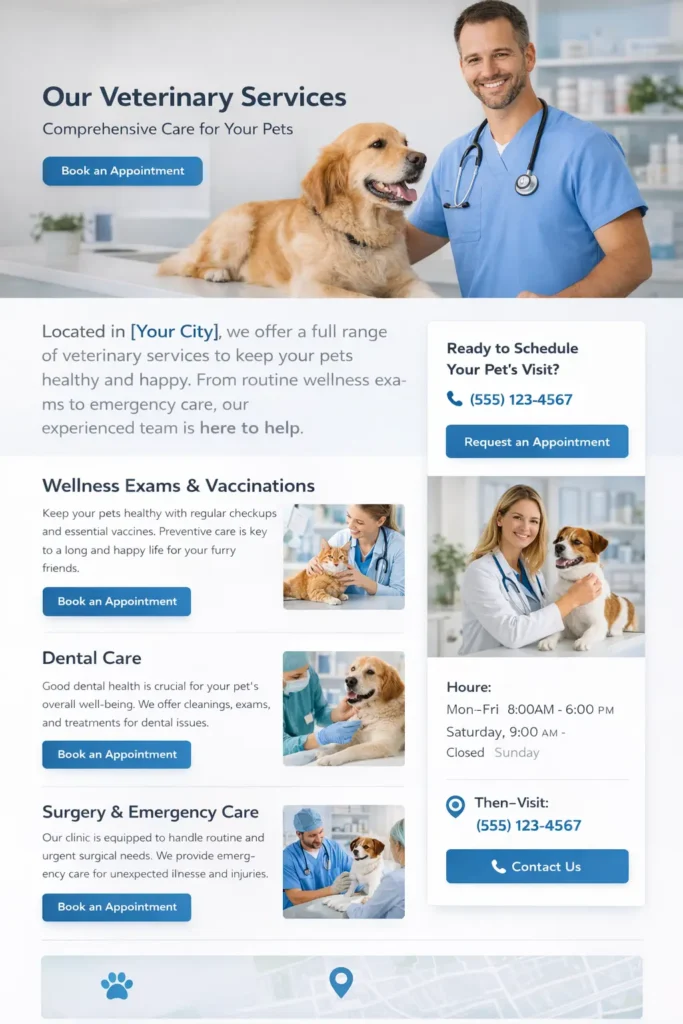
Service pages are often the ranking engine. Separate pages for wellness exams, vaccinations, dental care, surgery, diagnostics, senior pet care, and emergency guidance help your site match more specific searches. They also reduce confusion because pet owners can land directly on the topic they need.
A contact page should do more than list an address. It should make action easy. Include a click-to-call number, map, parking notes if relevant, office hours, form access, and what to do in urgent cases outside office hours.
A reviews or testimonials section also matters. Even if reviews exist on Google, showing selected testimonials on your site helps reinforce confidence before someone clicks away.
If you want examples of how messaging and page flow can support conversions, the article on conversion-focused website strategy is a useful related read. For niche-specific direction, vet website design ideas can also help shape content priorities.
The local SEO pieces clinics should not ignore
Local SEO is often where clinics lose ground without realizing it. They may publish a decent site but leave out the signals that help them show up for nearby searches.
One of the most important connections is between your website and your Google Business Profile. The practice name, address, phone number, hours, and categories should be consistent. Google also notes that verified profiles allow businesses to manage public information and keep details accurate for searchers.
Location signals should also appear naturally on your website. That includes your city, service area, nearby neighborhoods, and local references where relevant. Do not stuff city names awkwardly into every sentence. Instead, place them in title tags, headings, page copy, footer details, and contact information where they make sense.
Schema, image alt text, internal links, page speed, and mobile usability also support performance. These are not glamorous tasks, but they help search engines understand your business and improve the user experience.
Blog content can strengthen this even more when it targets practical questions. Good topics might include puppy vaccine schedules, when to call a vet for vomiting, what to expect after spay surgery, or how often dogs need dental cleanings. Articles like these build topical relevance and capture informational searches that can later turn into appointments.
What makes a clinic website convert better
Ranking is valuable, but ranking without appointments is not enough. A site should turn trust into action.
That usually happens when three things work together: message clarity, low friction, and proof.
Message clarity means your visitor knows what you do and what to do next. Low friction means your forms are short, your buttons are obvious, and your phone number is easy to tap. Proof means reviews, doctor bios, certifications, FAQs, and real clinic photography that support your claims.
Strong CTA placement is often underestimated. One “Book Appointment” button at the top is not enough. Good websites repeat the next step at logical points without feeling aggressive. They might use “Book an appointment,” “Call now,” “Request a visit,” or “Meet our team” based on page intent.
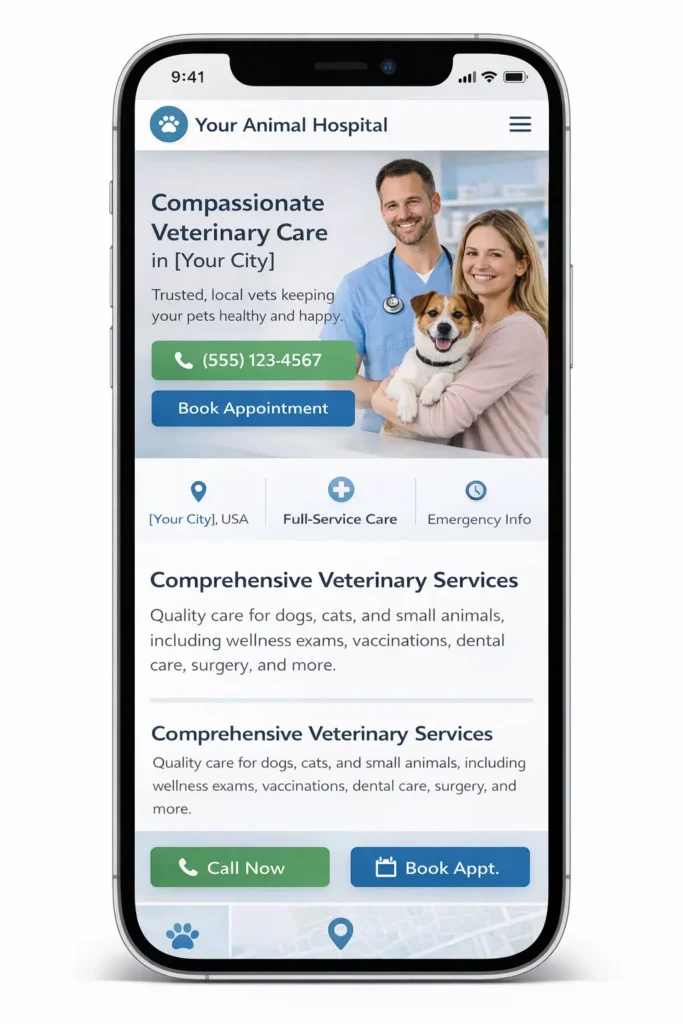
Your mobile layout deserves special attention here. Many local searches happen on phones. If the menu is clunky, forms are long, or the text is too cramped, visitors drop off quickly.
Here is a simple conversion framework clinics can use.
| Website element | What it should do |
|---|---|
| Hero section | State who you help, where you are, and the main action |
| Service pages | Explain care clearly and answer decision-stage questions |
| CTA buttons | Appear often enough to guide without interrupting |
| Trust proof | Show reviews, staff credentials, affiliations, and real photos |
| Contact options | Offer click-to-call, forms, map info, and urgent instructions |
Clinics with AAHA accreditation or other meaningful credentials should make that visible as well. AAHA explains that accreditation matters because it signals high standards and helps pet owners feel more confident about the care their animals receive.

Content choices that improve rankings without sounding robotic
A lot of clinic websites struggle because they try to sound “SEO friendly” instead of helpful. The result is awkward text that repeats the same phrase and adds little value.
The better approach is to build topic depth naturally. For example, on a dental page, explain signs of dental disease, what an exam includes, what happens during cleaning, recovery expectations, and when owners should book. That creates useful content without stuffing keywords.
The same goes for your homepage. Instead of listing every treatment in one generic paragraph, guide visitors into category sections. Preventive care, diagnostics, surgery, urgent care, and patient resources are clearer buckets than a giant block of text.
FAQs can also help with AI overviews and featured snippets when they answer real questions directly. Short opening answers followed by slightly deeper context often perform well because they are easy to extract and still useful for humans.
Images matter too. Use authentic clinic photography whenever possible. Stock photos can support design, but they should not dominate. Pet owners want to see your actual team, lobby, treatment rooms, and the kinds of pets you serve.
Useful external references can also strengthen trust when they are genuinely relevant. For example, pet owners may appreciate resources from Google Business Profile Help for location accuracy and AAHA’s guide on why accreditation matters when evaluating standards of care. Both can support confidence without distracting from your core conversion path.
Common mistakes that hold clinic websites back
Some sites fail because they are outdated. Others fail because they are unclear. In both cases, rankings and conversions suffer.
One common issue is generic copy that could belong to any clinic in any city. That kind of content gives search engines very little to work with and gives pet owners no strong reason to choose you.
Another issue is weak navigation. If a visitor cannot find services, pricing guidance, urgent care instructions, or doctor information quickly, frustration rises fast.
Some clinics also ignore internal linking. This is a missed opportunity. A homepage should guide visitors toward priority pages. Blog posts should connect naturally to services. Service pages should connect to appointment actions and related care topics.
Thin service pages are another problem. A page with one short paragraph and a button rarely ranks well. It usually needs a clearer structure, better supporting information, and stronger evidence that the page fully addresses the topic.
Finally, slow load times hurt everything. They affect user experience, mobile performance, and search visibility. Even a beautiful website loses value when it feels sluggish.
A practical structure for a high-performing clinic homepage
A homepage does not need to be complicated, but it should be intentional. A strong flow often looks like this:
Start with a clear hero that states your clinic type, city, and primary action. Follow that with a short trust section that introduces your team or differentiators. Then feature your main services with clean cards or short summaries.
After that, add proof. Reviews, badges, doctor bios, or a clinic overview video can work well. Then answer common concerns such as accepted pets, appointment process, financing, urgent care guidance, and location details.
The page should end with a strong CTA section and footer details that reinforce local relevance.
This kind of flow works because it matches user intent. Pet owners do not want to hunt for information. They want to feel confident, informed, and ready to act.
How to make the article and page strategy work harder for Rank Math
If the goal is better Rank Math scores without sacrificing quality, focus on substance first and plugin prompts second. Use the primary phrase in key locations, but make sure the page still reads naturally. Improve title clarity, internal links, image alt text, slug relevance, and FAQ usefulness. Those changes usually do more than chasing a perfect score with forced repetition.
Also, build semantic support around the topic. Related terms such as vet website design, local SEO for veterinarians, pet owner experience, appointment booking, mobile optimization, emergency vet information, and trust signals can help reinforce page relevance without overusing one phrase.
Make your snippets stronger, too. Meta titles and descriptions should promise a clear outcome, not just mention the topic. Searchers click when they understand what they will get.
A good page should answer three questions before the visitor leaves the first screen:
Can you help me?
Can I trust you?
Can I contact you fast?
If the answer is yes, rankings have a much better chance of turning into business.
Final Thoughts on Veterinary Clinic Website
A veterinary clinic website should do more than look clean. It should help local pet owners feel informed, reassured, and ready to book. When the structure is clear, the local SEO foundations are strong, and the trust signals are visible, the site becomes a real growth asset rather than an online placeholder.
FAQs
1. How do I choose the best vet website provider in the USA?
The best choice is the provider that understands both local SEO and conversion design for service businesses. A clinic website is not just a visual project. It needs clear service pages, strong mobile usability, fast load times, and messaging that helps pet owners trust the practice quickly. Review their portfolio, ask how they handle internal linking and local search optimization, and make sure they can build pages that support appointments, not just aesthetics.
2. What should a vet website include for pet owners in the USA?
The most important elements are clarity, trust, and easy action. Pet owners should immediately find your services, phone number, booking options, hours, location, doctor bios, and urgent care guidance. They also want proof that your clinic is credible, so reviews, photos, certifications, and simple explanations of what to expect matter a lot. A good site removes uncertainty and helps visitors take the next step with confidence.
3. Why does a vet website matter for local SEO in the USA?
A well-built site strengthens your visibility in nearby searches and supports your map presence. Search engines look for consistent business information, relevant local content, clear service pages, and a good user experience. When your website aligns with your Google Business Profile, uses location signals naturally, and answers search intent well, it becomes easier for your clinic to appear for the searches that matter most in your area.
4. Can a clinic website help increase appointments and trust?
Yes, a strong site can directly improve both appointment volume and credibility. When pet owners can quickly understand your services, meet your team, read reviews, and contact you without friction, they are more likely to book. Trust grows when the experience feels professional, honest, and easy to navigate. In many cases, better structure and messaging can improve results even before more traffic arrives.