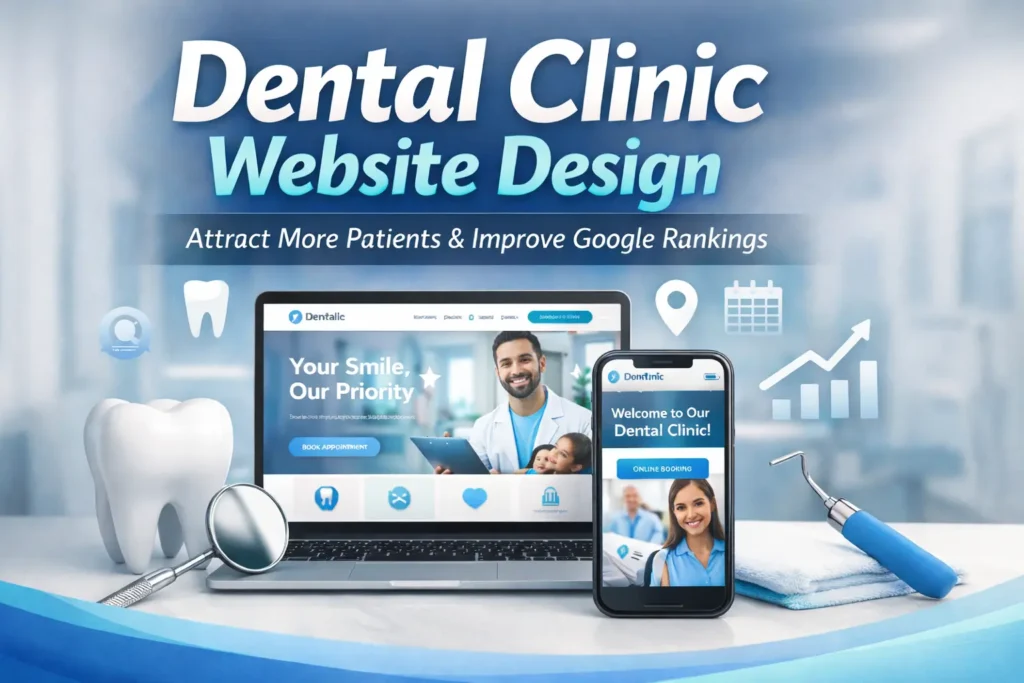
Dental clinic website design matters because patients judge your credibility, convenience, and professionalism within seconds of landing on your site. A well-built dental website makes it easier for people to trust your clinic, understand your services, and book an appointment without friction.
Most dental practices do not lose leads because they lack skill or experience. They lose leads because their site feels outdated, loads slowly, hides key information, or fails to answer what a nervous first-time patient wants to know right away. That is why a strong dental website is not just about colors and layout. It is about clarity, conversion, local visibility, and patient confidence.
If you are planning a new site or upgrading an older one, the goal should be simple. Make every page easy to understand, easy to use, and easy to trust. That approach supports both SEO and answer engine visibility because Google and AI systems tend to favor pages that are clear, well-structured, and genuinely helpful.
For clinics that want a polished foundation, working with our studio can help align design, messaging, and conversions from the start.
Why Website Design Matters for Dental Clinics
A patient searching for a dentist often compares several clinics in a single session. They are not just looking for treatment options. They are asking quiet questions in their head.
Can I trust this clinic?
Do they look professional?
Do they treat my issue?
Can I book quickly?
Will this place feel comfortable?
Your website answers all of those questions before anyone calls your front desk. A cluttered homepage, stock-heavy visuals, or vague service copy can create hesitation. A clean layout, reassuring language, clear service pages, and visible contact options reduce that hesitation.
This is especially important in dentistry because many patients feel anxious before they ever schedule. Your website should lower that anxiety. That means simple navigation, warm imagery, transparent information, and content that explains what to expect.
A good site also supports business goals behind the scenes. It helps with local search visibility, improves mobile performance, increases appointment requests, and gives your clinic a stronger brand presence in a competitive area.
You can see how healthcare-adjacent service brands build trust online by reviewing this animal hospital website design example, where structure and user experience do a lot of the conversion work.
What Patients Expect From a Dental Website Today
The average visitor is not reading every line. They are scanning for proof that your clinic is right for them. That means the site has to surface the most important information early and in the right order.
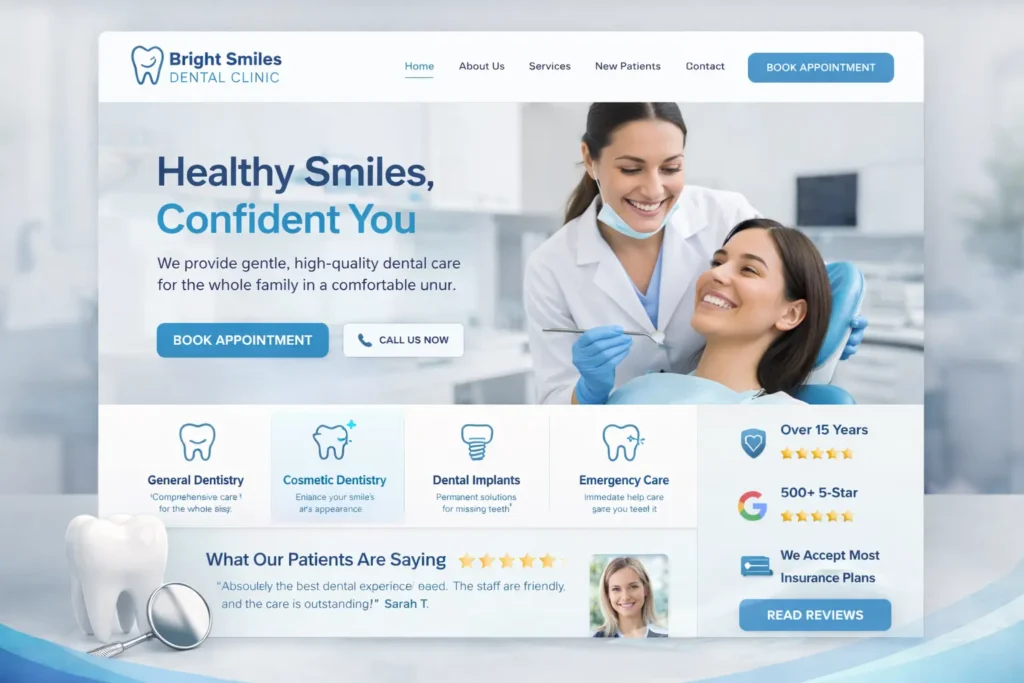
Patients usually want to see your location, phone number, accepted services, insurance or financing details, reviews, and a clear next step. They also want to know whether you offer the treatment they need, whether your clinic serves families or cosmetic patients, and whether booking is easy.
Below is a practical view of what matters most.
| Patient Need | What Your Website Should Show |
|---|---|
| Trust | Real team photos, testimonials, credentials, and a polished design |
| Convenience | Click-to-call button, online booking, map, hours, and fast loading pages |
| Service clarity | Dedicated pages for implants, veneers, emergency care, cleaning, and whitening |
| Comfort | Friendly tone, what-to-expect content, FAQs, and financing details |
| Local relevance | Location pages, local keywords, and schema-friendly structure |
A lot of dental clinics still bury this information under generic homepage copy. That is a mistake. The strongest sites place answers where patients can find them immediately.
For clinics reviewing options, website design & development services are often most effective when they combine conversion strategy, content structure, and local SEO in one plan rather than treating them as separate tasks.
The Core Elements of a High-Performing Dental Website
A dental website should feel calm, clear, and action-oriented. The design must guide the patient, not distract them. Here are the elements that usually make the biggest difference.
A clear hero section
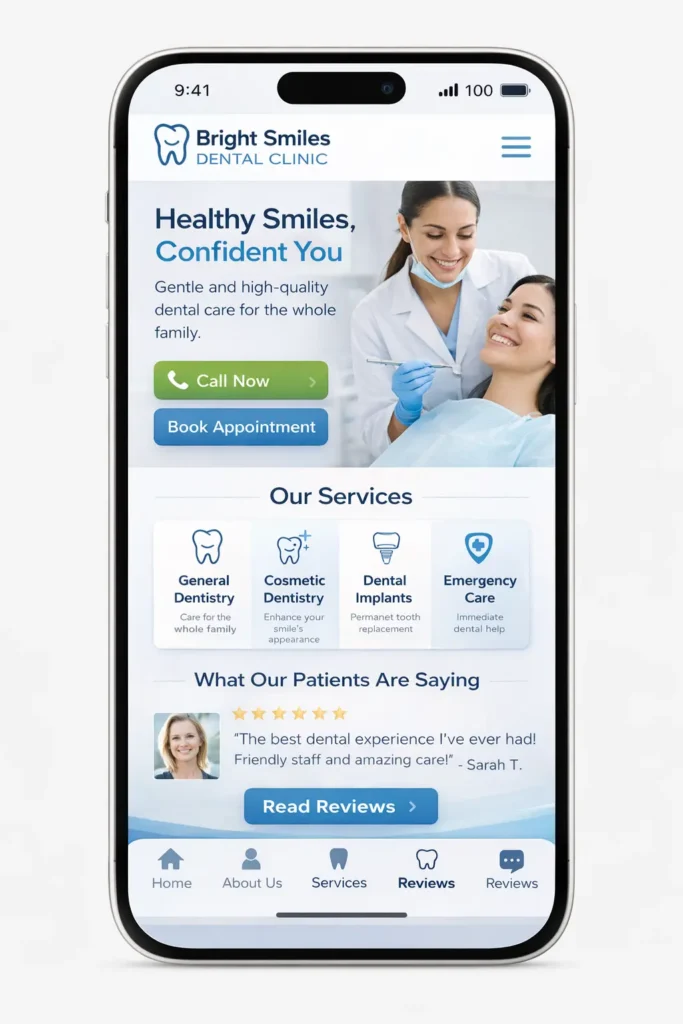
The top of the homepage should explain who you help, what you offer, and what action the visitor should take next. A strong opening often includes a concise headline, short supporting copy, one main call to action, and one secondary call to action.
For example, a clinic may highlight family dentistry, cosmetic services, and same-day appointments. The visitor should not need to scroll to figure out the basics.
Simple navigation
Dental websites often become crowded because clinics try to fit everything into the top menu. Keep it focused. Home, About, Services, New Patients, Reviews, Blog, and Contact are usually enough. If you offer several treatments, use a services dropdown rather than forcing all options into the main navigation.
Strong service pages
Each core treatment needs its own page. This helps both rankings and conversions. A whitening page should answer different questions than an implants page. A root canal page should speak to urgency and comfort in a different way than a routine cleaning page.
Dedicated pages also help answer engine systems understand which topics your clinic covers in depth.
Visible contact and booking options
Patients should be able to call, book, or request an appointment from any page. Sticky mobile buttons often perform well here. Keep forms short. Name, phone, email, preferred service, and preferred time are enough for most clinics.
Local trust signals
Add reviews, affiliations, years of experience, insurance information, and clear office details. These are not just credibility boosters. They reduce the friction that would otherwise stop someone from reaching out.
How Design Supports Google Rankings and GEO Visibility
Design and SEO are closely connected. A beautiful site that loads slowly or hides content will struggle. A fast, structured site with useful pages has a much better chance of earning visibility.
Google’s own Search Essentials emphasizes helpful, people-first content and accessible page structure, which directly supports stronger site performance: https://developers.google.com/search/docs/fundamentals/creating-helpful-content
For dental clinics, this matters in several ways. A clean heading structure helps search engines understand each page. Fast loading times improve usability. Mobile-friendly layouts support patient behavior because most local searches happen on phones. Well-written service pages increase relevance for treatment-specific searches. Internal links help both users and crawlers move naturally across the site.
Answer engine optimization also benefits from concise definitions, question-based subheads, and direct explanations. If a patient asks, “Do dentists offer same-day emergency appointments?” your emergency page should answer that in a clear paragraph near the top, not hide it deep in the page.
This is one reason content structure matters as much as visual design. A strong page is not just attractive. It is easy for humans and machines to interpret.
The American Dental Association also provides patient education standards that can inspire trustworthy content sections, especially for preventive care and treatment explanations: https://www.mouthhealthy.org/
Which Pages a Dental Website Should Include
A dental site does not need dozens of pages to perform well. It needs the right pages with the right depth. In most cases, these are the essentials.
| Page Type | Why It Matters | Best Use |
|---|---|---|
| Homepage | Gives first impression and directs next steps | Brand trust, services overview, booking CTA |
| About Page | Humanizes the clinic | Dentist bio, team culture, credentials |
| Service Pages | Improves rankings and conversion intent | One page per major treatment |
| New Patient Page | Reduces friction for first-time visitors | Forms, insurance, financing, expectations |
| Reviews Page | Builds social proof | Showcase patient feedback and outcomes |
| Contact Page | Supports fast action | Phone, map, hours, booking form |
| Blog | Expands long-tail reach and GEO visibility | Educational content and local relevance |
A blog still matters because it helps your clinic answer specific questions patients are already searching for. It also creates natural internal linking paths to service pages. For instance, a blog about pet care clinics can still teach layout and trust-building lessons for healthcare websites, which is why this veterinary clinic website article is useful to study from a structural standpoint.
How to Make the Site Convert More Visitors Into Appointments
Traffic alone does not grow a practice. The site must convert. This is where many clinics miss the mark. They invest in visuals but forget the path to action.
Start by tightening your calls to action. Use one primary action across the site, such as Book an Appointment or Request a Visit. Keep the phrasing consistent so people do not have to think.
Next, make your value clear. Instead of generic copy like “quality dental care for the whole family,” say what makes your clinic easier to choose. This could be sedation options, same-week appointments, bilingual support, transparent financing, or advanced cosmetic work.
Then reduce the form friction. Long forms can feel like work. Patients who are already anxious are even less likely to complete them. Ask only what your team needs to follow up.
You should also think carefully about mobile behavior. Many visitors will call instead of filling out a form. That means the phone number should be large, tappable, and repeated in key spots.
Small trust details can raise conversion rates, too. Examples include:
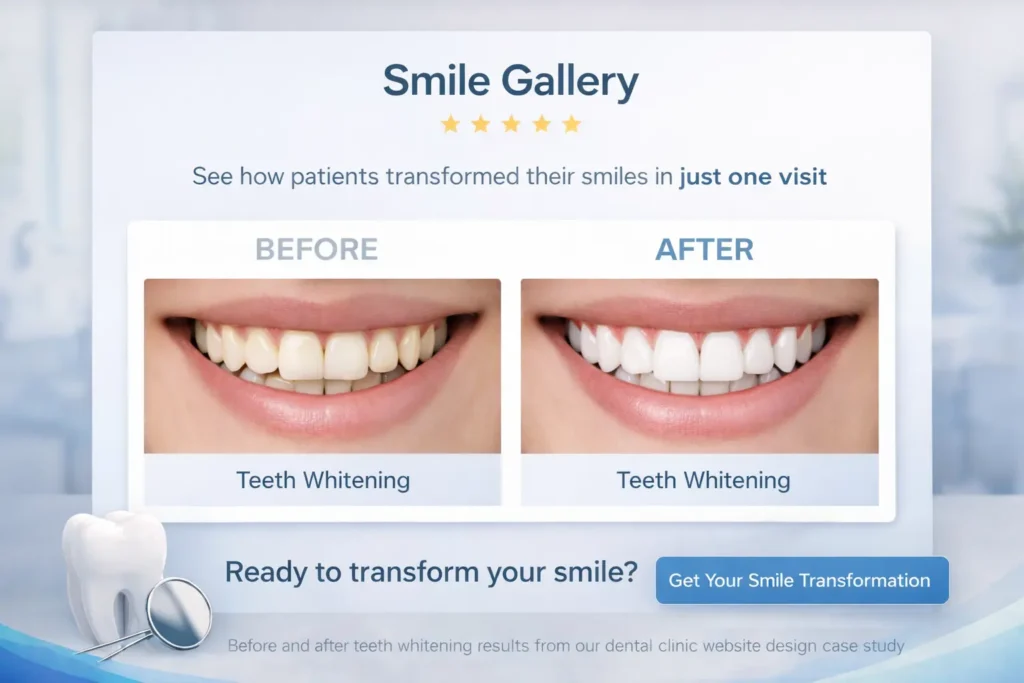
✅ Before-and-after treatment photos
✅ A welcome note for nervous patients
✅ Short explanations of first visit steps
✅ Insurance and financing info in plain language
✅ A short review slider near booking sections
Best Practices for Content, Layout, and Patient Experience
The best dental websites balance reassurance with clarity. Here is how that usually looks in practice.
Write in patient-friendly language. Many clinics accidentally sound too technical. Use plain explanations first, then add detail where needed. “Dental implant treatment replaces a missing tooth root” is easier to understand than dense clinical phrasing.
Break content into sections. Use descriptive headings. Keep paragraphs readable. This improves scanning and makes your site more extractable for AI-generated answers.
Use real photos wherever possible. Patients can feel the difference between authentic team imagery and generic stock visuals. A real front desk photo, treatment room image, or dentist portrait builds confidence faster.
Keep branding calm and consistent. Blues, whites, soft neutrals, and clean typography are common in healthcare for a reason. They support trust and cleanliness. That said, do not copy every other clinic. A modern design still needs its own personality.
It also helps to study broader layout patterns and article organization inside the Salt Web Designer blog if you want a content model that supports search visibility without sounding robotic.
Common Mistakes That Hurt Dental Website Performance
A clinic may have strong treatment quality and still underperform online because of a few preventable issues.
One of the biggest is homepage overload. Trying to say everything at once usually means nothing stands out. Another issue is weak service depth. If every page says nearly the same thing, neither users nor search engines get enough context.
Slow page speed is another problem, often caused by oversized images, bloated themes, or unnecessary scripts. Thin trust signals also hurt. Visitors want proof, not just promises.
Finally, many clinics forget to update their websites regularly. Outdated staff photos, expired promotions, broken forms, and old office hours quietly damage credibility.
The fix is not always a full rebuild. Sometimes the best option is a strategic redesign focused on structure, speed, messaging, and conversion flow.
A Smart Approach for Clinics Planning a Redesign
If your clinic is considering a refresh, do not start with color palettes alone. Start with goals.
Do you want more new patient bookings?
Do you want better local search performance?
Do you want to highlight cosmetic services more effectively?
Do you want fewer drop-offs on mobile?
Once goals are clear, the right design decisions become easier. A clinic focused on cosmetic dentistry may need visual storytelling and stronger gallery placement. A family practice may need better new-patient guidance and insurance clarity. An emergency-focused clinic may need faster access to urgent care information.
That is where dental clinic website design becomes a business tool, not just a branding project. The best choice is the one that supports how your patients search, think, and book.
Wrapping It Up
A strong dental website should do three things well. It should make patients feel comfortable, make services easy to understand, and make booking the next step feel simple. When those pieces work together, your site becomes more than an online brochure. It becomes a steady source of qualified appointments.
If your current site feels dated, hard to manage, or unclear, upgrading your dental clinic website design can improve both rankings and patient conversions without overcomplicating the user experience.
Frequently Asked Questions
1. Why does website design matter when trying to attract new dental patients?
Good website design builds trust fast. Most people decide whether a clinic feels credible within seconds of landing on the homepage. If the site is modern, clear, and easy to use, visitors are more likely to stay, explore treatments, and book an appointment. Strong design also helps nervous patients feel more comfortable because it presents your team, process, and services in a reassuring way rather than a confusing one.
2. What features should a website for a dental practice include?
The right features make the site easier to use and easier to convert. A dental website should include clear service pages, click-to-call contact details, online appointment requests, office hours, location information, patient reviews, insurance or financing details, and a mobile-friendly layout. It should also have a strong homepage, an informative new patient page, and simple navigation so visitors can find answers without feeling overwhelmed.
3. How does website design support better Google visibility for a dental clinic?
Website design improves SEO when it supports structure, speed, and clarity. Google favors pages that are helpful, accessible, and easy to understand. When a dental website has clean headings, fast performance, strong internal links, mobile responsiveness, and useful service content, it becomes easier for search engines to interpret. That gives each page a better chance of ranking for local and treatment-based searches while also supporting answer engine visibility.
4. How often should a dental clinic refresh or update its website?
Most clinics should review their site every year and consider larger updates every 2 to 3 years. Small updates such as new photos, fresh reviews, updated service copy, and accurate office details should happen regularly. A full redesign may be needed sooner if the site feels outdated, loads slowly, performs poorly on mobile, or no longer reflects the clinic’s current brand, services, or patient expectations.