A small healthcare company needs a website that makes trust obvious fast, explains services clearly, and turns visitors into booked patients or qualified leads. A healthcare website for small business works best when it combines patient-friendly messaging, strong technical SEO, clear calls to action, and privacy-aware design.
If your site looks generic, loads slowly, or hides the next step, people leave. If it answers the right questions, connects your services to local search intent, and makes contact easy, it becomes one of your strongest growth assets.
Why This Type of Website Matters
For a small healthcare brand, a website is not just a digital brochure. It is often the first place a patient, family member, or referral partner decides whether your business feels credible, modern, and safe to contact.
That first impression matters even more in healthcare because people do not browse casually. They search when they need help, reassurance, availability, or answers. A site that communicates trust quickly can shorten the path from search to inquiry.
Google’s Search guidance consistently emphasizes helpful, reliable, people-first content, clear keyword use in important page elements, and crawlable internal links that help search engines understand your site. The same core practices also support visibility in newer AI-driven search experiences.
For healthcare businesses, trust also overlaps with privacy. The U.S. Department of Health and Human Services explains that the HIPAA Privacy Rule sets national standards for protecting identifiable health information, and HHS also provides specific guidance intended to help smaller providers and small businesses navigate compliance-related resources.
That does not mean every small healthcare website needs the same setup. A therapist, dental office, wellness clinic, home care provider, pediatric practice, med spa, or veterinary clinic may have different conversion paths. Still, the winning structure is usually the same: simple navigation, service pages that match search intent, proof that builds confidence, and a clear next step on every page.
What a High-Performing Healthcare Site Should Include
A strong healthcare website should answer five questions fast:
Who are you?
What do you offer?
Who is it for?
Why should someone trust you?
What should they do next?
If a visitor has to hunt for those answers, the site is underperforming.
Core Pages That Pull Their Weight
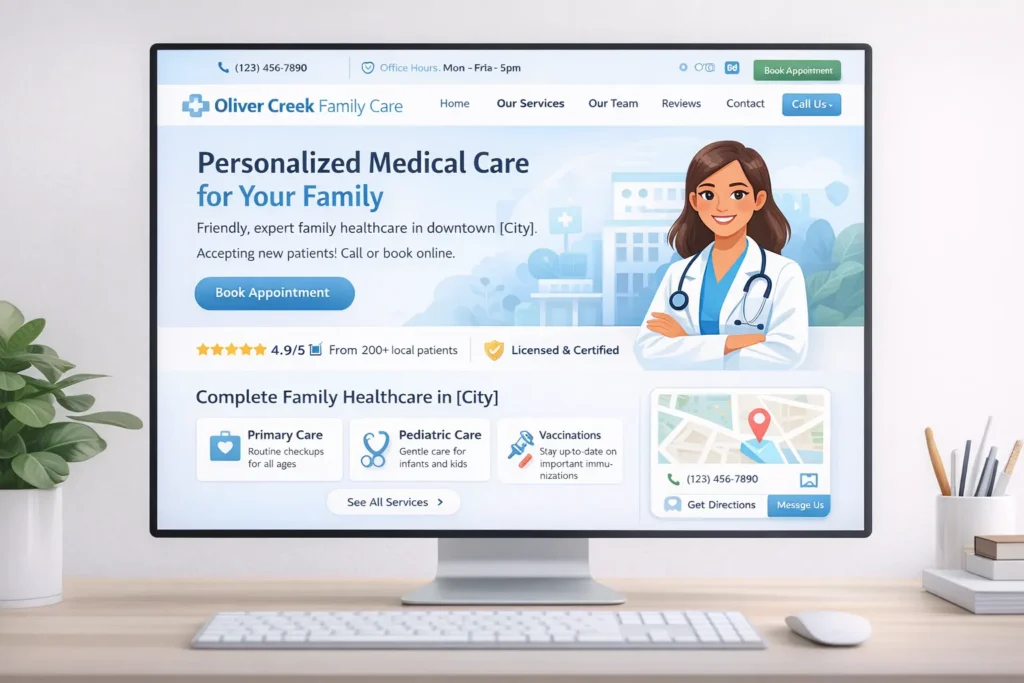
Your homepage should frame the offer clearly. Instead of vague branding language, lead with the primary service, location, audience, and outcome. For example, a small clinic should not say “Compassionate care for every stage of life” and stop there. It should explain the type of care, who it serves, and how to book.
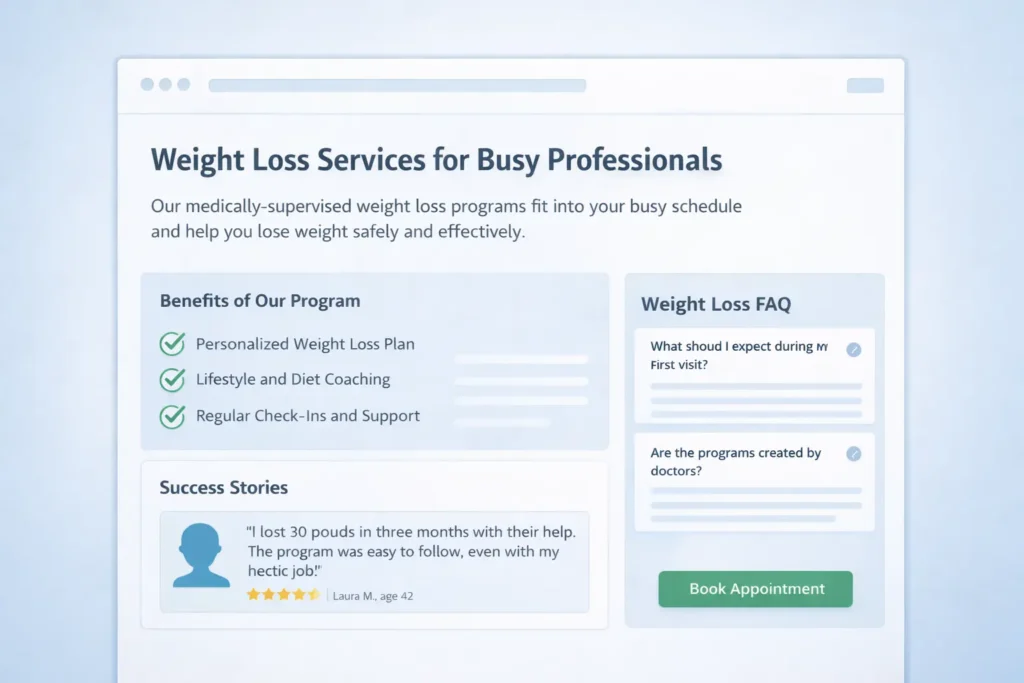
Your service pages matter even more. These pages should target one main service each, explain who the service is for, outline the process, answer objections, and include a local trust layer such as credentials, experience, or real patient concerns.
Your about page should make the business feel real. In healthcare, people want a face, philosophy, and reason to trust the provider behind the service.
Your contact page should do more than list a phone number. It should reduce friction with a simple form, a clickable phone number, hours, map details, and a direct call to action.
A blog or resource hub adds depth when it is strategic, not random. Google recommends content that is helpful and created for people first, not pages made mainly to manipulate rankings. That means educational content tied to real patient questions tends to be more useful than thin keyword pages.
Must-Have Trust Signals
Healthcare buyers look for reassurance before they convert. The strongest websites make trust easy to verify.
| Website Element | Why It Matters | Best Use on the Page |
|---|---|---|
| Provider credentials | Builds authority quickly | Above the fold, about page, service pages |
| Real testimonials | Reduces hesitation | Homepage, service pages, footer |
| Clear contact info | Improves confidence and conversions | Header, contact page, footer |
| Privacy-aware messaging | Reassures cautious visitors | Forms, contact page, footer |
| Service explanations | Lowers confusion | Dedicated service pages |
| Photos of the team or the location | Makes the brand feel real | Homepage, about page, local pages |
This is also where design quality matters. Clean spacing, readable fonts, mobile clarity, and obvious buttons are not cosmetic extras. They influence whether visitors stay long enough to act.
A practical tip here is to review every important page and ask one question: “Can a first-time visitor understand the offer and next step in under 10 seconds?” If not, rewrite the hero, simplify the menu, or move the CTA higher.
How to Structure the Site for Rankings and Leads
A site can look polished and still miss search opportunities. Ranking well usually comes down to alignment between the page, the query, and the user’s next action.
Start With Search Intent, Not Just Keywords
Healthcare businesses often chase broad terms that are hard to win. A smarter move is to build content around intent buckets such as:
Service intent
Location intent
Comparison intent
Question intent
Problem-solution intent
For example, a clinic may have stronger traction with pages like “pediatric urgent care in [city]” or “weight loss clinic for busy professionals” than with an oversized term like “healthcare services.”
Google’s Search Essentials says to use words people would actually use to look for your content and place those words in prominent locations such as titles, headings, alt text, and link text. It also recommends making links crawlable so Google can discover and understand related pages across your site.
That is where internal linking becomes powerful. Your homepage should support priority services. Your service pages should point to related blogs. Your blogs should guide readers back to the highest-converting service pages.
A natural internal link flow for this topic could look like this: learn about small business web design experts if you are planning a healthcare-specific build, then explore website design & development services if you need a clearer scope for redesign, SEO, speed, or ongoing support.
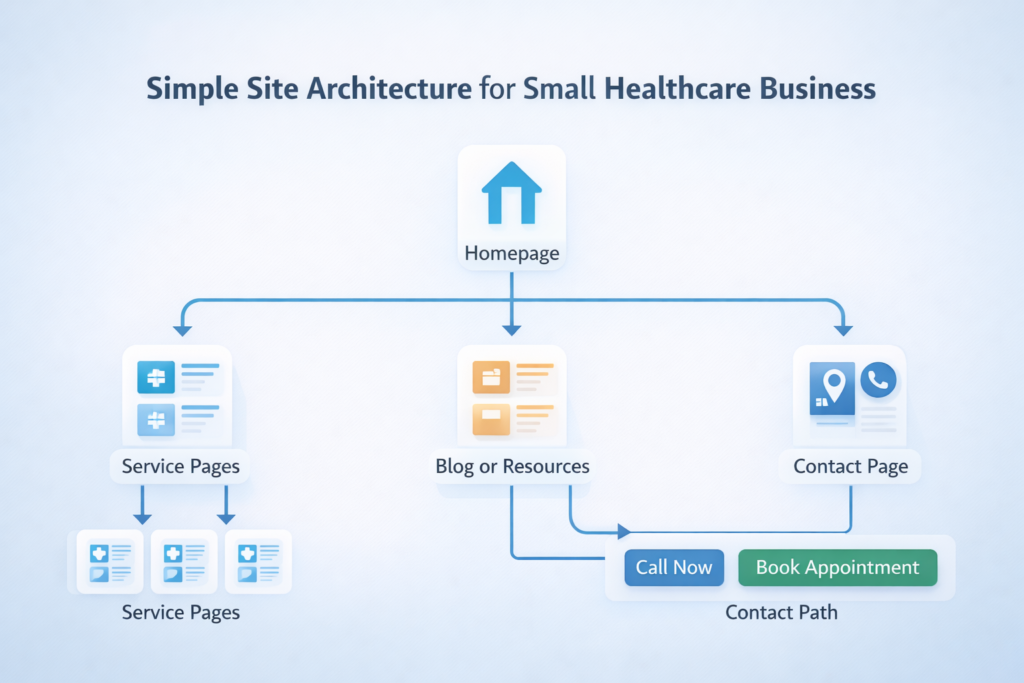
Build a Strong Page Hierarchy
Small healthcare sites usually perform better when they follow a clean structure:
Homepage
Primary service pages
Location pages, if applicable
About
Contact
Blog or resources
Policy pages
That structure helps both users and search engines. It also makes future content easier to scale.
Local SEO Matters More Than Most Owners Realize
Many small healthcare businesses are local by nature. Even if they serve telehealth or hybrid audiences, local trust still matters. Your site should reinforce:
Service areas
Office address or regions served
Consistent contact details
Location-specific copy where relevant
Embedded map or clear directional info
One practical move is to create service pages that mention the audience and local context naturally. Another is to publish blogs that answer nearby search behavior. For example, someone researching a clinic website may also want to study what works in adjacent healthcare niches, which makes resources like medical clinic website design and veterinary clinic website useful supporting reads.
The Features That Make the Biggest Difference
A lot of small businesses overbuild the wrong things. They focus on flashy effects instead of functions that improve trust and conversion.
The most useful features are usually simple:
Fast loading pages
Mobile-first design
Strong page titles and headings
Clear service descriptions
Sticky or repeated CTAs
Simple forms
Online booking if relevant
Click-to-call on mobile
FAQ sections
Trust indicators near forms
Accessible design choices
HHS web guidance for writing online content stresses knowing your audience, removing needless wording, and following accessibility best practices. That is especially relevant in healthcare, where clarity directly affects user comfort and decision-making.
Features vs Priority Table
| Feature | Priority for Small Healthcare Businesses | Why |
|---|---|---|
| Mobile responsiveness | Essential | Most visits begin on phones |
| Fast load speed | Essential | Slow pages lose trust and traffic |
| Online booking | High | Reduces friction for ready-to-convert users |
| Service-specific landing pages | Essential | Improves rankings and conversions |
| HIPAA-aware contact process | High | Supports privacy expectations |
| Blog content | High | Builds topical authority over time |
| Live chat | Medium | Helpful if staffing allows |
| Patient portal links | Medium to High | Useful if already part of operations |
| Video introductions | Medium | Good for trust, not mandatory |
| Animation effects | Low | Nice to have, rarely a ranking driver |
The best setup is often the one patients can use easily without thinking about it.
How a Small Healthcare Business Can Rank Higher on Google
Ranking higher is rarely about one trick. It is usually the result of doing the fundamentals better than competitors.
Start with pages that match commercial intent. Your homepage should target the main category and market position. Each core service should have its own page. Then support those pages with blogs that answer patient questions and link back to the service.
Next, tighten on-page SEO. Use descriptive titles, natural headings, and internal anchors that make the relationship between pages obvious. Google’s documentation specifically points to these basics as foundational, and its guidance for AI search features says the same best practices still apply.
Then improve content depth. Instead of writing generic copy like “we care about your health,” explain your process, ideal patient type, appointment expectations, common concerns, follow-up details, and why your approach is different.
A practical content framework that works well is:
Why the service matters
Who it helps
How the process works
What to expect
When to seek help
Why choose your practice
That structure supports both SEO and conversion because it mirrors real search behavior.
You should also make your links work harder. Supporting articles can educate while pushing authority to conversion pages. For example, a practice improving its digital presence can compare niche-specific examples, such as vet website design, when planning layout, CTA placement, and trust content.
For additional guidance, it is worth reviewing Google’s SEO Starter Guide and the HHS page for small providers and small businesses, both of which add useful context for discoverability and privacy-conscious operations.
Custom Website or Template: Which Is Best?
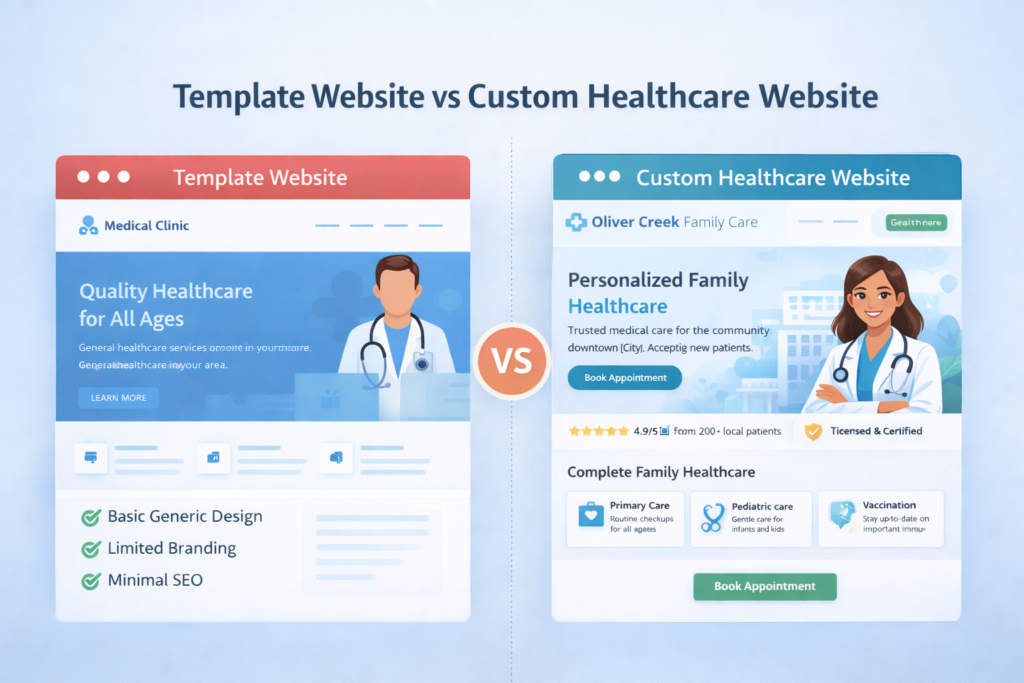
This is where many small healthcare brands get stuck. Templates are faster and cheaper upfront. Custom builds are more flexible and more strategic when growth matters.
A template can work when the business is new, the services are simple, and the goal is to launch a clean site without custom functionality. It is also practical if you already know the structure you need and just want a polished version of it.
A custom build is often better when the business needs stronger differentiation, location or service SEO, a more refined conversion path, or a design that reflects a higher-trust healthcare brand.
Here is the simplest way to decide:
Choose a template if you need speed, lower cost, and a basic presence.
Choose custom if you need rankings, scalability, stronger trust signals, and better conversion performance.
A template saves time, but it often carries limitations in layout flexibility, speed tuning, content hierarchy, and long-term SEO expansion. A custom build lets you shape the site around your exact services, brand voice, and growth plan.
Common Mistakes That Hurt Performance
The first big mistake is writing like every other healthcare site. Generic copy blends in and weakens trust.
The second is combining too many services on one page. That makes it harder to rank and harder for visitors to know where to click.
The third is weak internal linking. If your blogs do not guide readers toward service or contact pages, you lose SEO support and conversion momentum.
The fourth is using forms that ask too much too early. A short, reassuring form usually beats a long, intimidating one.
The fifth is treating compliance and privacy language as an afterthought. Even a simple footer, policy setup, and careful wording around forms can make the site feel more trustworthy.
Final Thoughts on the Best Path Forward
The best healthcare website for small business is not the one with the most pages or the fanciest design. It is the one that earns trust fast, explains services clearly, supports privacy expectations, and guides visitors toward the next step without friction.
If you want stronger rankings, stronger local visibility, and better conversion quality, build around clear service intent, patient-friendly content, thoughtful internal links, and a design that feels credible from the first screen. That is what turns a small healthcare site into a steady growth channel.
Frequently Asked Questions
1. Why does a small healthcare business website matter?
A strong healthcare site builds trust before the first call or appointment. People searching for care often compare several providers in a short time, so your website helps them decide whether your business feels credible, current, and easy to contact. It also gives you control over your messaging, your services, and your local visibility. When the site is clear, fast, and helpful, it supports better conversions and better search performance at the same time.
2. What should a small healthcare business site include?
The essentials are clear services, trust signals, and an easy next step. At minimum, the site should include a focused homepage, dedicated service pages, an about page, contact details, strong calls to action, and privacy-aware forms or messaging. It should also show proof such as credentials, reviews, team photos, or process explanations. For growth, add educational blog content and internal links that connect informational pages to revenue-driving services.
3. How can a small healthcare business improve its Google visibility?
Better rankings usually come from better structure and better content alignment. Start by giving each core service its own page, then support those pages with helpful blog posts that answer real patient questions. Improve titles, headings, internal links, page speed, and mobile usability. Keep the writing specific instead of generic, and make the next action obvious. Over time, this creates stronger topical relevance, stronger user signals, and better conversion intent.
4. Is custom development better than using a template for a small healthcare brand?
Custom is usually better when you need flexibility, SEO depth, and stronger differentiation. A template can work for a quick launch or a limited budget, especially if your services are simple. But a custom site is often the better long-term choice when your business needs local landing pages, stronger conversion flow, better speed tuning, or a more distinctive healthcare brand presence. The right answer depends on your stage, goals, and how much growth you want the site to support.