Medical clinic website design should make it easy for patients to trust your practice, understand your services, and book an appointment without friction. The best clinic websites are clear, fast, mobile-friendly, and built around real patient questions, not just visual style.
A strong clinic website does more than look clean. It supports growth by helping new visitors move from concern to action. That usually means finding the right service page quickly, checking insurance or location details, reading provider information, and booking with confidence. When those steps feel simple, the website starts working like a front desk that never closes.
That is also why modern healthcare sites need to balance three things at once: patient trust, usability, and search visibility. Google continues to emphasize helpful, people-first content, while healthcare topics fall into a category where clarity, credibility, and accuracy matter even more.
If your current site feels dated, slow, or hard to navigate, the problem is rarely just design. In most cases, the issue is that the website is not guiding patients toward the next step clearly enough. A better structure, better messaging, and better local SEO usually have a bigger impact than adding more pages.
Why a better clinic website matters for patient growth
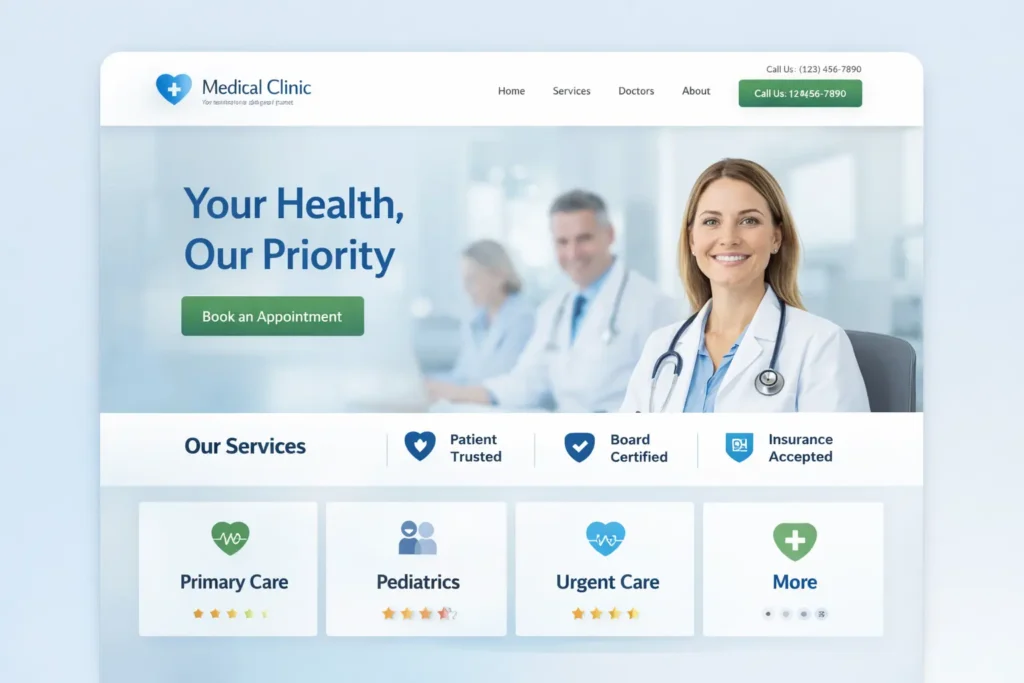
When someone lands on a clinic website, they are often trying to solve a specific problem. They may want same-week availability, directions, accepted insurance, or reassurance that your team treats their condition. If they cannot find that answer quickly, they leave.
That is why the best-performing clinic sites focus on patient intent first. They remove guesswork. They explain services in plain language. They show where the clinic is, who it helps, and what the next step looks like.
This matters for growth because trust is built before a patient ever calls. A polished site alone is not enough. Patients want signs that the practice is established, responsive, and easy to work with. Helpful service pages, strong calls to action, provider bios, testimonials, and updated contact details all help reduce hesitation.
For medical practices, this trust layer is even more important because users often compare several providers before booking. Official health resources also show that people evaluate healthcare providers based on issues like location, hours, coverage, and whether the service feels like a good fit.
A website that supports patient growth usually does these things well:
✅ Explains what the clinic treats
✅ Makes booking visible on every key page
✅ Works smoothly on mobile
✅ Shows proof of experience and credibility
✅ Helps the clinic appear in local search
If you want to see how healthcare-specific positioning changes the page flow, review this animal hospital website design example and compare how service clarity and trust signals are placed near conversion points.
What should be included on a medical clinic website
A medical clinic website should feel complete without feeling crowded. Patients do not want to hunt for information. They want a clear path.
Here is a simple view of what matters most.
| Website Element | Why It Matters |
|---|---|
| Clear hero section | Helps visitors understand who you help and what to do next |
| Appointment CTA | Turns traffic into calls, forms, or bookings |
| Service pages | Improves SEO and answers specific patient needs |
| Provider bios | Builds trust and credibility |
| Insurance and payment info | Reduces friction before contact |
| Location, hours, and map | Supports local SEO and patient convenience |
| Reviews or testimonials | Adds social proof |
| FAQ section | Captures search intent and supports AI summaries |
The homepage should act like a guide, not a brochure. It should quickly answer: who you are, what you offer, where you are, and how to book. Many clinic websites bury these basics below sliders, stock photos, or vague copy. That creates an unnecessary drop-off.
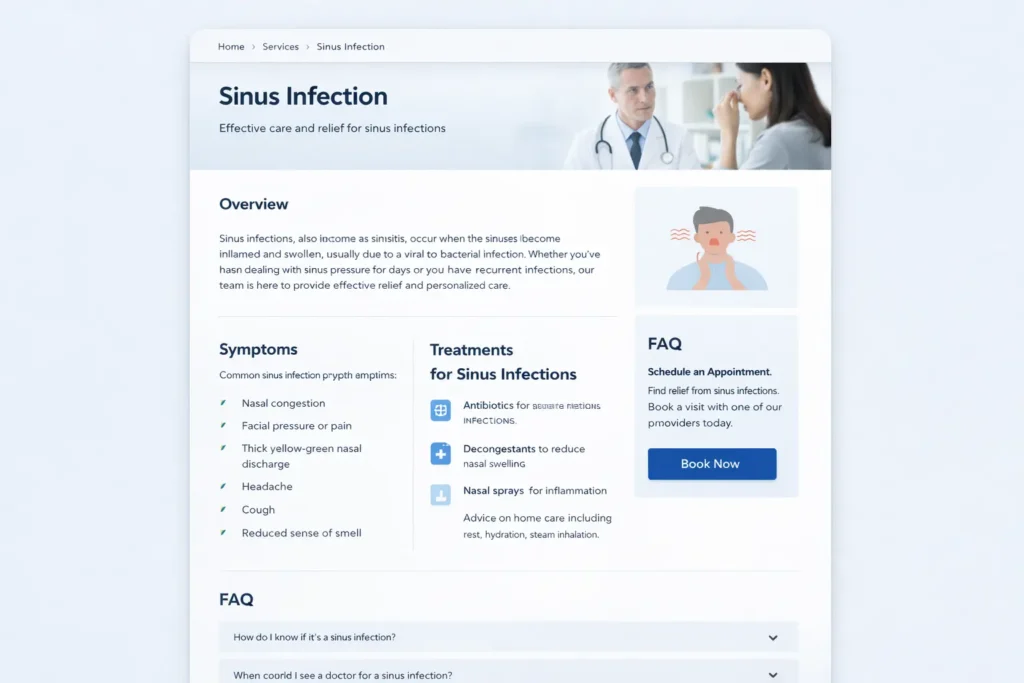
Service pages are especially important. Instead of one generic treatments page, stronger websites create individual pages for each high-intent service. For example, urgent care, family medicine, physical exams, pediatric care, women’s health, or dermatology should each have its own page when relevant. This gives search engines a clearer context and gives patients faster answers.
Provider bios should also do more than list credentials. They should humanize the practice. A strong bio often includes specialties, experience, clinical interests, education, and a short welcoming note. That combination supports trust and can help patients feel more comfortable before a first visit.
You can also study broader conversion structure examples from our studio to see how messaging, calls to action, and page hierarchy can be adapted for local service brands.
How clinic website design affects SEO
Design affects SEO more than many practices realize. It is not only about keywords on a page. It is also about whether search engines and users can move through the site easily.
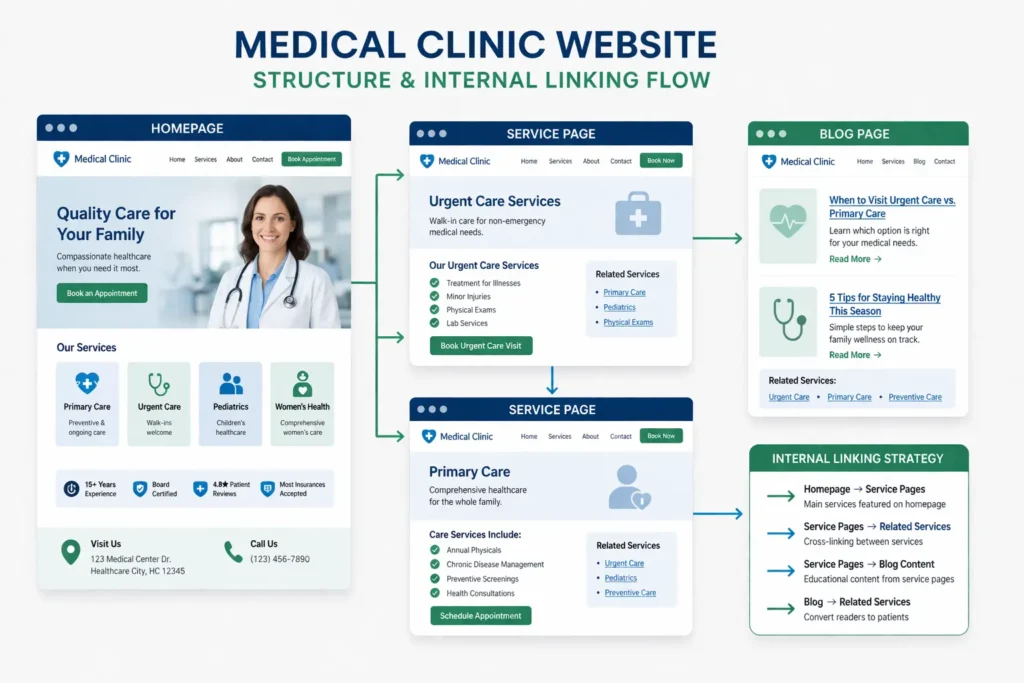
A good structure supports SEO in several ways. First, it helps search engines understand page relationships. Second, it improves engagement because patients can find answers faster. Third, it increases the chances that individual service pages rank for specific local queries.
For healthcare websites, this usually means building a content system around service intent and local relevance. A homepage may target the main city and brand terms, while service pages target treatment keywords, and blog articles answer informational searches.
Here is how design choices connect with SEO performance:
| Design Choice | SEO Impact |
|---|---|
| Fast mobile load speed | Helps usability and search visibility |
| Clear page hierarchy | Improves crawlability and topical structure |
| Dedicated service pages | Targets higher-intent keywords |
| Internal linking | Distributes authority and supports discovery |
| FAQ sections | Expands semantic relevance and answer visibility |
| Local contact details | Reinforces local business signals |
Google’s own guidance emphasizes helpful, reliable, people-first content and encourages creators to think about the “Who, How, and Why” behind the content. For a clinic, that means content should clearly reflect who provides care, how the site helps patients make decisions, and why the information exists in the first place.
This is also where internal links matter. Linking between service pages, condition pages, and relevant blogs helps both users and search engines understand topical depth. For example, a dental or specialty clinic can strengthen relevance by connecting its core services with educational content, like dental clinic website design when discussing niche healthcare web strategy.
The best layout for a clinic homepage
The homepage should not try to explain everything. It should guide visitors on the right path quickly.
A practical homepage layout often looks like this:
1. A direct hero section
Lead with one clear promise. Avoid generic lines like “quality care for everyone.” Be specific about the clinic type, patient audience, and location. Pair that with one strong CTA, such as Book an Appointment or Call the Clinic.
2. Quick trust signals
Place credibility markers early. These can include years in practice, review highlights, accepted insurance groups, accreditations, or provider credentials.
3. Core services overview
Feature your top services in a clean grid or card section. Each one should link to a dedicated page.
4. About the team
A short clinic summary with one or two provider photos helps the site feel more personal and established.
5. Booking and contact block
Include phone, address, hours, and a booking option before the footer. This is especially useful on mobile.
6. FAQ or patient resource section
A short FAQ helps answer common concerns and can improve search coverage for real-world questions.
7. Footer with essential utility links
Include contact details, map, forms, and important policy pages.
This kind of page flow works because it respects how patients scan. They usually start with “Do you offer what I need?” then move to “Can I trust you?” and finally to “How do I contact you?”
If your website already has traffic but weak conversions, the issue is often here. The homepage may be attractive, but it is not focused enough. A stronger messaging hierarchy and a cleaner path to inquiry usually improve results faster than adding more decorative design.
Which pages are most important for ranking and conversions
Not all pages carry the same weight. Some pages attract traffic. Others close the gap between interest and action. The best clinic websites treat both as important.
The pages that usually matter most are the homepage, top service pages, location pages if applicable, provider bios, contact page, and a focused blog. Each serves a different purpose.
Your homepage builds authority and supports branded or local discovery. Service pages target high-intent searches and explain the care path. Provider pages help patients feel safe booking. Contact and appointment pages reduce friction. Blog content captures questions earlier in the research journey.
A practical breakdown looks like this:
✅ Homepage for brand trust and local relevance
✅ Service pages for commercial intent
✅ Blog posts for informational searches
✅ Provider pages for credibility
✅ Contact page for conversion completion
This is where a lot of clinics underperform. They put too much detail into the homepage and not enough depth into service pages. Ranking usually improves when each major service gets its own useful, locally relevant page with strong internal linking and a clear call to action.
A broader content hub can also support this. Linking naturally to your website design & development services page or to educational content in the main blog can strengthen topical paths without making the article feel forced.
What makes a clinic website trustworthy
Trust online is built through small signals repeated consistently. A clean layout helps, but credibility usually comes from the details.
Patients want to know who is behind the practice. They want to see real names, real services, real contact details, and signs of ongoing care quality. Vague claims, thin service descriptions, or outdated office information can quietly damage trust even if the design looks modern.
The strongest trust signals for clinics usually include provider bios, recognizable credentials, updated hours, real office photography, patient reviews, and clear privacy or contact policies. In healthcare, this matters because users often need enough confidence to share personal information or make an appointment.
Helpful external resources can support that credibility, too, when they are used naturally. For example, linking to Google’s guidance on helpful, reliable, people-first content can reinforce content quality standards, while a patient-focused reference like MedlinePlus on choosing a doctor or health care service fits naturally in educational healthcare content.
A trustworthy clinic website also avoids overcomplication. It does not make patients decode medical language or search for key answers. It explains care in a way that feels professional but approachable.
How much does a clinic website usually cost?
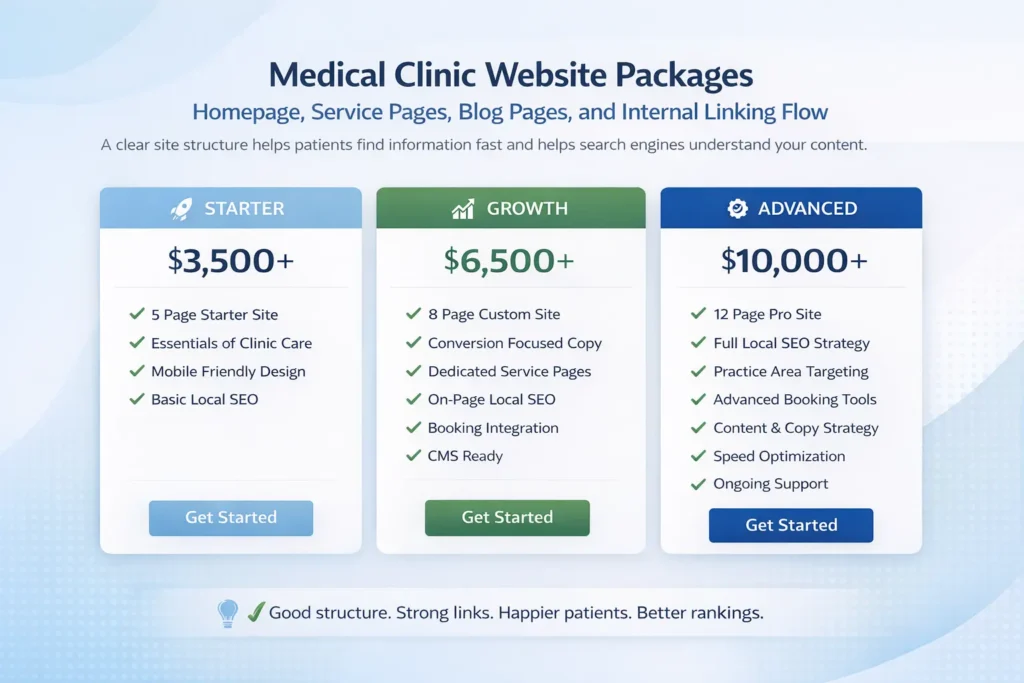
Cost depends on scope, not just design quality. A small clinic brochure site costs less than a conversion-focused website with custom service pages, booking integration, local SEO setup, copywriting, and technical optimization.
In practice, pricing usually rises based on the number of templates, the number of service pages, content needs, migration work, and whether the project includes strategy. That is why two websites can look similar on the surface but perform very differently after launch.
A simple, low-cost build may give you a basic online presence. A stronger custom build is more likely to improve visibility, trust, and bookings over time. For many clinics, the better question is not “What is the cheapest option?” but “What version helps us acquire patients more efficiently?”
A useful way to think about cost is this:
- Lower-budget option: simpler layout, fewer custom pages, lighter SEO foundation
- Mid-range option: custom messaging, stronger structure, optimized service pages
- Higher-end option: full strategy, conversion copy, advanced local SEO, custom integrations
The best option depends on where your clinic is today. If you are launching a new practice, a clean, focused site with strong essentials may be enough. If you already have traffic and weak conversions, investing in strategy, copy structure, and service-page SEO is usually the smarter move.
Common mistakes that hold clinic websites back
Many clinics do not have a traffic problem first. They have a clarity problem.
A few common mistakes show up repeatedly: generic headlines, weak service pages, poor mobile spacing, hard-to-find contact details, and no clear local intent. Another issue is relying on one all-purpose treatments page instead of building individual pages around what patients are actually searching.
Some sites also overuse stock imagery and underuse real proof. A homepage with polished visuals but no provider detail, no service depth, and no clear booking flow often feels less trustworthy than a simpler site built around patient needs.
The good news is that these issues are fixable. In many cases, better page hierarchy, better messaging, and stronger internal linking produce noticeable improvements without needing a full rebuild.
Closing thoughts on building the right clinic site
A good clinic website should help patients feel informed, comfortable, and ready to take the next step. Medical clinic website design works best when it combines trust, clarity, and local SEO into one simple experience that supports real patient decisions.
That is why the strongest clinic websites are not just visually modern. They answer the right questions, structure information cleanly, and guide people from search to scheduling without confusion. When that happens, medical clinic website design becomes a growth tool, not just an online placeholder.
Frequently Asked Questions
1. Why does a clinic website matter for patient growth?
It directly affects trust and conversion. A clinic website often creates the first impression before a phone call ever happens. If the site is clear, modern, and easy to use, patients are more likely to stay, explore services, and book. If it feels outdated or confusing, many will leave and compare another provider instead. Growth comes from making the path from search to appointment feel simple and reassuring.
2. What should a clinic website include?
It should include the pages and details patients actually need to act. That usually means a strong homepage, individual service pages, provider bios, contact details, hours, location information, booking calls to action, and a helpful FAQ section. You can also improve performance with patient reviews, insurance information, and clear internal links. The goal is to reduce uncertainty so visitors can move forward confidently.
3. How does design influence SEO for a clinic website?
Design supports SEO through structure, usability, and relevance. Search visibility is stronger when your website loads well on mobile, has clear navigation, and uses dedicated pages for major services. Good design also helps users stay engaged longer because they can find answers faster. For clinics, that means your layout is not just visual. It helps search engines and patients understand the site more clearly.
4. How much does a clinic website usually cost?
The price depends on the level of strategy and customization involved. A basic website can be relatively affordable, but a stronger build with custom copy, local SEO, service-page structure, and booking integration will cost more. Clinics should compare value, not just price. A cheaper site may save money upfront, but a better-planned website often delivers stronger patient inquiries and longer-term growth.