
How to rank small business website starts with a site that is easy to understand, easy to use, and easy for Google to crawl. When your design supports search intent, mobile usability, local relevance, and clear conversion paths, rankings usually improve alongside lead quality.
A lot of small business owners think ranking is only about keywords. It is not. A beautiful site that loads slowly, hides its services, or sends every visitor to one generic page will struggle no matter how polished it looks. The websites that usually win are the ones that explain what they do, where they work, who they help, and what the next step should be.
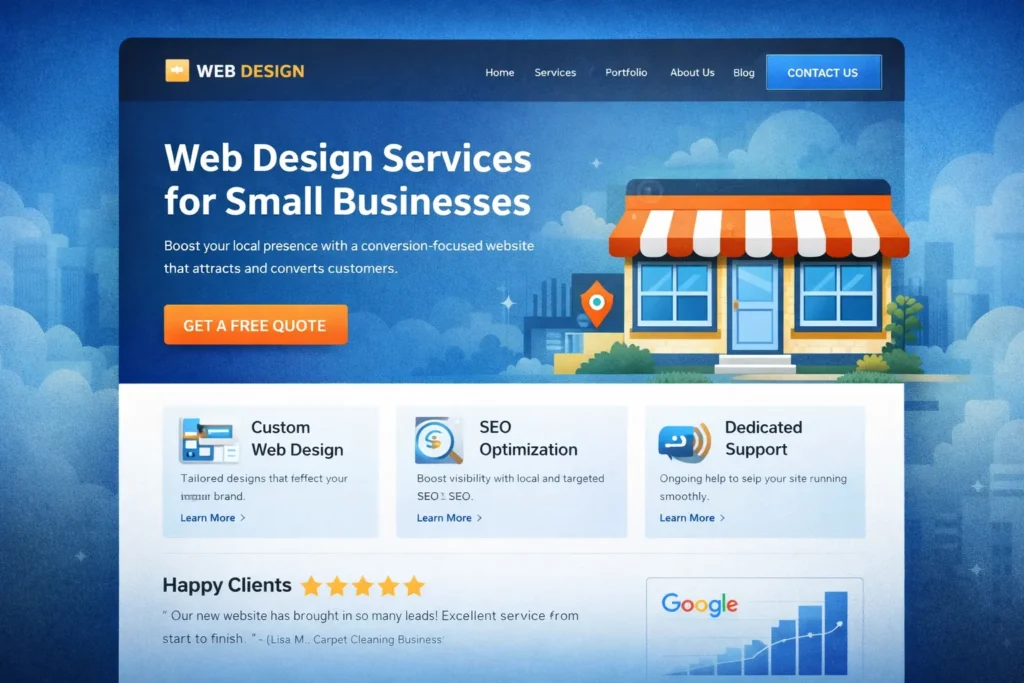
Why Most Small Business Websites Do Not Rank Well
Many small business sites are built like online brochures. They look decent, but they do not answer the questions a customer is typing into Google.
A homepage that says “Welcome to Our Business” is not helping search engines or people. A better homepage says exactly what the business does, who it serves, and where it serves them. For example, “Web Design for Local Service Businesses in Florida” is clearer than a vague brand statement with no context.
The same issue happens deeper in the site. Some businesses place every service on one page, every city on one line, and every CTA in the footer. That creates weak relevance. Google is better at understanding pages when each page has a distinct purpose, clear headings, useful content, and logical internal links. The official Google’s SEO Starter Guide still points to page clarity, helpful titles, and crawlable structure as core basics.
Another problem is the mobile experience. Google uses the mobile version of a site for indexing and ranking, so a site that looks fine on desktop but feels cramped, slow, or broken on mobile is already at a disadvantage. That matters even more for local service businesses, because many buyers search on their phones when they need help fast.
Here is where many sites lose traction:
| Common issue | What users and Google see | Better design fix |
|---|---|---|
| One generic homepage | Unclear service relevance | Add clear service-led sections and location relevance |
| No dedicated service pages | Thin topic coverage | Create separate pages for each core service |
| Slow mobile load times | Friction and drop-offs | Compress images, simplify layouts, and reduce heavy scripts |
| Weak trust signals | Low confidence | Add reviews, portfolio, process, and real business details |
| Poor internal linking | Harder discovery | Link homepage, services, blogs, and portfolio naturally |
If your current site feels too broad, too thin, or too template-heavy, your best move is usually to rebuild around user intent, not just appearance. That is exactly where strong website design & development services can create a ranking advantage.
What Google and Customers Both Need to See
A small business website does not need to be huge to rank. It needs to be understandable.
Google explains that it usually discovers pages automatically, but it also recommends making content accessible, keeping the site crawlable, and using a sitemap to help search engines find important URLs more efficiently. Submitting a sitemap in Search Console is still only a hint, but it is a useful one.
That means your design should support these basics from the start:
✅ Pages should be linked from somewhere logical
✅ Titles and headings should match the page topic
✅ Navigation should make important pages obvious
✅ Mobile layouts should preserve the same important content
✅ The site should run on HTTPS and load cleanly on phones
This is why “pretty” is not enough. Search-friendly web design is about structure. When a site buries services behind sliders, tabbed content, or fancy animations, it often weakens the very pages that should be doing the ranking work.
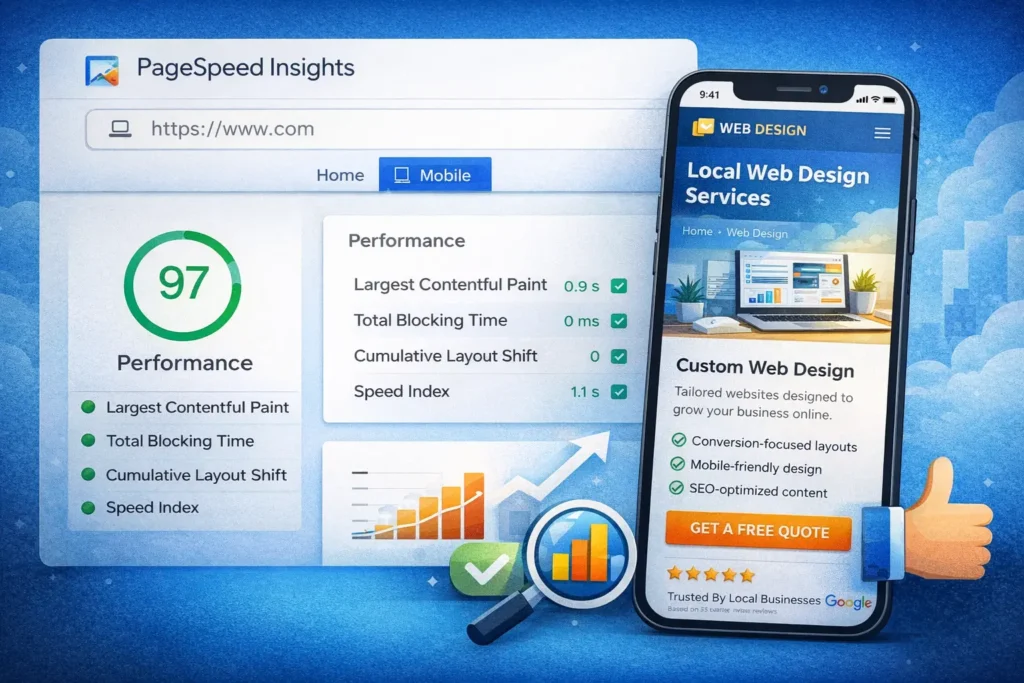
Speed also matters here. You do not need a perfect score, but you do need pages that feel fast and stable. Google’s Search Console guidance around Core Web Vitals and Google’s PageSpeed Insights both reinforce the idea that lighter pages and better mobile performance make sites easier to use and easier to improve.
How to Build Pages That Are Easier to Rank
If you are a web designer or a business owner hiring one, this is the part that matters most. Ranking usually improves when the website is built around page purpose, not just page count.
Your homepage should introduce the business clearly, but it should not try to rank for every service variation by itself. Think of the homepage as the trust-building overview. It should tell visitors what you do, who you help, where you work, and why you are credible. Then it should send traffic deeper into service pages.
Your service pages are where relevance gets stronger. If you design websites for cleaners, contractors, coaches, or clinics, separate pages let you target the real phrases buyers use. A janitorial company does not search the same way a dentist does. That is why topic separation matters.
Location relevance matters too, especially for service businesses. Even if you do not build dozens of city pages, your design should still include local proof. Put your service area, case studies, testimonials, and contact details where users can see them without hunting around.
A portfolio page is often underrated for SEO. It is not only a sales asset. It can support trust, lower bounce risk, and create supporting internal links to related services or industries. A well-built project gallery can do more than showcase visuals. It can help confirm expertise.
This page structure is usually the sweet spot for a small business site:
| Page type | What it should answer | Why it helps ranking |
|---|---|---|
| Homepage | What do you do and who do you help? | Establishes brand, core relevance, and trust |
| Service page | What specific service do you offer? | Builds topical focus for individual keywords |
| About page | Why should someone trust you? | Supports expertise and conversion confidence |
| Portfolio or case study page | What results or examples can you show? | Adds proof and deeper engagement |
| Blog page | What related questions can you answer? | Expands search coverage and internal linking |
A practical example helps. Imagine a local web design company targeting cleaners and home service businesses. Instead of one page called “Our Services,” the better route is a homepage, a main services page, one page for redesigns, one page for maintenance, one portfolio page, and blog content that supports buyer intent. That is the kind of structure that gives search engines clearer pathways and gives visitors better reasons to stay.
If you want a real example of niche relevance, look at content patterns like janitorial website design and local cleaning business websites. Those topics work because they align the offer, the audience, and the page intent instead of trying to speak to everyone at once.
Why Local Proof Matters More Than Most Owners Expect
For a small business, ranking is not only about on-page SEO. It is also about trust, relevance, and proof.
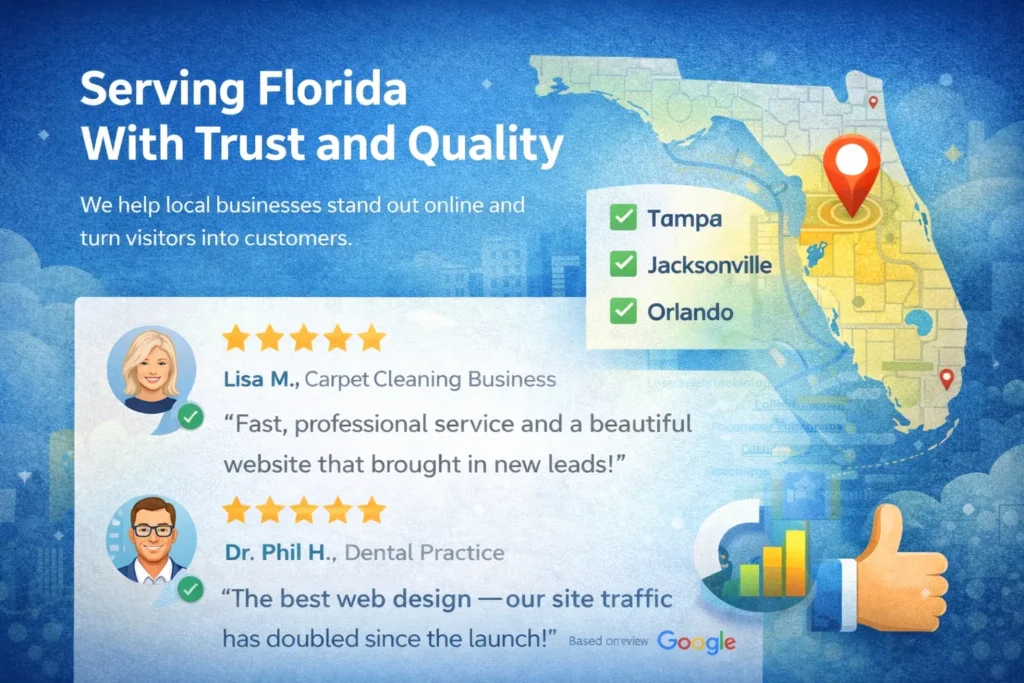
Google Business Profile guidance says local results are mainly based on relevance, distance, and prominence. Your website cannot change distance, but it can absolutely help with relevance and prominence by making your services clearer, your location signals stronger, and your credibility easier to verify.
This is where design directly supports SEO.
A well-ranked local site usually includes:
a visible business name, a real service area, clear service language, review proof, real work samples, and contact details that are easy to find. If those signals are buried or missing, the site feels weaker even if the visual design is stylish.
For example, a homepage hero can mention the core service and target audience. A testimonial section can mention city names naturally. A footer can reinforce service areas and business details. A case study can show before and after outcomes for a real business type. These are design decisions, but they also support discoverability.
Blog content can strengthen that local and topical relevance, too. A useful internal link, such as local SEO for small business website helps connect design decisions with visibility strategy. That matters because good internal linking tells both readers and search engines which pages support each other.
Which Website Design Option Is Best for Ranking
Not every business needs the same website model. This is where a lot of owners either overspend or underbuild.
A one-page website can work if you are validating a new offer, running paid ads to one service, or operating in a very low-competition niche. It is fast to launch, but it limits topical depth. You have fewer opportunities to target separate services, industries, or local search patterns. For ranking, it is usually the weakest long-term choice.
A lean service-led website is the best option for most small businesses. This usually means a homepage, dedicated service pages, an about page, a portfolio or proof page, a contact page, and a few strategic blog posts. It gives you enough structure to rank for real queries without becoming bloated. For most local businesses, this is the best mix of speed, affordability, and SEO flexibility.
A custom growth site is better when the business serves multiple cities, has several service categories, or wants to scale content marketing hard. This approach creates more SEO opportunities, but only if the architecture is planned well. Otherwise, it turns into thin-page clutter.
So which option is best? For most service businesses that want better search visibility and better conversion quality, the winner is the lean service-led site. It is easier to maintain, easier to optimize, and easier for Google to understand.
That is also why so many business owners end up choosing conversion-focused web design instead of generic drag-and-drop templates. The right structure does not just look more professional. It performs more professionally.
A Practical 90-Day Plan After Launch
A good website launch is not the finish line. It is the start of the ranking process.
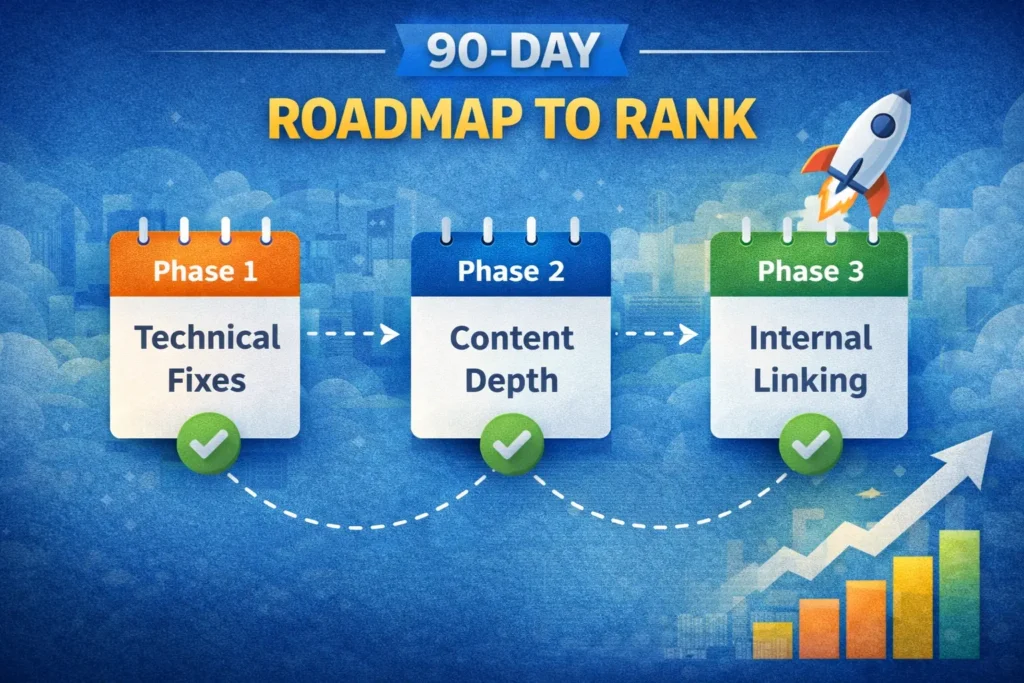
In the first 30 days, focus on technical cleanup. Make sure your site is indexable, mobile-friendly, connected to Search Console, and supported by a valid sitemap. Check for thin pages, broken links, oversized images, and weak title tags. This is the foundation stage, and it matters more than flashy extras.
In days 31 to 60, strengthen page depth. Improve your main service pages, add trust elements, refine calls to action, and publish supporting content that answers buyer questions. This is also the right time to review competitors and see how clearly they present their services, proof, and locations.
In days 61 to 90, start tightening internal links and measuring performance. Which pages are getting impressions? Which service pages hold attention? Which blog posts deserve links from the homepage or service pages? Small improvements here can compound quickly, especially on local sites with low to mid competition.
One practical tip that works well: do not publish five weak blogs just to look active. Publish two or three useful ones that connect directly to the service pages you want to grow. That kind of intent alignment usually performs better than random content volume.
Final Take on How to Rank Small Business Website
The strongest small business websites do not chase rankings with tricks. They earn visibility by being clearer, faster, more useful, and easier to trust. When the design supports service intent, local proof, strong page structure, and smart internal linking, the site becomes easier to rank and easier to convert.
If your current website feels generic, crowded, or hard to grow, the smarter move is not adding more random content. It is rebuilding the structure so every important page has a job. That is the difference between having a site online and having a site that actually brings in qualified leads.
Frequently Asked Questions
1. Can website design really affect Google rankings for a small business?
Yes, website design can affect rankings because it shapes how clearly your content is presented and how easily people can use the site. A strong design improves mobile usability, internal linking, page speed, trust signals, and conversion paths. A weak design can hide important content, slow pages down, and make service relevance harder to understand. Even when two businesses offer the same service, the one with better structure usually gives Google and users a clearer experience.
2. Do I need separate service pages, or can one page rank for everything?
Separate service pages are usually the better choice if you want stronger relevance and better conversions. A single page can become too broad, especially when you offer different services or target different customer needs. Dedicated pages let you match headings, copy, proof, and calls to action to one offer at a time. That makes the page easier to rank for specific searches and easier for visitors to trust when they are ready to contact a web designer.
3. Is a one-page website enough for a local service business?
A one-page website can work in limited situations, but it is rarely the best long-term SEO option for a service business. It can be fine for a brand-new company, a very narrow offer, or a temporary launch. However, it restricts your ability to build topical depth, internal links, and separate trust sections for each service. Most local businesses do better with a compact multi-page site that includes service pages, proof, and a contact flow that feels intentional.
4. How long does it usually take for a redesigned website to improve rankings?
Most redesigned websites need time before rankings improve in a meaningful way. Some technical gains can show up quickly, especially if the old site had crawl, speed, or mobile problems. But stronger gains from better structure, service relevance, and internal linking often take weeks or a few months to build. The timeline depends on competition, content quality, backlink history, and whether the redesign actually made the website clearer, faster, and more trustworthy.