
A janitorial website should prove trust in seconds, show the services and locations you cover, and make it easy for a prospect to request a quote. The best version is fast, mobile-first, locally optimized, and built around proof like certifications, testimonials, scope of work, and clear calls to action.
Too many cleaning sites look polished at first glance, but still lose leads because the messaging is vague, the navigation is cluttered, and the quote button feels like an afterthought. When the structure is clear, and the copy speaks to real buying concerns, your website stops acting like an online brochure and starts acting like a sales tool.
Read on to see why this matters, how to structure the pages, and which website option makes the most sense if you want a stronger return from your traffic.
Why this matters for janitorial brands
Janitorial buyers rarely make decisions the same way casual shoppers do. A homeowner may want a quick impression and a simple booking path, but a property manager, office administrator, school director, or facility lead often wants more reassurance before making contact. They look for consistency, professionalism, response time, service coverage, proof of results, and signs that your team can handle an ongoing contract without creating more work for them.
That is why the site should answer trust questions before the visitor even asks them. Are you insured? What kinds of facilities do you clean? Do you handle recurring service, floor care, deep cleaning, day porter work, or post-construction cleanup? Can a visitor understand your service area in a few seconds? Can they request a walkthrough without hunting through the menu? Strong janitorial web design makes these answers obvious.
Google also says its ranking systems are designed to prioritize helpful, reliable, people-first content, and its Search Essentials outline the technical requirements, spam policies, and best practices that support visibility in Search. For a cleaning company, that means real service detail, real local relevance, and real proof will beat thin, keyword-stuffed copy every time.
The sections that matter most
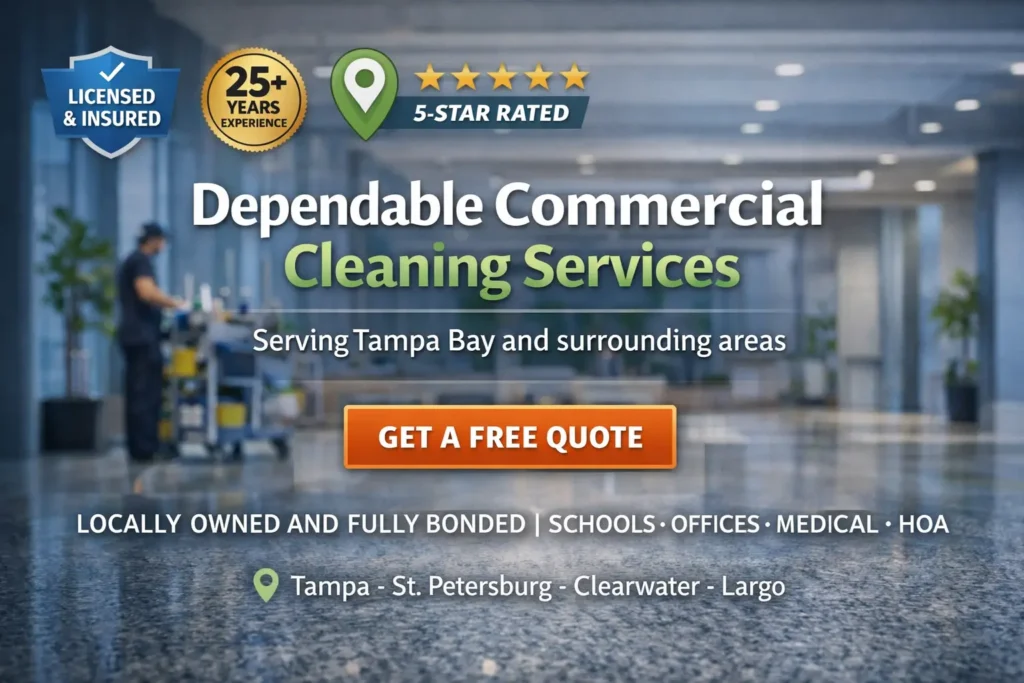
A high-converting cleaning site does not need to be complicated, but it does need the right blocks in the right order. The goal is to remove doubt, build confidence, and create a simple next step.
| Website Section | Why It Matters | What To Include |
|---|---|---|
| Hero section | Creates the first impression fast | Clear headline, service area, CTA, phone number |
| Trust strip | Reduces hesitation | Insured, bonded, years in business, industries served |
| Services overview | Helps visitors self-identify | Office cleaning, floor care, disinfection, porter service, specialty work |
| Process section | Makes the company feel organized | Consultation, site walkthrough, proposal, start date |
| Testimonials or proof | Builds credibility | Reviews, client logos, before-and-after visuals, case snippets |
| Quote form | Converts intent into action | Name, company, property type, frequency, ZIP, preferred contact |
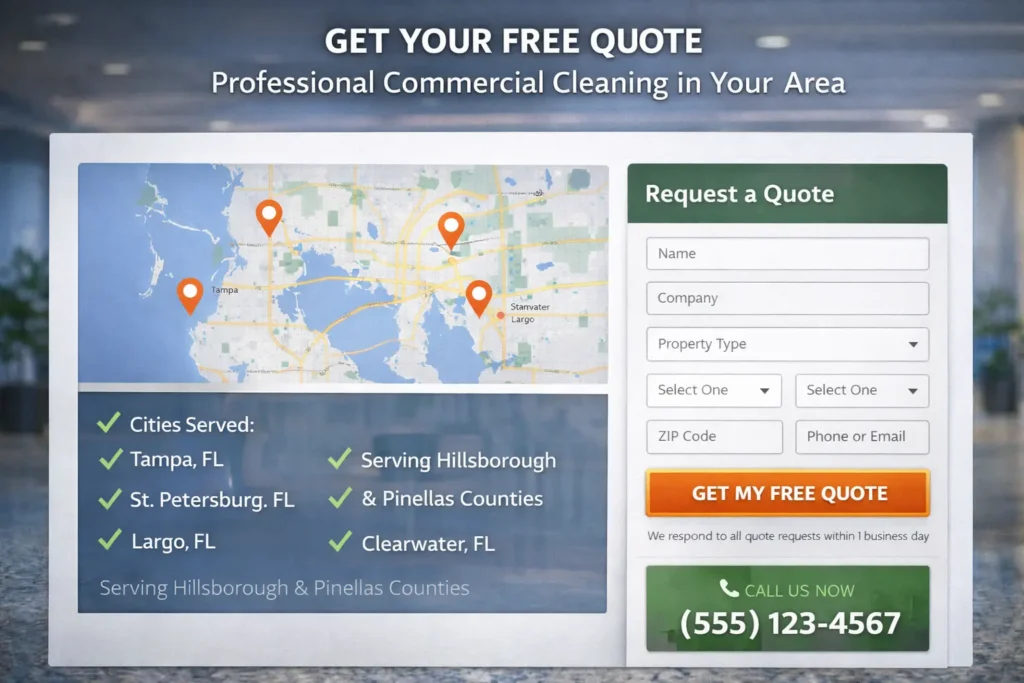
| Service area section | Supports local SEO and user clarity | Cities served, map cues, local landing pages |
| FAQ | Handles objections | Pricing questions, scheduling, scope, supplies, contracts |
This is also where design and copy need to work together. A sleek layout alone is not enough. If the copy only says “quality cleaning at affordable prices,” it sounds like every other competitor in the market. What wins is specificity. Talk about the buildings you serve, the cleaning standards you follow, the hours you operate, and the outcomes buyers care about, whether that is cleaner restrooms, more consistent floor appearance, or a more reliable after-hours crew.
What a janitorial website needs to convert
The homepage should lead with the business outcome, not just the service label. Instead of a generic line about “professional cleaning,” lead with what the buyer gets: dependable commercial cleaning for offices, medical spaces, schools, retail, or multi-site properties. That shift makes the site feel more serious and more relevant from the first screen.
After that, the strongest layout usually follows a simple pattern. Start with the offer and the area you serve. Move into credibility. Show services in a scannable way. Explain the process. Add proof. Finish with a quote form and a strong call to action. This structure works because it answers the exact flow most visitors follow in their heads: “Can you do the work? Can I trust you? What do you offer? What happens next?”
A separate service page strategy matters just as much. If you offer office cleaning, floor stripping and waxing, post-construction cleanup, day porter service, school cleaning, or medical office cleaning, each one deserves its own page. Not because you need more pages for SEO, but because each service has a different buyer concern, a different sales angle, and a different set of proof points. The more specific the page, the easier it becomes to rank and convert.
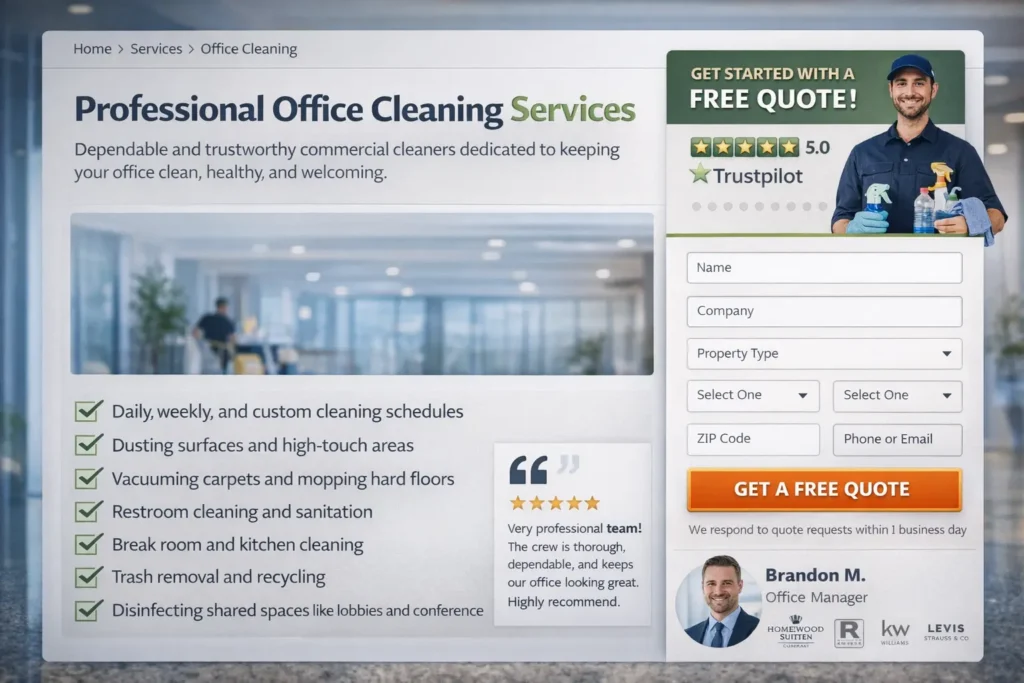
A good quote form is also shorter than many companies think. You do not need to ask everything on the first interaction. Ask for just enough to qualify the lead: contact name, company, property type, size estimate or square footage range, service frequency, ZIP code, and preferred contact method. That keeps the form useful without feeling like homework.
This is where a strategic build beats a random template. Templates often stack sections because they look nice in a demo. A conversion-focused site arranges sections because each block reduces friction and moves the visitor closer to action. If you are positioning your business for larger commercial contracts, that difference matters.
If you want to see how cleaning niches shift the page angle, compare the messaging flow in house cleaning website examples, the positioning inside this commercial cleaning website design guide, and the service framing from these maid service website ideas. They are different markets, but they show how smart structure changes with buyer intent.
Local SEO, speed, and trust signals that actually help
For most cleaning companies, local visibility is part of the design job, not something added later. Many janitorial brands operate as service-area businesses. Google Business Profile explains that service-area businesses can define the places they serve by city, postal code, or another area type, and if they do not serve customers at their business address, they should remove that address from the profile. That matters because the website and the profile should support the same local footprint instead of sending mixed signals.
That is why location pages need to be handled carefully. A page for “office cleaning in Tampa” should not be a copied page with the city swapped out. It should mention the service context, types of facilities, scheduling patterns, and trust elements relevant to that location. Helpful local content is stronger than doorway-style pages, and it aligns better with Google’s people-first guidance.
Speed is part of conversion, too. Google defines Core Web Vitals as real-world measures of loading, interactivity, and visual stability, and recommends good results for search success and overall user experience. PageSpeed Insights reports these signals, including LCP, INP, and CLS, which makes it a practical tool to run after launch on your home, service, and city pages.
For that reason, it makes sense to blend in resources like PageSpeed Insights during the build process, not only after the site goes live. And if your company visits clients at their locations instead of serving them in-store, Google’s service-area business guidance is worth reviewing while you plan your contact page, footer details, and local signals.
Structured data is another quiet win. Google says LocalBusiness structured data can communicate details like business hours, departments, and reviews, which can help search engines understand your business information more clearly. It is not a substitute for strong design or strong copy, but it supports the overall clarity of the site.
Which option is best if you want more leads?
The answer depends on where the business is today.
If you are a newer operator with a tight budget, a simple launch site can work as a short-term starting point. The key phrase there is short-term. A basic site can help you get online, collect a few testimonials, and prove demand. But it often reaches its limit quickly, especially once you want to rank in multiple cities, separate residential from commercial offers, or position for larger accounts.
If you already have a site and it gets some traffic, a strategic redesign is usually the best value move. You keep what is working, fix what is underperforming, tighten the copy, improve the structure, and build stronger conversion paths. This is often the sweet spot for established janitorial companies because it avoids a total reset while still upgrading the parts that actually affect leads.
If you want to compete harder for commercial contracts, multi-location visibility, or a more polished brand presence, a custom conversion-focused build is usually the strongest option. It gives you better control over service architecture, location pages, trust signals, visual proof, and calls to action. It also gives the content room to sound like your business instead of a generic cleaning template.
| Option | Best For | Main Advantage | Main Limitation | Best Use Case |
|---|---|---|---|---|
| DIY template | New businesses with a minimal budget | Fast to launch | Generic layout and weaker conversion flow | Temporary starter site |
| Redesign | Existing sites with some history | Improves leads without rebuilding everything | Limited by the old structure if the foundation is weak | Best value for most established companies |
| Custom build | Brands chasing stronger growth | Full control over structure, content, SEO, and UX | Higher investment | Best long-term option for serious local lead generation |
For most businesses in this space, the best applicable option is not the cheapest one. It is the one that matches the revenue goal. If you only need a web presence, a starter site is fine. If you want better quote quality, stronger local visibility, and a site that supports sales conversations, a redesign or custom build is usually the smarter choice.
That is also where growth-driven web design becomes more useful than a pretty template. If you are already comparing providers, your next step should be checking website design & development services and reviewing real portfolio highlights so you can judge how the work handles trust, structure, and lead flow in practice.
Common mistakes that keep cleaning sites from ranking and converting
One of the biggest mistakes is trying to speak to everyone on the same page. Residential visitors and commercial buyers do not think the same way. If the homepage mixes maid service language, janitorial contract language, and post-construction cleanup all in one loose message, the site becomes harder to trust. Clearer segmentation nearly always performs better.
Another issue is relying too heavily on stock visuals without proof. Buyers do not just want “clean” branding. They want signs of operational maturity. That can be before-and-after photos, team standards, quality control checklists, client sectors, or a short case study about how you reduced complaints or improved consistency at a property. Clean design helps, but proof closes the gap between curiosity and contact.
Many sites also hide their strongest conversion elements. The phone number is buried. The form is too long. The CTA only appears once. The mobile version drops key trust blocks. These are design problems, but they are also sales problems. If the person is ready to request a walkthrough, the page should make that next step obvious.
A smarter next step for your janitorial website
The strongest cleaning websites do not win because they say more. They win because they say the right things in the right order. They build trust quickly, explain services clearly, support local search, and move visitors toward one simple action.
If the goal is to attract better-fit leads, not just more pageviews, then your site needs to work like a conversion system. That means focused messaging, clear service pages, useful proof, fast performance, and a design that respects how janitorial buyers actually make decisions. Done well, the website stops being a placeholder and starts helping your business grow.
Frequently Asked Questions
1. What should a janitorial company website include?
A lead-focused cleaning website should include clear services, trust signals, local coverage, and a simple quote path. In practice, that means a strong hero section, specific service pages, proof like reviews or client results, a short contact form, and mobile-friendly calls to action. It should also explain who you serve, such as offices, schools, clinics, or retail spaces, so the right buyers immediately feel that the site was built for them.
2. How much does janitorial website design usually cost?
The real cost depends on whether you need a starter site, a redesign, or a custom lead-generation build. A simple website can be enough for a new company that only needs a digital presence, but businesses that want local SEO pages, stronger messaging, and better conversion flow usually need more strategy and more content. The better question is not “what is the cheapest website?” but “what level of website helps us win the kind of jobs we want?”
3. Is SEO or design more important for a janitorial company’s site?
SEO and design work best when they support each other. SEO helps people find the pages, but design is what helps those visitors trust the company and take action. A fast page with good local targeting can still underperform if the layout is confusing or the copy sounds generic. On the other hand, a beautiful site with weak service pages and no local structure may look good but fail to generate qualified leads consistently.
4. How long does it take to build a janitorial company website?
A quality build usually depends on content, approval speed, and how many pages you need. A small starter site can move faster, while a full website with separate service pages, location pages, testimonials, and quote-flow planning naturally takes longer. The timeline also depends on whether branding, photos, copywriting, and SEO setup are included. In most cases, a thoughtful launch is better than a rushed one because structural problems are expensive to fix later.