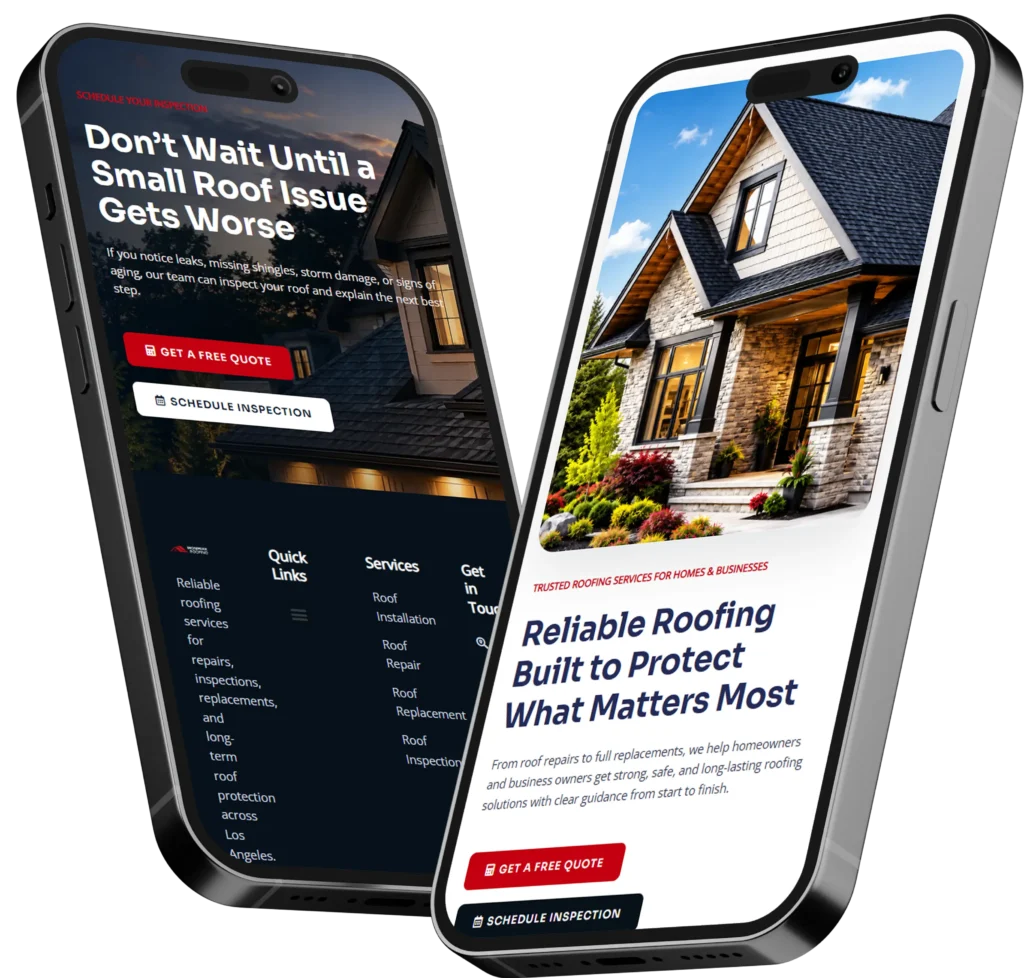
A commercial cleaning website should make trust, scope of work, and quote requests obvious within seconds. The best versions combine clear service pages, proof of performance, and simple contact paths so facility managers can act fast.
If your site looks generic, hides your service areas, or makes people hunt for a quote form, you are likely losing serious leads before a conversation even starts.
This matters even more in commercial cleaning because buyers are rarely browsing for fun. They are comparing providers, checking credibility, reviewing service fit, and deciding whether your company looks reliable enough for offices, retail spaces, medical facilities, or multi-site contracts.
Read on to see what pages matter most, how to structure them, which design option fits your stage of growth, and how to turn your site into a stronger lead source for your business.
If you want to see how strong layouts and conversion elements come together, browse our project gallery or review our website design & development services.
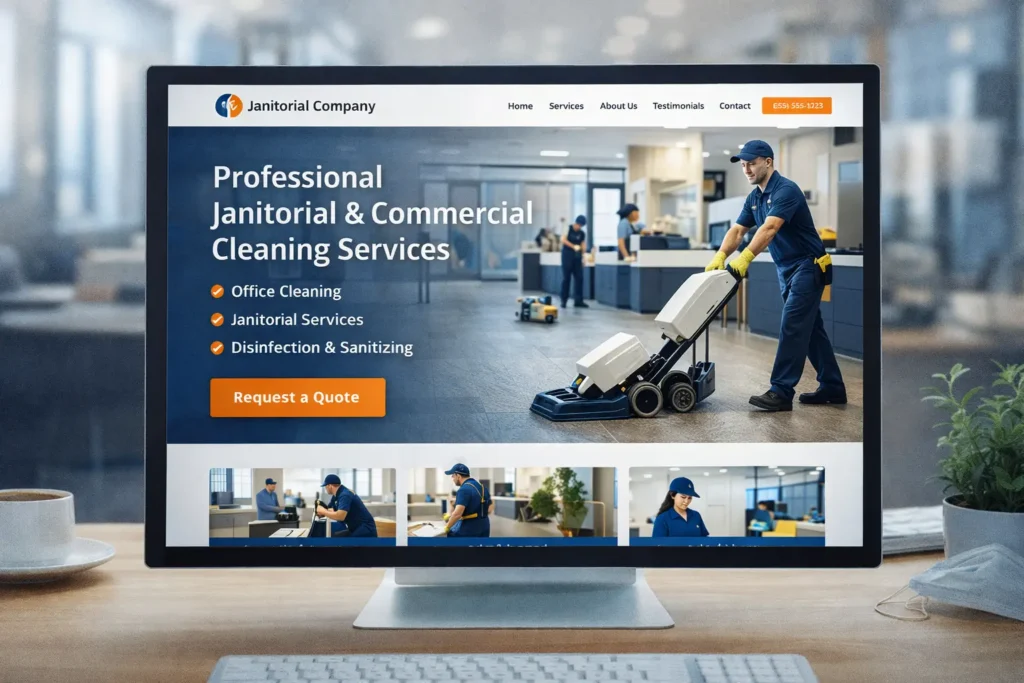
Why Website Design Matters for Commercial Cleaning Companies
Commercial cleaning buyers think differently from residential customers. They are often office managers, operations teams, property managers, or business owners who need consistency, compliance, and dependable communication. That means your site cannot rely on a nice logo and a few stock images. It has to answer business questions quickly.
A strong site helps people understand three things right away. First, what you clean. Second, where you work. Third, how to request a quote without friction.
That is why messaging has to be more precise than “we make spaces sparkle.” A commercial buyer wants to know whether you handle office cleaning, floor care, post-construction cleanup, day porter work, disinfection, or scheduled janitorial contracts. They also want to know whether you serve one city, several counties, or a wider region.
When your structure is clear, your site starts doing sales work before your team ever replies. It filters bad-fit inquiries, warms up qualified leads, and gives serious prospects a reason to reach out.
A good benchmark is this: if someone lands on your homepage and cannot tell within a few seconds whether you serve their building type, their area, and their problem, the design is underperforming.
What Pages Every High-Intent Cleaning Site Should Include
The easiest way to improve results is to stop treating every visitor the same. A commercial prospect usually wants details, while a general visitor only needs a quick overview. Your site should serve both.
Here is a practical page structure that works well for cleaning companies that want better rankings and better conversion quality.
| Page | What it should do | What to include |
|---|---|---|
| Homepage | Build trust fast and guide the next click | Clear value proposition, service area, primary CTA, proof, top services |
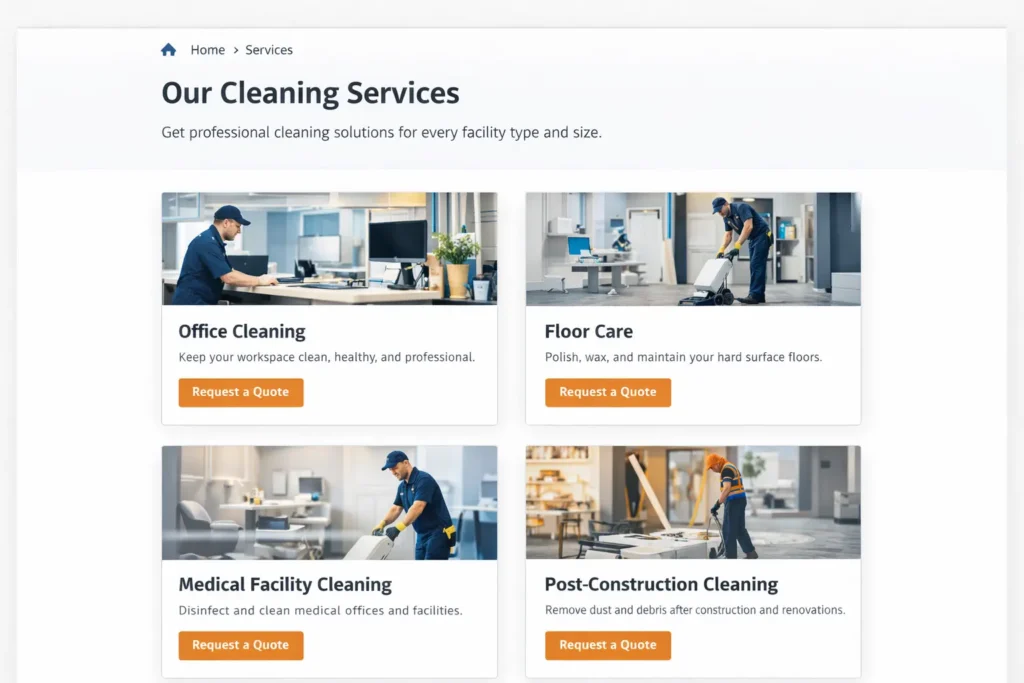
| Service Pages | Match search intent and explain outcomes | Separate pages for office cleaning, janitorial, floor care, disinfection, and post-construction |
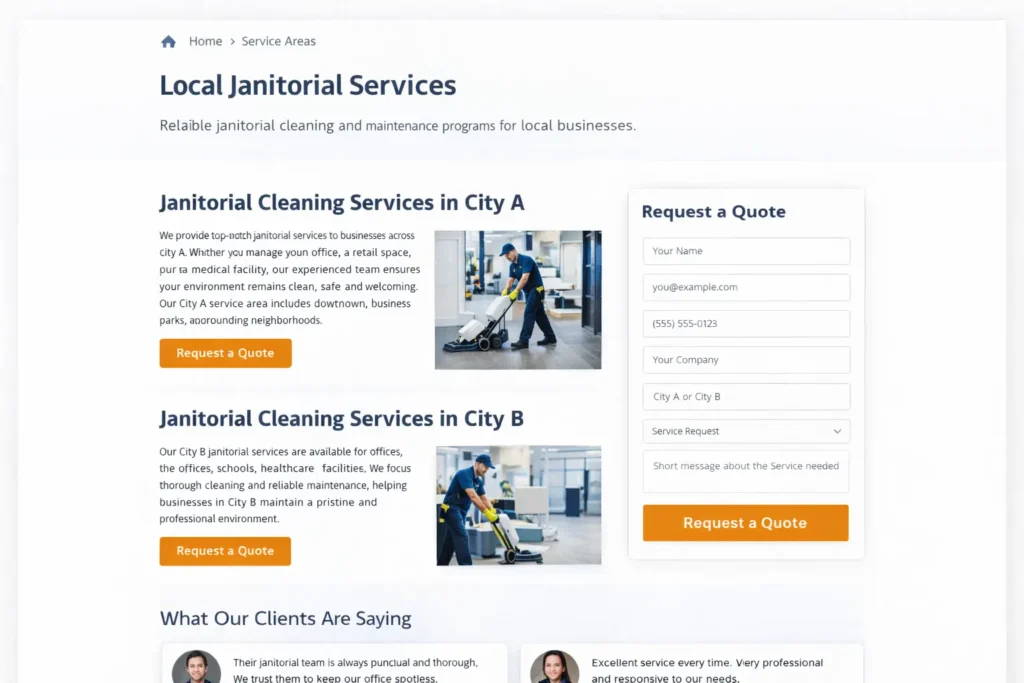
| Location Pages | Support local visibility and relevance | City or area-specific copy, nearby service examples, contact details |
| About Page | Reduce risk and humanize the company | Team story, process, certifications, service standards |
| Reviews / Proof Page | Reinforce trust | Testimonials, before-and-after examples, case snapshots, and industries served |
| Contact / Quote Page | Remove friction | Short form, phone, email, service area map, and expected response time |
The homepage should never try to say everything. Its job is to guide. Think of it as the front desk, not the whole building.
Your service pages do the heavier conversion work. If you clean offices, medical spaces, retail stores, schools, or industrial spaces, those deserve clearer separation. A prospect searching for recurring office cleaning usually wants a page that sounds built for that need, not a generic paragraph buried on the homepage.
Your location pages matter too. They help connect your business to the markets you actually serve. They also give you room to mention local context, nearby business districts, common building types, and scheduling needs that are specific to that area.
📌 Practical tip: if you only have one “Services” page right now, your fastest win is often splitting that page into focused service pages and improving the quote flow on each one.
How to Build Trust Into the Design
Trust is the center of a commercial cleaning site. Buyers are not just asking whether you can clean. They are asking whether you can show up on time, follow the scope, communicate well, and protect their property.
That is why the best cleaning websites use trust elements early, not as an afterthought at the bottom.
Start with the headline. It should say who you help and what outcome you deliver. Then follow with proof. This can include industries served, years in business, response times, client logos if permitted, insurance and bonding details, staff training standards, or simple process highlights.
You also want visual proof to feel real. Generic mop-and-bucket stock photos do not carry much weight. Better images show actual team members, real uniforms, branded vehicles, supervisors on-site, or facility environments you commonly serve.
Design also affects trust through clarity. A cluttered page feels risky. A simple layout with strong spacing, readable text, and obvious calls to action feels organized. That matters because people often project website quality onto service quality.
Here are the trust signals worth prioritizing:
✅ clear list of industries or building types served
✅ testimonial snippets that mention reliability or communication
✅ visible insurance, bonding, or safety information
✅ real photos or project examples when possible
✅ quote form that feels short and easy, not overwhelming
If you want inspiration for service-focused layouts, our cleaning service website article is a useful place to compare structure choices.
Which Website Option Is Best for Your Business
Not every commercial cleaner needs the same type of site. The best option depends on your stage, your budget, and how aggressive you want to be with growth.
| Option | Best for | Strengths | Limitations |
|---|---|---|---|
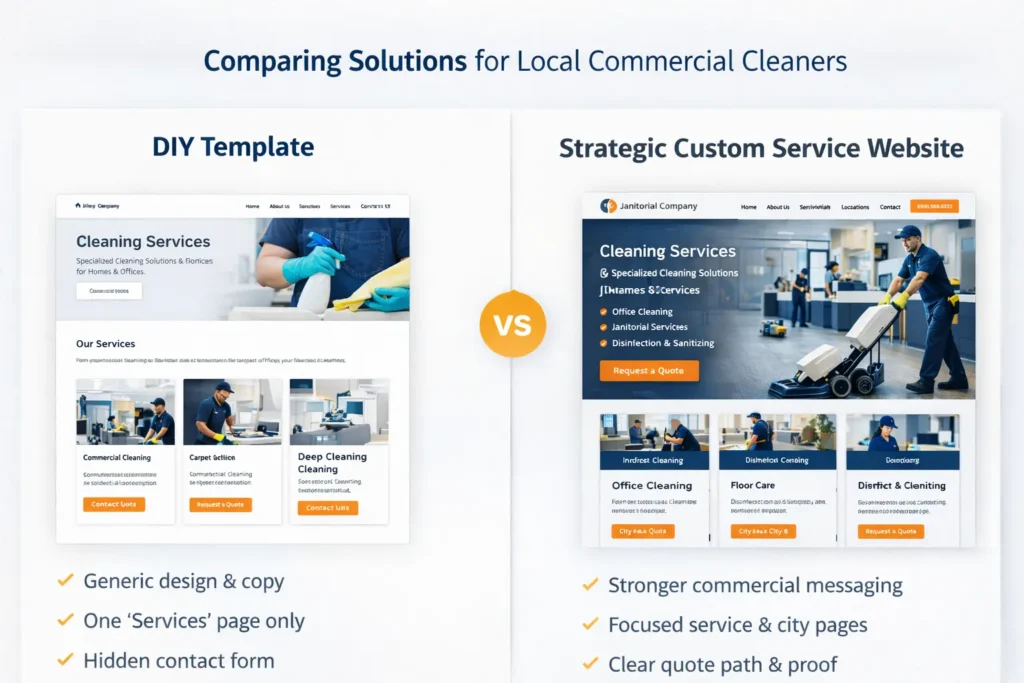
| DIY builder site | Very early-stage businesses | Low cost, fast launch | Often looks generic, weaker SEO structure, and limited conversion strategy |
| Pre-made niche template | Owners who need a cleaner look quickly | Faster than custom, more polished than DIY | Can still feel similar to competitors, less flexible |
| Semi-custom service website | Growing local companies | Better messaging, stronger structure, easier to scale | Needs a strategy and proper setup |
| Fully custom lead-gen build | Companies targeting larger contracts or multiple areas | Best for authority, scalability, and conversion | Higher investment and more planning |
For most commercial cleaning companies, the best middle ground is a semi-custom or custom service website with a focused page strategy. That usually gives you the strongest balance between speed, branding, SEO structure, and lead quality.
Why is this often the best route? Because commercial cleaning usually depends on trust, specificity, and local relevance. A generic template may look fine, but it often lacks service depth, location depth, and sales flow. That is where custom thinking makes the difference.
The “right” choice also depends on what you sell. If your company is targeting recurring office contracts, multi-location accounts, or specialized services, you need stronger messaging and page structure than a one-page brochure site can offer.
For businesses comparing approaches, our contractor lead website guide helps show how a stronger structure turns service traffic into actual inquiries.
What Features Matter Most for Leads
Design trends are not the main issue here. Conversion features are.
A commercial cleaning website that wins more inquiries usually includes the following practical features:
A quote button that stays visible.
This sounds basic, but many service sites bury their main call to action. Your quote path should stay easy to find on desktop and mobile.
A short quote form.
Do not ask for every detail up front. Name, company, property type, location, service need, and contact info are usually enough to start.
Specific service blocks.
Visitors should be able to skim and immediately see whether you handle the type of cleaning they need.
Proof near the call to action.
Reviews, industry types served, or “insured and bonded” style proof should appear close to forms and buttons, not only at the bottom of the page.
Fast mobile experience.
Many decision-makers first check a service provider from a phone, especially when comparing multiple companies.
FAQ support.
Good FAQs reduce hesitation and improve topical depth at the same time.
There is also a major difference between decorative copy and decision-making copy. Decorative copy sounds pretty. Decision-making copy helps a prospect answer, “Can this company handle my building, my schedule, and my standards?”
That is why feature sections should not just say “high quality service.” They should say things like “nightly janitorial for office suites,” “flexible scheduling for retail spaces,” or “day porter support for high-traffic facilities.”
How SEO Fits Into Better Website Design
Design and SEO work best together, especially in local service industries.
Google’s SEO Starter Guide explains that SEO improvements help search engines crawl, index, and understand your content. In plain language, that means your pages need structure, clarity, and relevance before they can compete well.
For a commercial cleaner, that starts with page separation. One generic services page rarely gives Google enough detail to understand the full scope of what you offer. Focused service pages and location pages make that job easier.
Off-site, your local signals matter too. Google says businesses with complete and accurate Business Profile information are more likely to show up in local search results. That is why your services, hours, service areas, and contact details should match across your website and your profile. You can review Google’s local ranking tips for the details.
Mobile performance matters as well. Google uses the mobile version of a site’s content for indexing and ranking, so weak mobile layouts can quietly hold back visibility. You can test key pages with PageSpeed Insights, which reports on both mobile and desktop performance and provides suggestions for improvement.
This is where smart design supports ranking:
- clean page hierarchy with clear headings
- focused service and city pages
- lighter images and stronger mobile layout
- simple navigation that helps users and crawlers
- useful copy that answers real buyer questions
If you are trying to rank beyond one service type, do not cram everything into a single page. Create a logical content path. For example, office cleaning, janitorial services, disinfection, and floor care can all support the main site while targeting different search intents.
How to Write Pages That Rank and Still Convert
A lot of cleaning websites make the same copy mistake. They write for themselves instead of for the buyer.
That usually sounds like this: “We are dedicated to excellence and customer satisfaction.” It is harmless, but weak. It does not answer what the buyer really needs to know.
A better approach is to write around problems, scope, and outcomes.
Instead of “quality cleaning solutions,” say what the service actually covers. Instead of “customized plans,” explain how scheduling works. Instead of “trusted professionals,” show the proof that supports the claim.
For example, a stronger service intro might explain that you clean shared office spaces, restrooms, kitchens, touchpoints, lobbies, and floors on a recurring schedule built around client traffic patterns. That sounds more real because it is more useful.
This also improves search performance because the language becomes more specific. Specificity creates relevance. Relevance creates stronger alignment with search intent.
A smart layout for service pages often looks like this:
- clear headline with service and audience
- short intro explaining what is included
- bullet or icon section for scope of work
- trust section with proof or process
- quote CTA
- supporting FAQ
If you want more layout inspiration for service businesses that need stronger sales pages, our house cleaning website article gives a useful comparison point, even though the audience is slightly different.
Common Mistakes That Hurt Rankings and Conversion
Most underperforming cleaning websites are not failing because the business is weak. They are failing because the structure creates friction.
The biggest issues usually look like this:
✅ one generic services page with no depth
✅ no clear service areas on the homepage
✅ stock-heavy design with little proof
✅ quote form hidden in the navigation only
✅ slow, image-heavy mobile pages
✅ weak headings that never mention service type or audience
Another common issue is mixing residential and commercial messaging on the same key pages. If you serve both, you need a cleaner separation. A facility manager should not land on a page that sounds written for someone booking a one-time house clean.
You also do not want every call to action to say the same thing. “Contact us” is fine, but more specific buttons often work better, such as “Request a Site Walkthrough,” “Get a Janitorial Quote,” or “Ask About Multi-Site Service.”
A Practical Build Strategy You Can Use Right Now
If you want a simpler path forward, focus on this order:
Start with your homepage. Make the message sharper, add proof higher on the page, and improve the main CTA.
Next, build or improve the service pages that match your best-fit jobs. If office cleaning and janitorial contracts are your top revenue drivers, those pages should be stronger than everything else.
Then create or improve location pages for the areas you actively serve. Do not mass-produce thin pages. Make them useful and locally relevant.
After that, tighten mobile speed, compress oversized images, simplify navigation, and shorten your quote form.
Finally, support the site with related blog content and internal links so the main service pages gain more context. This is also where linking to your local website design team can make sense if readers are ready to move from research into action.
Closing Thoughts
A commercial cleaning website works best when it speaks to facility managers like buyers, not browsers. When your pages clearly explain services, locations, proof, and next steps, the site becomes more than an online brochure. It becomes a stronger filter, a better sales tool, and a more reliable source of qualified inquiries.
If your current site feels too broad, too dated, or too hard to navigate, the smartest move is usually not adding more fluff. It is tightening the structure, sharpening the copy, and making the quote path easier from the first screen to the final click.
Frequently Asked Questions
1. What should a commercial cleaning company’s website include?
The most important elements are clear service pages, trust signals, and an easy quote path. A strong website should show what types of facilities you clean, which locations you serve, and how a prospect can request an estimate without confusion. It should also include proof such as testimonials, certifications, insurance details, or industry experience. For a web design client, these elements matter because they directly influence whether the site attracts low-quality clicks or serious inquiries.
2. How much does it cost to design a website for a cleaning business?
The cost depends on the level of strategy, customization, and lead-generation features included. A basic template build can be relatively affordable, but it often lacks the page depth and conversion structure needed for competitive local service markets. A more strategic build with service pages, city pages, stronger calls to action, and better mobile performance usually costs more because it is designed to generate business, not just exist online. For commercial cleaning brands, that difference is often worth it.
3. Can a better website really help a cleaning company get more leads?
Yes, a better website can improve both lead volume and lead quality when the structure matches buyer intent. If the homepage is clearer, the services are separated properly, and the quote form is simple, more qualified visitors will take action. Better design also helps reduce bounce from people who cannot tell what you do. For web design buyers, the real goal is not just more traffic. It is better-fit leads from the right pages.
4. Do commercial cleaning companies need separate pages for each service and city?
In most cases, yes, separate pages are one of the strongest ways to improve clarity and relevance. A single services page usually stays too broad to rank well or convert well for multiple search intents. When each service has its own page and each core service area has useful local content, the site becomes easier to understand for both users and search engines. That structure also gives web designers more room to create stronger calls to action and more targeted messaging.