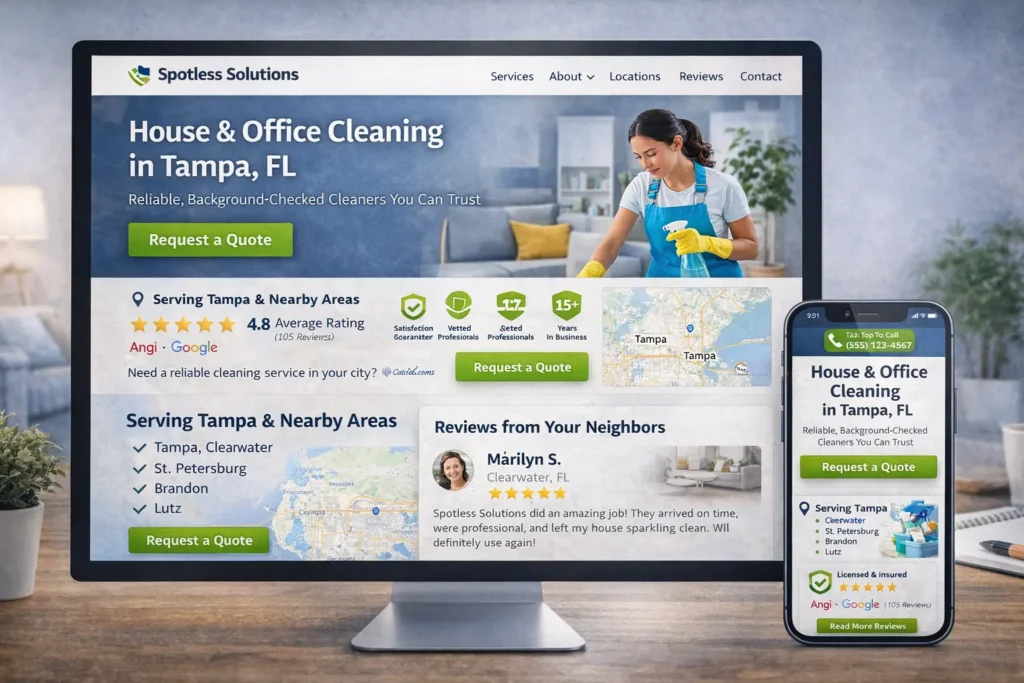
A cleaning service website should make trust, services, and booking clear within seconds. When a homeowner, office manager, or property manager lands on your site, they should instantly understand what you offer, where you work, and how to request a quote.
The best-performing sites in this space are not flashy for the sake of it. They are clear, fast, local, and built around the questions real buyers ask before they hire. That is what helps a web designer create something that looks polished, supports local visibility, and turns visits into inquiries instead of bounce-offs.
If you are hiring a designer, this is the standard to look for. If you are redesigning your current site, this is the framework worth following.
Why cleaning companies lose leads on weak websites
Most cleaning businesses do not lose leads because people hate the service. They lose leads because the website makes visitors work too hard.
A visitor lands on the page and cannot immediately tell whether you handle residential cleaning, office cleaning, deep cleaning, move-out cleaning, or recurring service. They are not sure whether you serve their area. The phone number is hard to find. The quote form asks for too much. The site feels outdated, generic, or slow on mobile. In a local service industry, that is often enough for someone to leave and call a competitor.
This matters even more for cleaning businesses because trust is the product before the service is. People are letting someone into a home, apartment, rental property, or workplace. Before they care about your mop system or checklist, they want to feel safe choosing you. A good website helps answer that emotional question fast.
That is why strong design in this niche is less about decoration and more about confidence. Good layout, clean spacing, real team photos, city-specific language, review proof, and direct calls to action all work together to reduce hesitation.
A web designer who understands this market should not start with colors alone. They should start with buyer intent. What does a first-time visitor need to see in the first screen? What objections are stopping the quote request? What details should appear before the user scrolls? Those are the questions that shape a better result.
If you want a broader service-business reference point, this home service website design guide is a useful companion because many of the same trust and structure rules apply to cleaning brands, too.
What a high-converting cleaning company site should include
A good service-business website does not need dozens of pages to work. It needs the right pages, the right order, and the right message on each one.
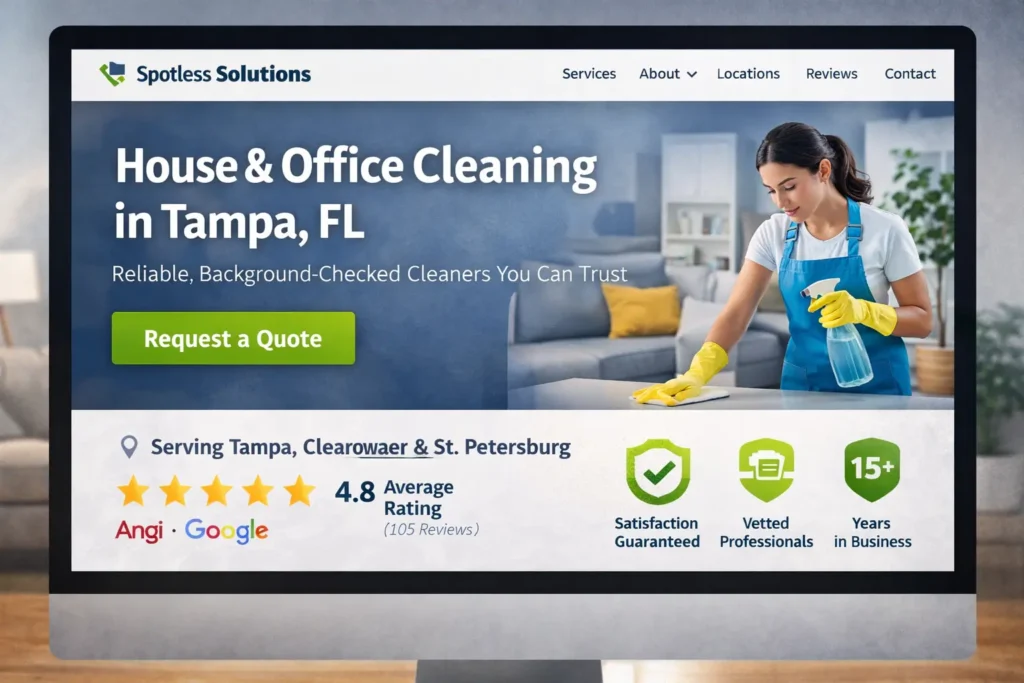
The homepage should make the offer obvious. That means a headline tied to the service and market, a short support line, one main call to action, and fast trust proof. For a local cleaner, a stronger headline is usually specific, not clever. “House Cleaning in Tampa for Busy Families and Airbnb Hosts” does more work than “We Make Spaces Shine.”
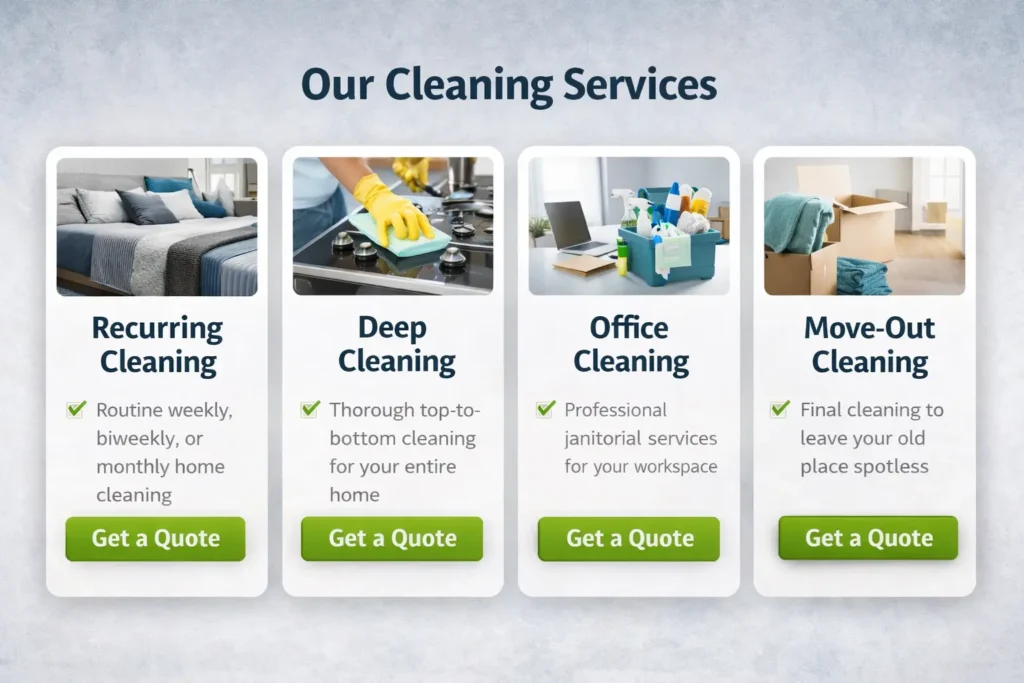
Your service pages should separate the real buying categories. If you offer recurring house cleaning, deep cleaning, move-in or move-out cleaning, and office cleaning, each one deserves its own page. That helps visitors self-select and helps the designer structure content for local search visibility.
Trust sections should not be vague. “We care about quality” is weak. Better proof includes review snippets, insured or bonded language if accurate, satisfaction policies, before-and-after visuals, team photos, and clear process steps. The goal is to remove friction before the quote form appears.
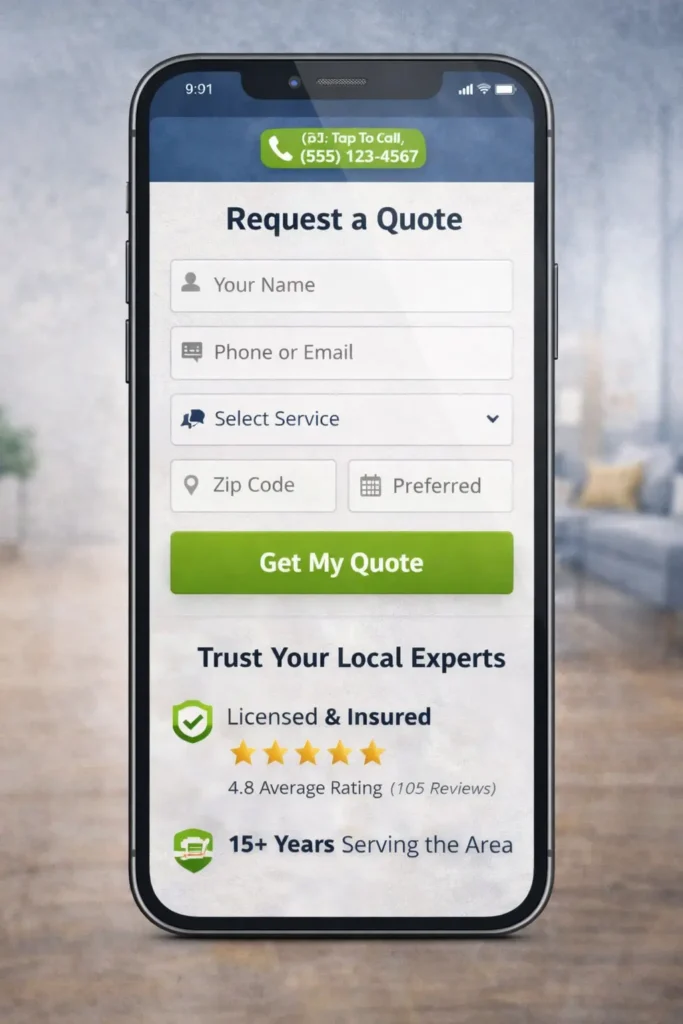
The quote form itself should stay short. Name, phone or email, ZIP code, service type, and preferred schedule are often enough for a first conversion. Long forms can feel like work, especially on mobile.
Here is a simple benchmark table you can use when reviewing a draft:
| Website Section | Why It Matters | What It Should Show |
|---|---|---|
| Hero section | Creates first impression in seconds | Service type, city or service area, primary CTA |
| Services section | Helps visitors find the right offer | Separate categories with short descriptions |
| Trust section | Reduces fear and hesitation | Reviews, guarantees, certifications, real photos |
| Service area section | Confirms local relevance | Cities, neighborhoods, ZIP codes, map cues |
| Quote/contact section | Converts interest into action | Short form, click-to-call, response-time expectation |
One practical tip that improves both clarity and lead quality is adding a short “Who this is for” line under major services. For example: “Best for weekly and biweekly home cleaning,” or “Ideal for offices that need after-hours janitorial support.” That small detail filters traffic in a useful way.
If you want to see how strong service business layouts are presented visually, browse these portfolio highlights. It helps cleaning business owners compare structure, not just style.
How the right structure improves trust, local SEO, and AEO
A lot of business owners think rankings come from adding more words. In practice, structure does a lot of the heavy lifting.
The homepage should target the core brand and primary market. Service pages should go deeper on each offer. City or service-area pages should answer location-specific questions without duplicating the same paragraph across every page. Blog content should support the service pages, not compete with them.
That means a smarter architecture often looks like this:
Home
Services
Individual service pages
Service areas or city pages
About
Reviews
Contact or quote page
Helpful blog content
This is where a web designer with strategy experience becomes valuable. They can help map which pages deserve priority now and which ones can be added later without creating thin content.
For cleaning businesses serving multiple towns, location relevance matters. Your city pages should not just swap out the place name. Each page should mention the type of customer you serve there, the common jobs you handle, the neighborhoods or nearby landmarks that build familiarity, and a tailored call to action. That makes the content feel useful rather than templated.
It also helps to connect the site to the rest of your local presence. Google’s own guidance stresses the importance of complete and accurate business information in local search, while Google Business Profile settings let service-area businesses define the areas they serve. Blending those details with your website makes your presence more consistent and easier for customers to trust through Google’s local ranking tips and Google Business Profile service-area guidance.
AEO matters here, too. Answer engines and AI summaries tend to pull from pages that are easy to parse. That is one reason the first section of your page should answer the main question fast. A short answer-first intro, descriptive subheadings, direct service explanations, and well-written FAQs all make the page easier for both people and machines to understand.
Here is another table that helps when deciding what kind of build makes sense for your stage:
| Option | Best For | Strengths | Limits |
|---|---|---|---|
| DIY builder | Very early-stage solo cleaners | Fast launch, low upfront cost | Often generic, weaker conversion structure |
| Template customization | Small to midsize teams | Better branding, faster turnaround, budget-friendly | Can feel limited if the service area or SEO strategy grows |
| Custom build | Established local brands or multi-city teams | Best flexibility, stronger lead flow setup, cleaner page hierarchy | Higher investment needs a clear strategy |
For most cleaning companies, the best option is not the cheapest one. It is the one that matches the next stage of growth. A brand with one crew and one service area may do well with a tightly customized service-business framework. A company expanding across multiple locations usually benefits more from a custom build with stronger page planning from the start.
If lead generation is your main KPI, this article on contractor lead website strategies is worth reading too because the conversion logic translates well to cleaning and other local service businesses.
Which design details actually move results
A lot of design choices feel small, but they change how people behave on the page.
The first is mobile usability. Many local service visitors are on their phones, often while multitasking or comparing providers quickly. Google recommends responsive web design and emphasizes strong overall page experience, mobile display, and Core Web Vitals as part of successful search performance. A designer should be thinking about finger-friendly buttons, readable text, fast-loading sections, and forms that are easy to complete on a smaller screen.
The second is visual proof. Stock images are common in this industry, but overusing them makes the business feel interchangeable. Even a handful of real images can do more work than a full library of generic ones. Team photos, branded vehicles, supply kits, uniforms, or a real office shot create more credibility than polished but obviously fake visuals.
The third is message order. Many sites talk about the company before they talk about the client’s problem. Flip that. Start with what the visitor needs. Then explain the process. Then show why you are trustworthy. Then ask for the inquiry. That order tends to feel more persuasive because it reflects how people make decisions.
A practical homepage flow often works like this:
problem → service solution → proof → service areas → quote action
That sequence feels natural because it answers the mental checklist most prospects already have.
Mistakes that quietly hurt rankings and quote requests
The most common issue is trying to make one page do everything. When residential, commercial, move-out, post-construction, and recurring plans all live in one crowded page, nobody gets a clear answer. Splitting those into focused pages usually improves clarity right away.
Another mistake is generic headlines. “Professional Cleaning Solutions” could belong to almost any company in any city. It does not help the visitor, and it does not give the page much topical strength. A better headline identifies the service, audience, and local angle quickly.
Weak internal linking is another missed opportunity. If your blog talks about home service brands, trade businesses, or lead generation, it should support the service pages and commercial pages that matter most. That is why it helps to connect related content naturally. For example, this trade business website guide can reinforce broader service-business structure ideas if you also market to contractors, maintenance teams, or field-service operators.
Then there is overdesign. Fancy motion, oversized sliders, and cluttered layouts often make a local site feel slower and less direct. A cleaning company does not need a complicated interface. It needs clear proof, clear service pages, and clear contact paths.
Finally, many sites bury their best conversion asset, which is fast contact. A sticky mobile button, repeated call to action, short form, and expected response time can all help. Something as simple as “Usually replies within one business day” can reduce friction because it tells the visitor what happens next.
If you are comparing scope, pricing, or what a smarter rebuild could look like, your next stop should be these website design & development services.
Final take
The best websites for cleaning businesses do not win because they are trendy. They win because they feel trustworthy, easy to use, and specific to the service area and customer problem.
A web designer should be helping you clarify your offer, organize your pages, strengthen local signals, and shorten the path to inquiry. When those pieces come together, you stop treating the site like an online brochure and start using it like a lead-generation asset.
That is the difference between a page that simply exists and a cleaning service website that helps the business grow.
To move forward, start with growth-driven web design, review the website design & development services, and compare execution ideas through the portfolio highlights.
Frequently Asked Questions
1. How much does a website for a cleaning company usually cost?
The cost depends on how custom the build needs to be, how many service pages you want, and whether the project includes copywriting, SEO setup, and lead form planning. The real cost driver is strategy, not just design. A simple starter site is usually cheaper, but if it lacks strong service pages, local structure, and trust-building sections, it may not generate enough leads to justify even a smaller investment.
2. What pages should a cleaning company website have?
At minimum, most cleaning businesses should have a homepage, dedicated service pages, an about page, a contact or quote page, and some proof elements such as reviews or case examples. Clear service pages are usually the most important part. They help visitors quickly identify whether you offer what they need, and they give a web designer the structure needed to target relevant local searches more effectively.
3. Do cleaning businesses need separate city or service-area pages?
Yes, in many cases they do, especially if the company serves multiple cities or wants to rank for specific local terms. Location pages work best when they are genuinely useful, not duplicated. A strong city page should mention the local audience, the specific services offered there, trust signals relevant to that area, and a tailored call to action so the page feels specific rather than copied.
4. How long does it take to design a strong website for a cleaning business?
The timeline usually depends on how prepared the business is with content, reviews, service details, and branding. A good website build is not only about design speed. It also includes planning the page structure, writing clear messaging, choosing the right calls to action, and making sure the site works well on mobile. A rushed launch can happen fast, but a site built to convert usually takes more thoughtful preparation.