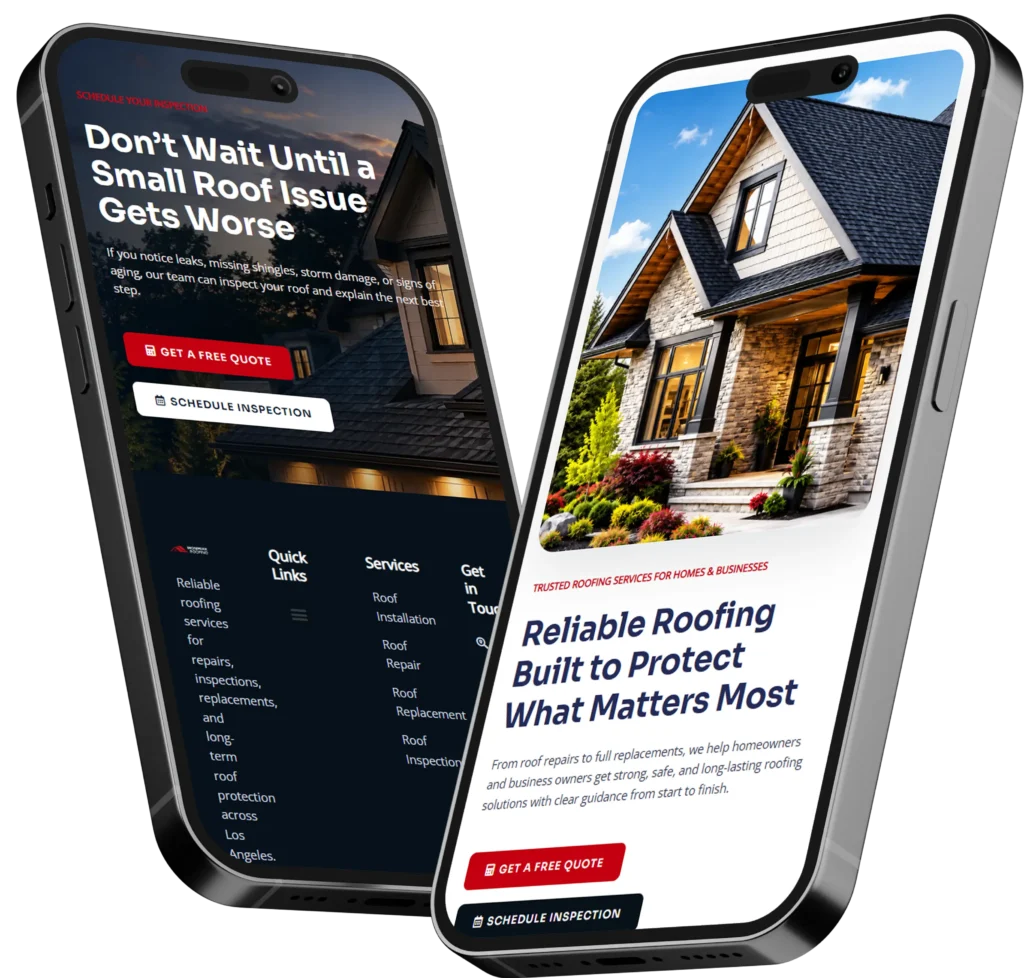
A contractor lead website should guide a visitor from problem to proof to action in under a minute. When the message is clear, the service pages match real search intent, and the contact path is simple, more of the right visitors turn into calls and quote requests.
A lot of contractor websites lose leads for one simple reason. They look like online brochures instead of sales tools. A homeowner lands on the page, scans for ten seconds, and still cannot tell if you handle their service, cover their area, or have enough proof to trust with a real project. That is where design stops being visual and starts becoming a business strategy.
The good news is that a lead-focused build is not complicated when the structure is right. Google recommends people-first content, using the words searchers actually use in important page elements, and making internal links crawlable so both users and search engines can understand the site faster.
If you want a benchmark for what a conversion-first build can look like, browse our portfolio highlights and compare how quickly each site communicates service, trust, and action.
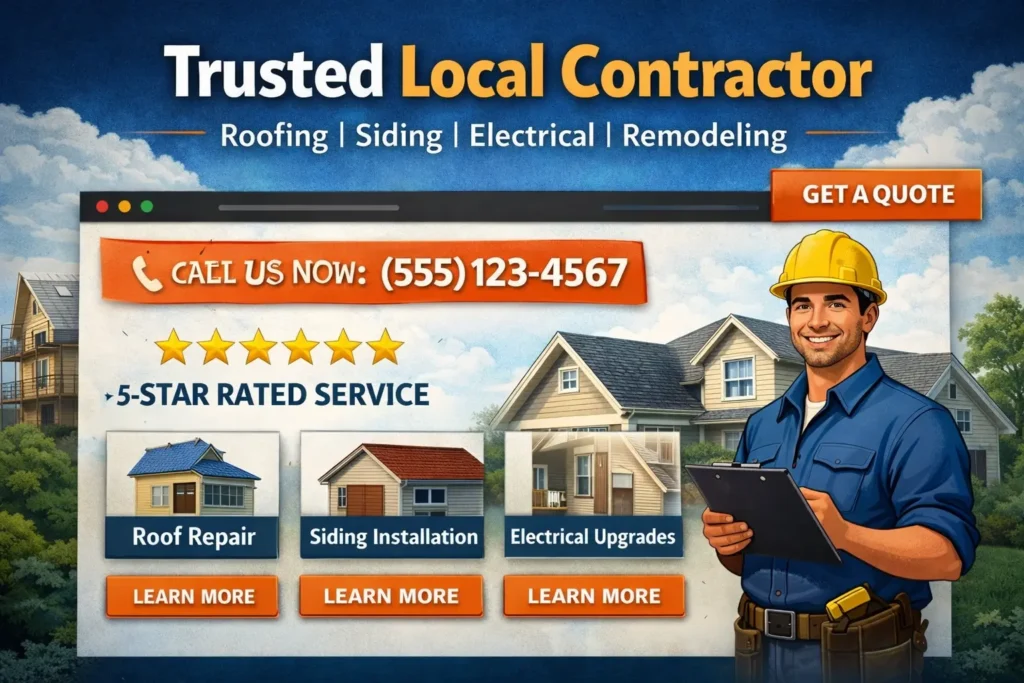
Why do many contractor websites still fail to generate qualified leads
Most underperforming sites do one of three things wrong.
First, they lead with vague messaging. Phrases like “quality craftsmanship” or “trusted professionals” sound fine, but they do not answer what the customer actually wants to know. A homeowner usually starts with a service-specific problem, such as roof leak repair, kitchen remodel estimate, panel upgrade, or emergency plumbing. If your headline stays broad, the visitor has to work too hard.
Second, they bury proof. Contractors sell trust before they sell service. That means reviews, project photos, certifications, warranties, and service area clarity should appear early, not halfway down the page. A visitor should not have to hunt for credibility.
Third, they create friction at the moment of contact. If the phone number is hard to find, the quote form feels long, or the mobile experience is clunky, visitors leave. For a contractor, that lost click is not just traffic. It is a missed job.
This is why the best contractor websites are rarely the ones with the fanciest animation. They are the ones who remove hesitation fast. They show the right service, in the right town, with the right proof, and make the next step obvious.
What a high-converting contractor website needs
A strong site should move like a guided path. The visitor lands, confirms you do the work, sees proof, checks location relevance, and contacts you. Every major page should support that path.
| Website Element | Why It Matters | What It Should Include |
|---|---|---|
| Homepage | Sets the first impression fast | Clear service headline, service area, trust badges, main CTA, featured reviews |
| Service Pages | Match high-intent searches | One service per page, real project details, FAQs, CTA above and below the fold |
| Service Area Pages | Support local relevance | Real towns served, local proof, unique copy, nearby project examples |
| About Page | Builds trust | Team story, years in business, credentials, process, warranty, or guarantee |
| Gallery / Case Studies | Helps people picture results | Before-and-after images, project scope, timeline, client outcome |
| Contact Page | Converts late-stage visitors | Tap-to-call number, short form, hours, map, service radius, quick response promise |
The homepage should act like the front desk of the business. It should answer four questions immediately: What do you do? Where do you do it? Why should I trust you? What do I do next? If even one of those is missing, the page loses strength.
Your service pages are where most of the real lead generation happens. This is where a general contractor, roofer, electrician, plumber, or remodeler wins by being specific. Instead of a single “Services” page with short blurbs, build separate pages that can rank and convert on their own. A page for bathroom remodeling should not be forced to do the job of kitchen remodeling, room additions, and whole-home renovations all at once.
If you want that structure done properly, our website design & development services are built around service-page architecture, clear conversion flow, and mobile-first performance.
How to structure the pages so they actually bring in leads
The strongest contractor websites do not start with design trends. They start with user intent.
A homepage should capture broad brand intent. A service page should capture solution intent. A service area page should capture local intent. A gallery or project page should capture proof intent. When those pages work together, the site becomes much easier to understand and much easier to trust.
A practical structure for most contractors looks like this:
| Page Type | Main Goal | Best CTA | Common Mistake |
|---|---|---|---|
| Homepage | Confirm fit quickly | Call now or request estimate | Talking too much about the company before the service |
| Individual Service Page | Capture intent and explain scope | Get a quote for this service | Combining multiple services on one page |
| Service Area Page | Reinforce local relevance | Book service in this area | Using duplicate city pages with almost no local detail |
| Gallery / Case Study Page | Prove quality visually | See similar projects or request pricing | Uploading photos without context |
| Contact Page | Convert ready visitors | Call, form, or schedule | Hiding the number or asking for too much information |
A roofer, for example, may need separate pages for roof replacement, roof repair, storm damage repair, and commercial roofing. An HVAC company may need AC repair, AC installation, heating repair, indoor air quality, and maintenance. A remodeler may need kitchen remodels, bathroom remodels, additions, and design-build services. The tighter the page-to-service match, the better the chance the visitor feels, “Yes, this is exactly what I was looking for.”
This is also where internal linking matters. Google’s Search Essentials recommends using words people would use to look for your content in prominent locations and making sure links are crawlable. In plain terms, your site should connect related pages with clear anchor text, not vague “click here” language. That helps both SEO and usability. You can review the guidance directly in Google Search Essentials.
For content ideas that already align well with home service intent, our home service website design article and trade business website guide are useful companion reads.
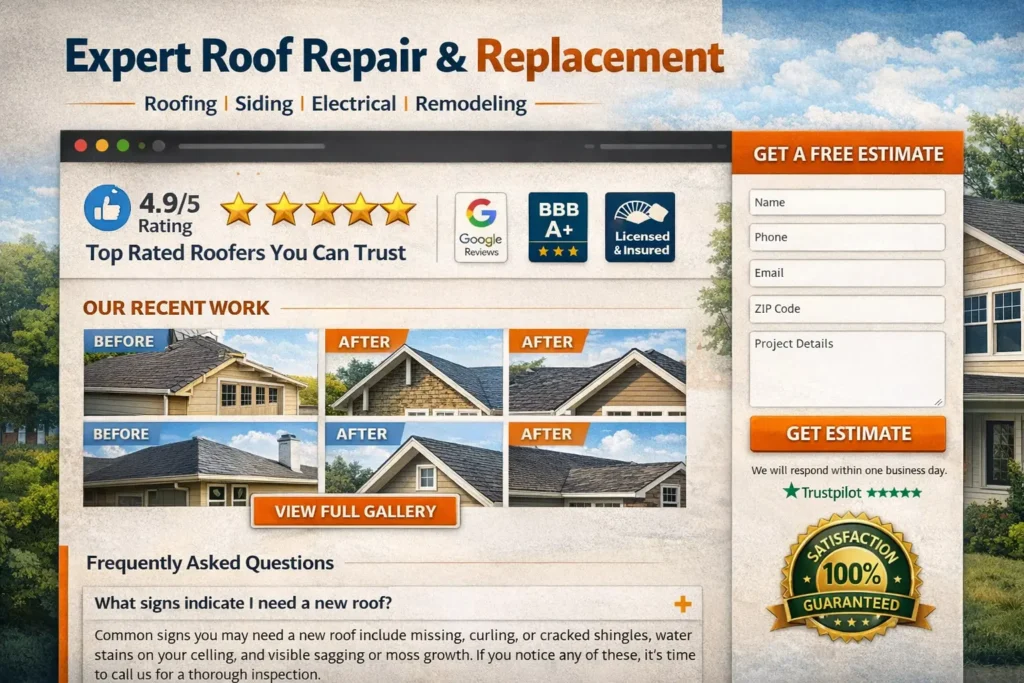
Which website option is best for most contractors?
This depends on stage, budget, and competition, but there is a clear winner for most local service businesses.
A one-page website can work as a temporary starter if you are brand new, running lean, or validating a market. It is better than having no site, but it usually runs out of space fast. You cannot target different services well, you have limited room for proof, and it is harder to build local SEO depth.
A template site with several pages is the next step up. It is faster to launch and often more affordable. For some contractors, especially solo operators or newer companies, this is a fair starting point. The issue is that templates often force your content into generic sections, which makes it harder to differentiate and harder to build a real conversion path.
The best option for most small to mid-sized contractors is a focused custom site or a heavily customized framework with dedicated service pages, local intent pages, a proof-rich gallery, and strong mobile CTAs. It does not need to be massive. In fact, a clean 7 to 15 page build often outperforms a bloated site because every page has a job.
Here is the simplest breakdown:
| Website Option | Best For | Strength | Limitation | Verdict |
|---|---|---|---|---|
| One-Page Starter | New businesses, very small budgets | Quick to launch | Weak service targeting and local depth | Good only as a short-term stopgap |
| Template Multi-Page Site | Small teams needing a faster launch | Affordable structure | Can feel generic and limit conversion flow | Acceptable if customized well |
| Custom Lead-Focused Build | Growing contractors in competitive markets | Best mix of SEO, clarity, and conversion | Higher upfront investment | Best overall option for serious lead generation |
If you are a contractor who wants more than a digital business card, choose the third option. It gives you the flexibility to rank for more terms, speak to more customer intents, and build stronger trust without clutter.
Local SEO matters because contractor searches are local by nature
Most homeowners do not search for “best contractor in the world.” They search for a specific service in a specific place. That is why your website cannot ignore local relevance.
Google says local results are mainly based on relevance, distance, and prominence. That means your site should clearly state what you do, where you work, and why people trust you there. Service pages, location references, review snippets, and real project examples all support that.
This does not mean stuffing city names everywhere. It means being useful. If you serve Tampa, St. Petersburg, and Clearwater, your site should reflect the kinds of projects you do in those areas, the neighborhoods you commonly work in, and the services people in those places actually ask for. That is more persuasive for users and more aligned with people-first search guidance.
A practical local setup usually includes:
a focused homepage, individual service pages, a few strong service area pages, embedded reviews, and a consistent business identity across your website and business profiles. That combination helps the site support local visibility instead of relying on one page to do everything.
Speed, mobile UX, and trust signals quietly make a huge difference
A contractor site often gets visited in a hurry. Someone has a leak, a broken AC unit, a failed outlet, or a remodeling deadline. They are checking your site on mobile, often comparing you against two or three competitors at the same time.
Google recommends good Core Web Vitals for search success and user experience. Web.dev defines good thresholds as Largest Contentful Paint within 2.5 seconds, Interaction to Next Paint at 200 milliseconds or less, and Cumulative Layout Shift at 0.1 or less. That is technical language for something simple: the site should load quickly, respond fast, and stay visually stable while the visitor is trying to act.
That is why I usually recommend:
compressed images, clean page layouts, minimal popups, sticky mobile CTAs, visible review proof near the top, and short quote forms. If you want to test performance before redesigning, run the site through PageSpeed Insights.
A simple trust stack near the top of the page can also lift confidence quickly. Think review rating, number of completed projects, years in business, financing availability, warranty mention, and license or certification details. Those details do not feel flashy, but they reduce doubt.
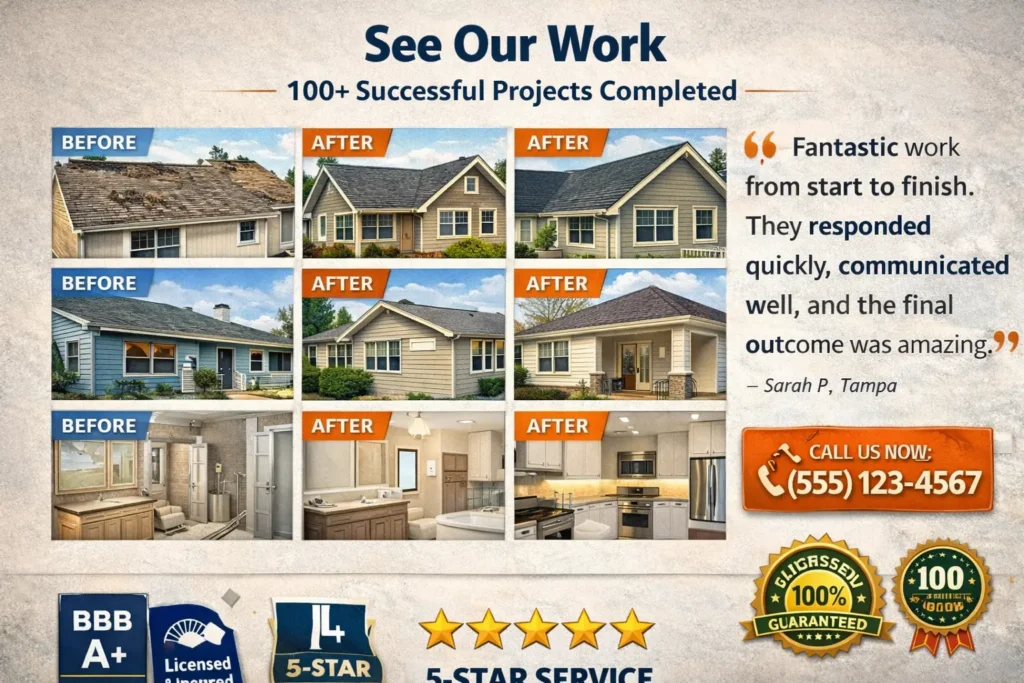
Practical design moves that improve lead quality
One of the smartest things you can do is make the site pre-qualify the lead a little before the call. This is not about making contact harder. It is about attracting the right projects.
For example, a remodeler can mention average project types, service radius, and whether design-build is included. A roofing company can separate residential and commercial work. An electrician can show whether they handle panel upgrades, EV chargers, troubleshooting, or only larger installations. When that information is clear, the wrong leads filter themselves out, and the better leads feel more confident reaching out.
Another effective move is placing proof closer to the decision point. Do not save testimonials for one isolated page. Put short review excerpts beside forms, below service descriptions, and near pricing or estimate language. People often decide at the moment they are asked to act.
Your form matters too. My usual starting point is six fields or fewer: name, phone, email, ZIP code, project type, and message. That is enough to start the conversation without scaring people away.
Finally, keep the contact options flexible. Some visitors want to call. Some want to send a form. Some want to see photos first. Some want to text. A lead-focused website respects that behavior instead of forcing one path.
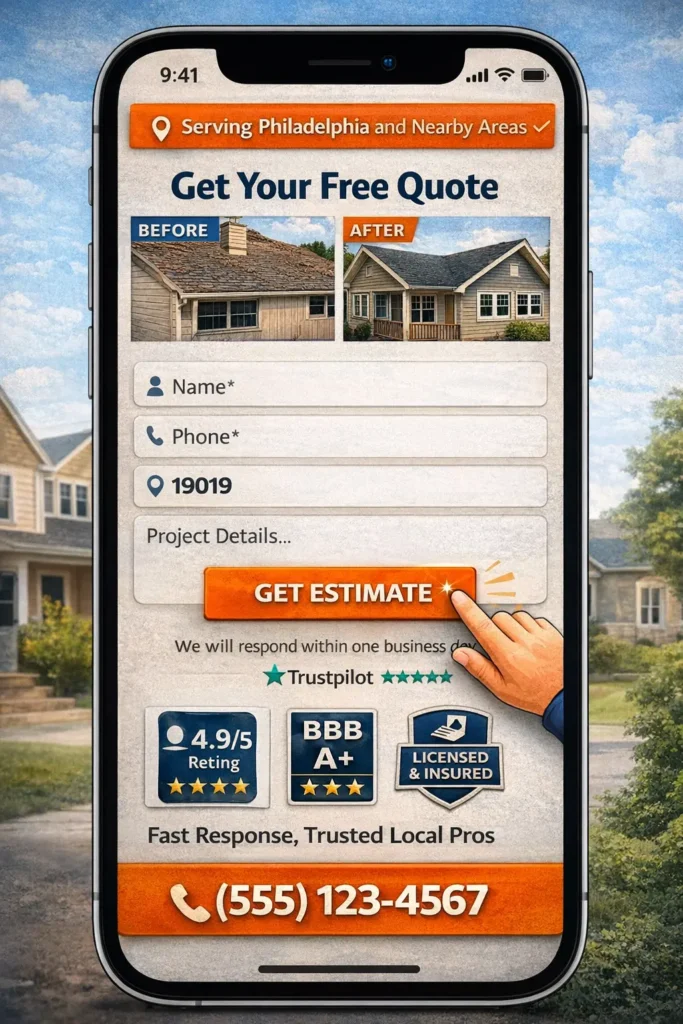
Final Take on a Contractor Lead Website
A contractor lead website works best when it feels less like a brochure and more like a guided sales conversation. It should answer the service question fast, support local intent, show real proof, and make contact simple on every device.
For most contractors, the best choice is not the cheapest site and not the biggest site. It is the clearest one. A focused build with dedicated service pages, local relevance, fast mobile performance, and strong trust signals will usually outperform a pretty site that says very little.
If your current website looks fine but does not bring in enough qualified calls, the issue is usually structure before traffic. Fix the path first. Then scale what is already working with growth-driven web design.
Frequently Asked Questions
1. What should a contractor’s website include to get more leads?
The most important pieces are service clarity, proof, and an easy next step. A contractor website should have a strong homepage, separate service pages, a contact page that is simple to use, and trust elements like reviews, project photos, warranties, and service areas. It should also work well on mobile, because a lot of high-intent visitors are searching from their phones when they are ready to call or request an estimate.
2. Is a template website good enough for a contractor business?
A template website can be good enough at the beginning, but it is rarely the best long-term option. It can help a newer business get online quickly, yet many template sites stay too generic and do not support a strong service-page strategy or local SEO depth. If your market is competitive, a customized site with better page structure, stronger messaging, and clearer calls to action usually gives you more room to grow.
3. How much should a contractor invest in website design?
The right budget depends on how competitive your market is and how much you expect the site to do. If you only need a simple online presence, the investment can stay modest. If you want the site to rank for multiple services, support local SEO, showcase project proof, and generate steady inquiries, the build should be treated like a lead-generation asset rather than a basic design expense. The better question is not cost alone, but return.
4. How long does it take for a redesigned contractor website to start generating leads?
Some improvements can help almost immediately, while stronger SEO gains usually take longer. Better layout, clearer calls to action, shorter forms, and improved trust sections can lift conversion rates as soon as the new site goes live. Organic growth from service pages, internal linking, and stronger local relevance typically builds over time as search engines crawl, understand, and trust the site more fully.