Cleaning company website design works best when it makes your services, service area, and next step obvious within seconds. The strongest sites feel trustworthy, load quickly, and guide visitors toward a quote without making a visitor think too hard.
That matters because most cleaning leads are not browsing casually. They are comparing options, checking if you serve their area, and deciding whether your business feels reliable enough to contact. Google’s guidance also continues to reward helpful, people-first content and strong page experience, which means good design now supports both rankings and conversions instead of sitting in a separate lane.
If you want to see how strong service-business layouts come together, review our website design & development services and browse our portfolio highlights. Both are useful if you are comparing what a real conversion-focused layout should look like for a local service brand.
Why Website Design Matters for Cleaning Companies
A cleaning business website is not just there to look polished. It has to answer practical questions fast. What do you clean? Where do you work? How does someone request a quote? The faster your site answers those questions, the more likely a qualified prospect is to stay. That is especially true for local service websites, where a clear hierarchy usually starts with a homepage, service pages, and a contact page, then expands into service-area pages where relevant.
A strong design also helps filter leads. A vague site tends to attract the wrong clicks because it hides the details that serious buyers want. A better site explains residential vs. commercial work, recurring vs. deep cleaning, move-out services, and location coverage in a way that feels easy to scan on mobile. That same clarity is what makes search engines and answer engines better understand the page.
This is where design directly affects trust. A homeowner wants to know whether your team is dependable and easy to work with. A property manager wants to know whether you can handle scope, communication, and consistency. When the layout is clean, the proof is visible, and the quote path is simple, the website starts acting like a sales tool instead of an online brochure. That trust-first approach also matches the tone and structure that already shows up in your related content, especially your commercial cleaning website design guide and your janitorial website design guide.
What a High-Converting Cleaning Website Should Include
The easiest way to improve a cleaning website is to stop treating every visitor the same. Someone searching “office cleaning” needs different proof from someone searching “house cleaning near me.” That is why separate service pages tend to work better than one generic catch-all page. Google and local SEO guides both point toward clear site structure, useful page-level detail, and accurate business information as stronger foundations for visibility.
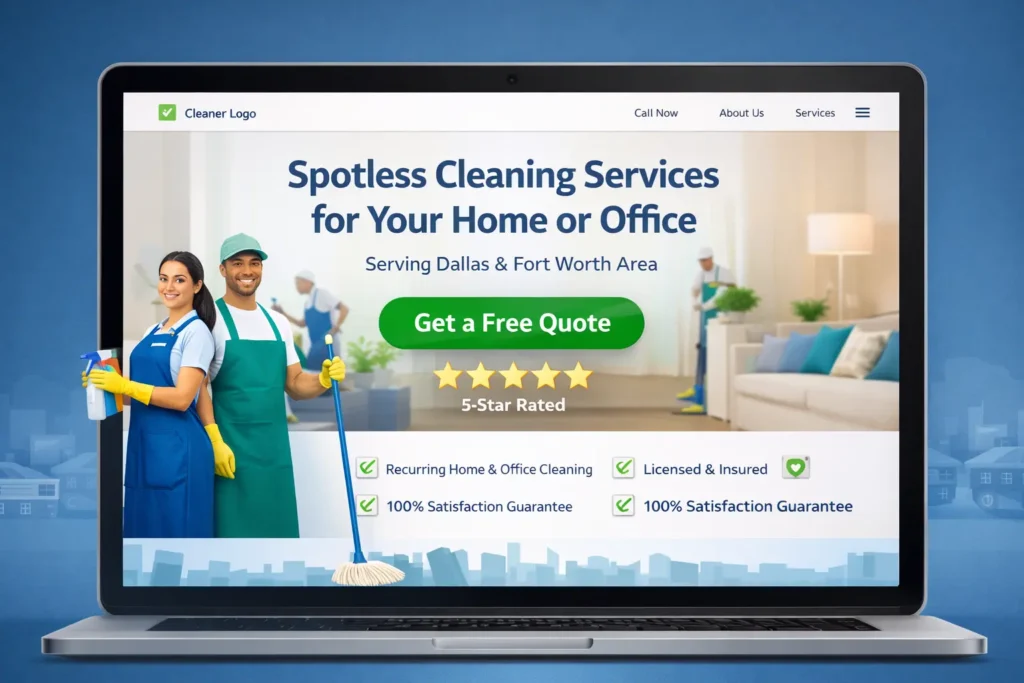
A good homepage should give a clean summary of your offer. It should say what you do, where you work, and what the next step is. Right below that, it should quickly support the promise with reviews, proof, service highlights, and a clear action button. You do not need fancy animation to do that well. In fact, simple usually wins because it removes friction.
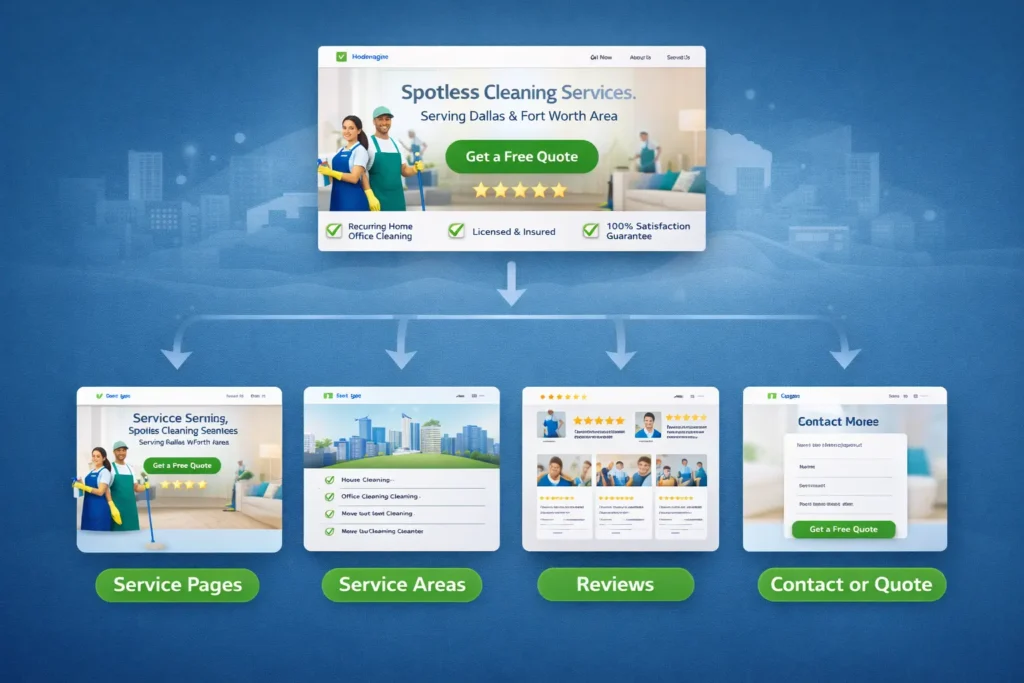
Here is a structure that works well for most cleaning businesses:
| Page | What it should do | Why it matters |
|---|---|---|
| Homepage | Explain services, location coverage, and the next step | Gives first-time visitors immediate clarity |
| Service pages | Break out house cleaning, office cleaning, deep cleaning, move-out cleaning, janitorial, or post-construction work | Matches search intent and improves relevance |
| Service-area pages | Show the cities or areas you actually serve | Supports local intent and reduces confusion |
| About page | Show who you are, how you work, and why people trust you | Builds credibility beyond price |
| Reviews or proof section | Display testimonials, before/after examples, certifications, insurance, and guarantees | Reduces hesitation |
| Contact or quote page | Keep the form short and mobile-friendly | Makes conversion easier |
That structure is practical because it mirrors how people search and how Google reads business entities. Google’s documentation for local business structured data also makes it clear that websites can give search engines details such as hours, departments, and other business information in a more organized format.
A practical example would be a homepage headline like: “Recurring Home and Office Cleaning in Tampa Bay. Get a Fast Quote Today.” That says more in one line than a generic welcome message ever will. It gives relevance, local context, and an action point immediately.
How to Build Trust Into the Design
Trust is where many cleaning websites fall short. They may have a nice color palette, but the page still feels thin because it does not answer the quiet questions in a buyer’s mind. Can I trust these people in my home? Are they insured? Do they actually serve my ZIP code? Can they handle recurring work? Do they respond quickly?
That is why the best layouts place proof early instead of burying it in the footer. A short review strip, a mention of being licensed or insured where applicable, a real team photo, and visible service-area information often do more for conversions than another block of generic sales copy. Google Business Profile guidance also stresses using accurate real-world information for your business and precise address or service-area details, which makes consistency across your site and profile especially important for local service brands.
A few trust elements tend to work especially well for cleaning websites:
✅ real review snippets that mention reliability or quality
✅ service-area language that matches where you actually work
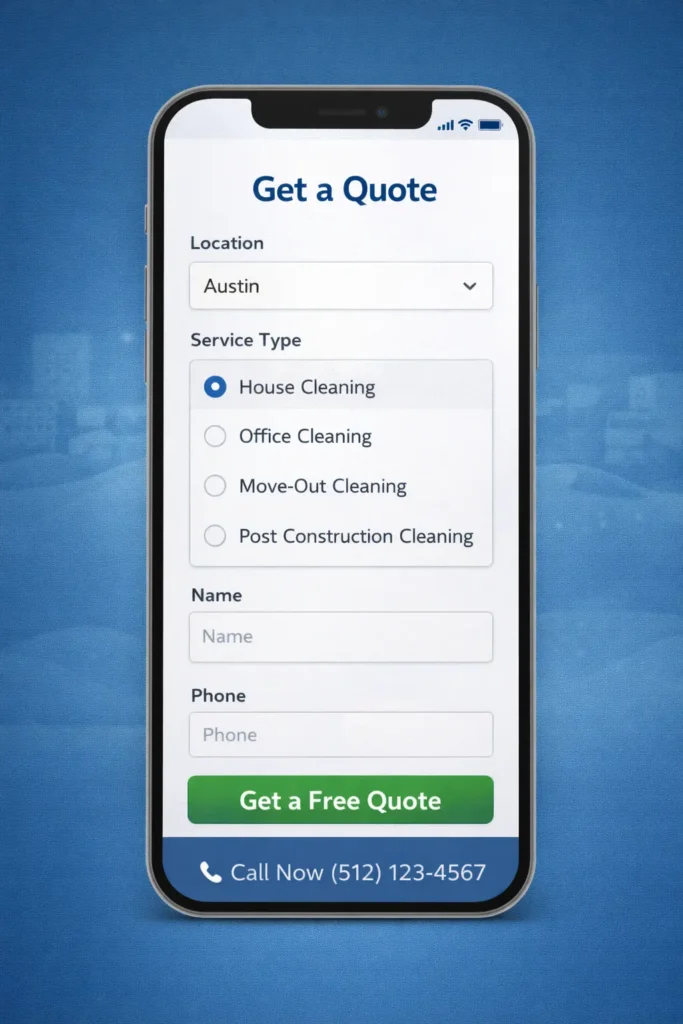
✅ a simple quote form with clear expectations on response time
These are simple, but they matter. If a cleaner serves Austin, Round Rock, and Cedar Park, the site should say so clearly. Google allows service-area businesses to define up to 20 service areas and recommends keeping that information specific and accurate, which means vague “we serve everywhere” language is usually the wrong move.
Another overlooked detail is photography. Use real photos when possible. For a cleaning business, that might mean team photos, detail shots of your process, or clean workspace images that feel believable. Visitors can spot generic stock imagery quickly, and when every cleaning company uses the same smiling spray-bottle photo, trust drops instead of rising.
How Better Design Supports SEO, GEO, and AEO
Good design helps rankings because it improves understanding. Search engines and answer engines respond better when the page structure is clear, the headings are descriptive, and the content actually answers the question behind the search. Google’s people-first content guidance is very direct on this point. Content should be made to help people, not just to manipulate rankings.
That means your cleaning website should not just chase keywords. It should answer realistic buying questions such as what is included in recurring cleaning, what neighborhoods you serve, how fast quotes are returned, and whether supplies are included. A website that answers those questions clearly is more useful for organic search, more extractable for AI answers, and better at converting the human visitor who lands there.
Performance matters here, too. Google recommends good Core Web Vitals and identifies loading speed, responsiveness, and visual stability as part of strong page experience. In plain terms, that means your site should load quickly, buttons should work without lag, and the layout should not jump around while someone is trying to tap “Request a Quote.” Reviewing Google’s Core Web Vitals guidance is worth it if your current site feels slow or frustrating on mobile.
For local visibility, consistency matters just as much. Your business name, service area, hours, and contact details should match across the website and your profile. It also helps to review Google Business Profile guidelines so your location and service-area information stay accurate. When your site and profile support each other, your cleaning business becomes easier to trust and easier to understand.
That is why the cleaning company website design should be treated as a sales and search asset at the same time. The best version is not the flashiest one. It is the one that makes intent, trust, and action easier on every screen size.
Which Website Design Option Is Best for a Cleaning Business
Not every cleaning business needs the same build. A solo cleaner launching a first website usually does not need the same setup as a multi-service company covering several cities. The right choice depends on how many services you offer, how competitive your market is, and how much lead quality matters to you.
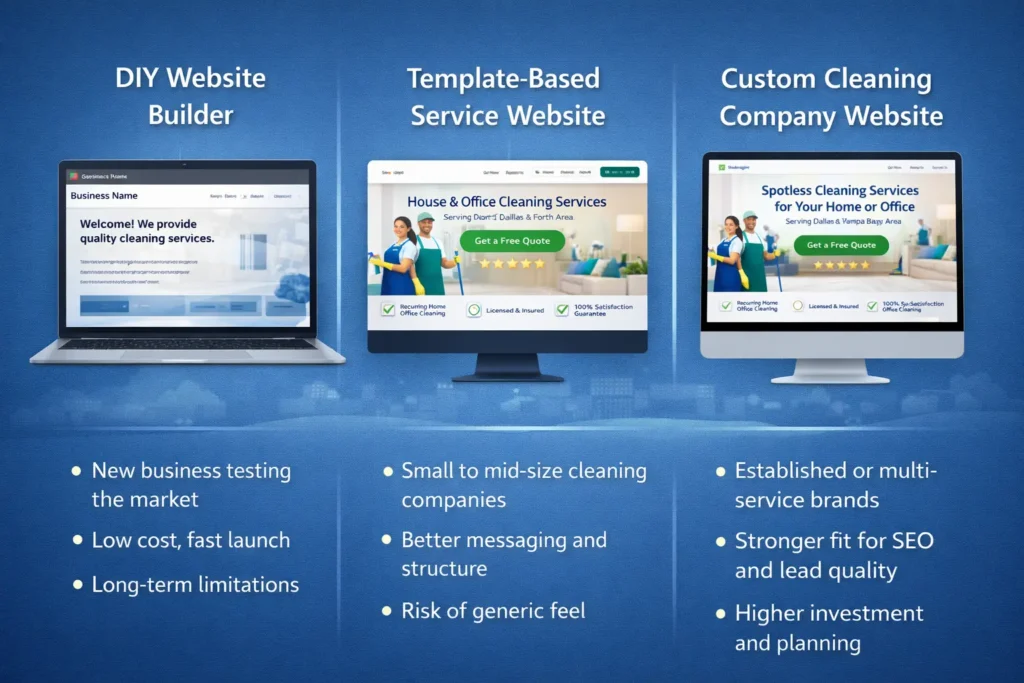
| Option | Best for | Strengths | Limitations |
|---|---|---|---|
| DIY builder | New business testing the market | Low upfront cost and fast launch | Often weak on messaging, structure, and conversion flow |
| Template-based custom setup | Small to mid-size cleaning companies | Better balance of speed, cost, and polish | Can still feel generic if the copy is not strategic |
| Fully custom site | Established cleaning brands or multi-service teams | Strongest fit for SEO structure, lead quality, and trust | Higher investment and more planning are required |
For most serious cleaning businesses, the middle or upper option tends to win. A template can work if the messaging is sharp, the pages are structured around actual services, and the mobile experience is clean. But once you are competing in multiple cities, targeting both residential and commercial leads, or trying to improve lead quality instead of just traffic volume, custom thinking becomes more valuable.
A good rule is this: if your current site already gets traffic but the leads are weak, the problem is often not visibility alone. It is structure, trust, or friction. That is where a web designer with service-business experience is usually the better choice, because they can improve headline clarity, CTA placement, internal linking, page order, and local relevance together instead of treating them as unrelated fixes.
Common Design Mistakes That Cost Cleaning Companies Leads
One of the biggest mistakes is hiding the main action. If someone has to hunt for your phone number or guess where to request a quote, the site is underperforming. Put the action in the hero, repeat it naturally down the page, and make the form short enough to finish on a phone.
Another mistake is using one page to describe every service. That usually creates thin positioning. A person looking for office cleaning and a person looking for move-out cleaning are not searching with the same intent. Dedicated pages help them feel understood. They also help search engines understand what each page is really about.
The third problem is generic copy. “We provide quality cleaning with excellent customer service” does not separate you from anyone else. Better copy sounds more specific. “Weekly apartment cleaning in Phoenix with easy online quotes and flexible scheduling” is much stronger because it tells the reader who it is for, what it offers, and how to move forward.
A final issue is weak local relevance. If you serve three counties, say which ones. If you specialize in Airbnb turnovers, medical office cleaning, or recurring house cleaning, make that obvious. The clearer the fit, the better the conversions usually become.
Final Thoughts on Cleaning Company Website Design
The best cleaning websites are clear before they are clever. When the structure makes sense, the trust signals show up early, and the next step is obvious, the site becomes easier to rank, easier to quote from in AI answers, and easier for real customers to use.
If your current site feels vague, dated, or too generic, start by fixing the basics first: service pages, service areas, proof, mobile speed, and quote flow. Those changes usually do more for rankings and conversions than any other design trend ever will.
Frequently Asked Questions
1. What should a cleaning business website include to attract better leads?
A cleaning business website should include clear services, local relevance, trust proof, and an obvious next step. In practice, that means a strong homepage headline, separate pages for major services, real reviews, visible service-area coverage, and a short quote form that works smoothly on mobile. The goal is not just to look professional. The goal is to help the right visitor quickly understand what you do, where you work, and why they should contact you instead of leaving for a competitor.
2. How much does it usually cost to hire a web designer for a cleaning company website?
The cost depends on the depth of the website, not just the design itself. A simple starter site with a few pages will cost far less than a custom build with service pages, city pages, FAQ content, portfolio sections, and conversion tracking. The better question is what the site needs to do. If you want better lead quality, stronger local SEO structure, and a cleaner user journey, a strategic build usually pays off faster than the cheapest option.
3. Is a custom website better than a template for a cleaning company?
A custom website is usually better when your cleaning business needs stronger positioning and better lead quality. Templates are fine for testing or getting online quickly, but they often leave important gaps in service structure, trust placement, and local targeting. A custom approach becomes more valuable when you offer multiple services, compete in a crowded market, or want the site to support both rankings and conversions instead of just looking clean.
4. Can website design really help a cleaning company rank better on Google?
Website design can absolutely help rankings when it improves clarity, speed, structure, and usability. Design alone will not replace SEO, but it strongly supports it. A better layout makes service pages easier to understand, improves mobile behavior, helps with internal linking, and keeps visitors engaged longer. When the website is fast, the headings are logical, the service areas are clear, and the content answers real buyer questions, the site becomes easier for Google and easier for customers at the same time.