
A gym website that gets leads helps local fitness businesses turn website visitors into real membership enquiries.
A high-converting gym website makes it easy for local prospects to understand your offer, trust your brand, and take the next step fast. The best gym sites combine strong messaging, mobile speed, proof, and a simple way to book, call, or claim a trial.
A lot of local gyms lose leads because their website acts like a brochure instead of a sales tool. It may look decent, but it does not guide visitors toward one clear action. When someone lands on your site after searching for a gym, personal trainer, bootcamp, or class near them, they should know within seconds what you offer, who it is for, and how to get started.

Why Most Gym Websites Do Not Turn Traffic Into Leads
Most gym owners think a website only needs a few nice photos, a class list, and a contact page. That is usually where the problem begins. A visitor does not arrive thinking, “I hope this gym has a beautiful layout.” They arrive with a question in mind: Is this the right place for me, and how do I try it?
That means your website has one job. It needs to remove hesitation.
For a local gym, hesitation usually comes from the same few issues:
✅ The offer is unclear
✅ The next step is hidden
✅ The site feels outdated or slow
✅ There is not enough proof
✅ The form asks for too much too early
Google also gives businesses more ways to surface important local details in Search. Its documentation explains that local business structured data can help pages appear in richer search experiences, while Business Profile categories and booking options help customers find relevant businesses and take action more easily. For a gym, that means your website and local presence should work together instead of operating like separate assets.
This is why design alone is never enough. A website that generates enquiries needs the right message, the right page structure, and the right conversion flow. It should feel less like an online flyer and more like a helpful front-desk staff member who knows exactly what to say.
How a Gym Website Turns Interest Into Enquiries
The strongest gym websites follow a simple sequence. They attract attention, build confidence, and then make the next step easy.
Start with one clear promise
Your homepage hero should answer three questions right away:
Who is this gym for?
What result can they expect?
What should they do next?
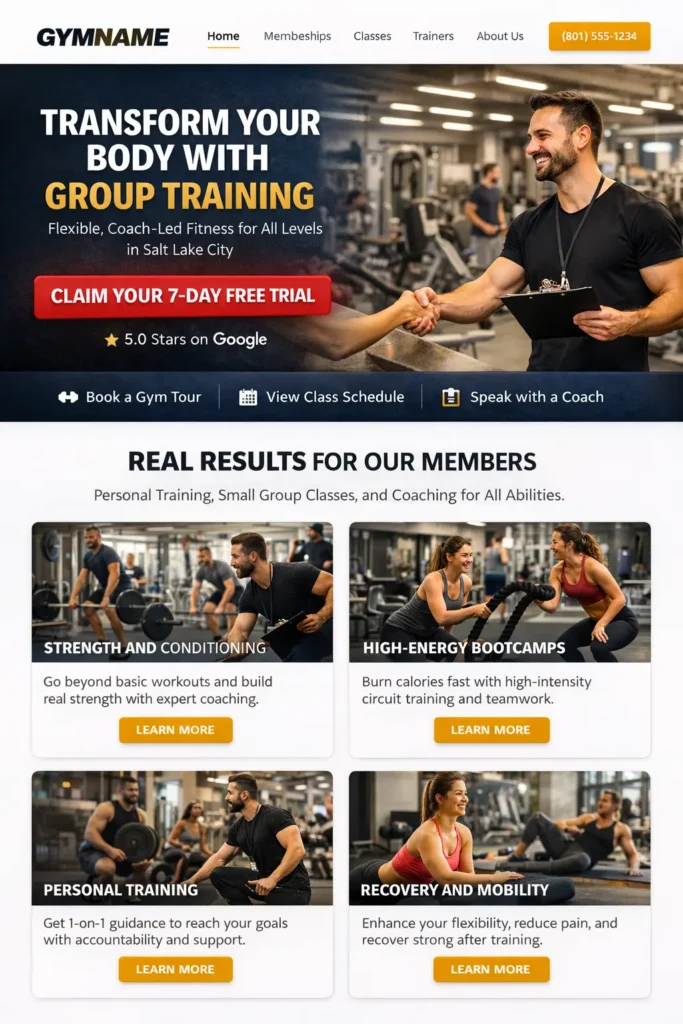
A vague headline like “Transform Your Life” is too broad. A better headline speaks to the visitor’s intent. Something like “Small Group Training for Busy Professionals in Salt Lake City” or “Strength Coaching and Fat Loss Programs for Beginners” is more specific and more useful.
Specificity helps the right people qualify themselves. It also reduces bounce because the visitor does not need to guess whether your gym is a fit.
Make the next step obvious
A visitor should never have to search for your call to action. The best option for most local gyms is one primary action across the site. That could be:
✅ Book a free consultation
✅ Claim a 7-day trial
✅ Schedule a gym tour
✅ Get your first class free
What matters is consistency. If one page says “Join Now,” another says “Contact Us,” and another says “Learn More,” you create friction. A single main CTA keeps the path clear.
Build trust before asking for contact details
A local prospect wants reassurance. They want to know the gym is real, the people are credible, and the experience matches what they need. That trust usually comes from:
✅ Real photos of the facility
✅ Coach bios with credentials
✅ Reviews and testimonials
✅ Membership or program details
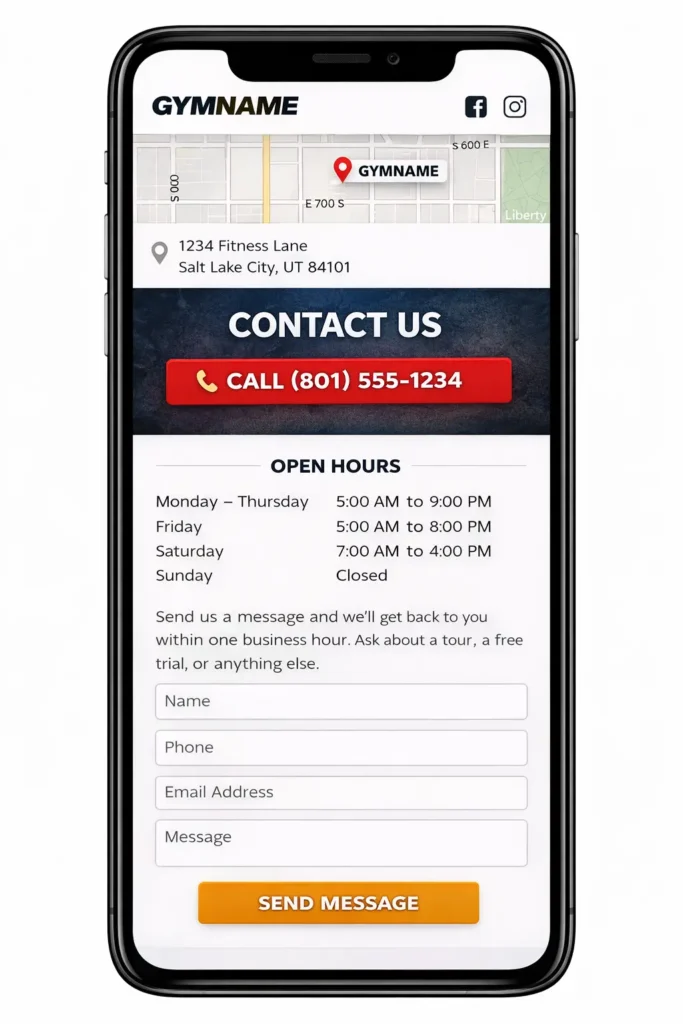
✅ A visible address, map, and hours
This is also where speed matters. Google recommends achieving good Core Web Vitals for success with Search and overall user experience, and a web.dev case study from Renault found a strong correlation between Largest Contentful Paint and conversion rate across 10 million visits. A slower site can still rank, but a faster site is easier to use and more likely to keep prospects moving.
Keep the form short and easy on mobile
Many gym leads come from mobile users who are deciding quickly. If your form is long, clunky, or hard to tap, you lose momentum. Google’s web.dev guidance emphasizes helping users complete forms as quickly and easily as possible, and HubSpot’s current lead form guidance recommends keeping lead capture forms short, mobile-friendly, and easy to find. You can review both here: LocalBusiness structured data guide and lead form best practices.
A gym does not usually need a ten-field enquiry form. Name, email, phone, and one qualifier, such as “I’m interested in personal training,” is often enough.
What Should a Lead-Focused Gym Website Include?
Here is the simplest way to think about it. Every important section should answer either why the visitor should trust you or what they should do next.
| Website Element | Why It Matters | Best Option for a Local Gym |
|---|---|---|
| Hero section | Creates the first impression and sets direction | Clear headline, short subtext, one CTA button |
| Offer section | Gives the visitor a reason to act now | Free trial, gym tour, intro session, or beginner package |
| Social proof | Reduces risk and builds trust | Google reviews, short member stories, before-and-after examples |
| Program overview | Helps visitors self-identify | Personal training, group classes, strength coaching, recovery, youth programs |
| Coach bios | Makes the business feel credible and human | Short bios with photo, specialty, certification, and coaching style |
| Contact and booking | Turns attention into a lead | Sticky CTA, short form, click-to-call, booking button |
| Local trust signals | Supports local SEO and confidence | Address, map, service area, parking info, hours, FAQs |
The best option is not always the fanciest feature. For example, many gym owners think a full membership portal should be the first priority. In reality, a clear trial offer and a friction-free contact flow usually create more lead opportunities than a complex members-only system.
Which Pages Matter Most for a Local Gym Business?
A gym website does not need dozens of pages to perform well. It needs the right pages doing the right job.
| Page | Main Goal | Best CTA |
|---|---|---|
| Homepage | Introduce the brand and guide the visitor | Book a tour or claim a trial |
| Membership page | Explain pricing logic and value | View plans or speak to a coach |
| Personal training page | Convert high-intent visitors | Book a consultation |
| Classes page | Show schedule and class style | Reserve a spot |
| About page | Build trust through story and team | Meet the coaches or start today |
| Contact page | Capture ready-to-act leads | Call now, get directions, or submit a form |
The homepage should not try to say everything. Its job is to direct the visitor to the right next page based on what they care about most.
Your membership page should not just list prices. It should explain what is included, who each option is for, and what happens after someone signs up or enquires. Even a short “best for beginners,” “best for accountability,” or “best for busy schedules” note can help improve decision-making.
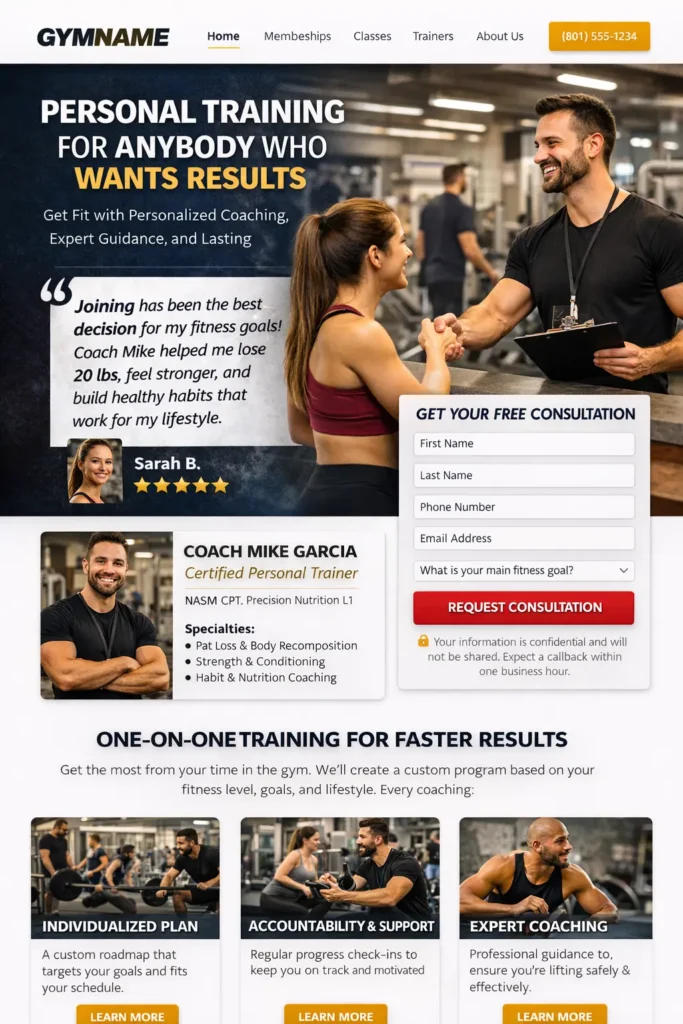
A personal training page is especially valuable because these visitors are often closer to converting. They want results, guidance, and accountability. This page should include coach photos, coaching philosophy, expected outcomes, and an easy way to book a first consultation.
Your classes page should do more than post a timetable. It should explain the feel of each class. Is it high-energy, beginner-friendly, strength-based, mobility-focused, or technique-heavy? That context helps people imagine themselves joining.
This is also a smart place to study what works across related niches. A well-structured yoga studio website often does a strong job of communicating atmosphere, class fit, and first-visit confidence. A strong fitness business website also shows how to separate offers clearly so a visitor does not feel lost.
The Best Conversion Path for Most Gyms
For most local gyms, the highest-performing path is simple:
- The visitor lands on a focused page
- They see a clear offer
- They read proof that the gym is trusted
- They complete a short form or tap to call
- They receive a fast follow-up
That follow-up matters more than many businesses realize. A website can generate the lead, but your process closes it. If someone requests a tour and hears nothing for a day, the site did its job, and the business lost the opportunity.
A strong thank-you page can also improve results. Instead of a flat “Thanks, we got your message,” tell them what happens next. Example:
“You’ll hear from our team within one business hour. Want to move faster? Call us now.”
That is a small change, but it reduces uncertainty and gives motivated leads another action.
If you want inspiration for layout and conversion flow, reviewing website redesign that converts and portfolio highlights is useful because it keeps attention on structure, hierarchy, and trust instead of just decoration.
Local SEO and On-Page Signals That Support Lead Generation
A website that converts still needs to be found. For a local gym, that means your site should support both user experience and local relevance.
Start with location clarity. Your city, neighbourhood, and service areas should appear naturally in titles, headings, body copy, and metadata where relevant. Do not force them into every sentence. Use them where they help the reader.
Next, make sure your core business details match across your website and your Business Profile. Google’s documentation notes that accurate contact details, categories, and links help customers find and learn more about your business, while business links can support actions such as bookings where eligible.
Then add FAQ content that reflects real buying questions. This helps both search visibility and conversion because you are handling objections before the lead disappears.
A few practical examples of strong SEO-supporting content for a gym site include:
✅ a page for personal training in your city
✅ a page for beginner-friendly group classes
✅ a page for weight loss coaching or strength coaching
✅ a FAQ about pricing, parking, hours, and trial options
The key is intent. Each page should serve a real user question, not just add another keyword variation.
Common Mistakes That Cost Gyms Leads
A surprising number of gym websites lose leads because of basic issues that are easy to fix.
✅ Stock-looking photos that do not show the real gym
✅ No visible CTA above the fold
✅ Slow mobile load speed
✅ Too many menu options
✅ Hidden pricing logic
✅ Forms that feel like paperwork
✅ No proof that beginners are welcome
One of the biggest mistakes is trying to appeal to everyone. A gym that speaks to everyone usually feels generic. A gym that speaks clearly to a real audience feels more credible. You do not need more words. You need better positioning.
For example, “We help busy parents build strength in 45-minute coached sessions” is stronger than “We offer world-class fitness solutions.” The first one sounds like a real service. The second sounds like marketing copy.
Better Results Start With a Gym Website That Gets Leads
A high-performing gym website is not about adding more pages, animations, or flashy effects. It is about giving the right person enough clarity and confidence to take the next step today.
When your messaging is specific, your pages are structured well, and your CTA is easy to act on, your site starts doing real business work. It helps you attract better-fit prospects, reduce wasted enquiries, and turn more of your existing traffic into tours, calls, and memberships.
If a local gym wants stronger results online, the best move is usually not “more traffic” first. It is improving what happens after the click.
Frequently Asked Questions
1. Why does a gym need a professionally designed website?
Because first impressions shape trust and action. A professionally designed gym website helps visitors understand your offer quickly, feel confident in your business, and move toward a booking or enquiry without confusion. It also makes your gym look active, credible, and current. For a local business, that matters a lot because many prospects compare multiple options in minutes. A polished site can be the difference between someone calling your gym or leaving for a competitor.
2. Can a better website really help a gym get more members?
Yes, a better website can absolutely help a gym get more members when it reduces friction. Better design alone is not the point. Better structure is. When your site clearly explains your programs, shows proof, loads quickly on mobile, and gives people one obvious next step, more visitors are likely to enquire. That means the same amount of traffic can produce better results. A stronger website improves conversion, not just appearance, and that is what ultimately drives membership growth.
3. What should a gym website include to generate leads?
A lead-focused gym website should include a clear headline, one strong CTA, trust signals, and an easy contact path. It should also explain your offers in plain language, show real photos, include testimonials, and make it easy to find your address, hours, and phone number. For most gyms, the most important pieces are the homepage, offer page, personal training or class page, and a short mobile-friendly form. Every section should move the visitor closer to the next action.
4. Is investing in web design worth it for a local gym business?
For most local gyms, investing in web design is worth it because the website supports every other marketing channel. Paid ads, social media, referrals, and Google searches all eventually push people back to your site. If the website is weak, you lose leads you already paid for or worked to attract. A better website can keep working every day by answering questions, building trust, and capturing enquiries. Over time, that makes it one of the most valuable marketing assets a local gym can own.