Plumber website design helps local plumbing companies get more calls by making services, trust signals, and contact options clear right away. The best plumber website design also improves local SEO, mobile conversions, and quote requests.
A plumber’s website should help local customers trust you fast, understand your services, and contact you in seconds. The strongest pages do this with clear service messaging, visible proof, service-area relevance, and a simple path to call, request a quote, or book.
A lot of plumbing websites look fine at first glance, but still underperform. They hide the phone number, bury service details, load too slowly on mobile, or try to rank one generic page for every job and every city. That usually leads to weak conversions even when the site gets traffic.
The better approach is simple. Build a site around what a real customer needs in the moment: “Do you handle my problem, do you serve my area, can I trust you, and how fast can I reach you?” When the answer is obvious on every important page, the website becomes a lead asset instead of just an online brochure.
Need a partner that already understands service businesses? Explore our local website design team and see our website design & development services if you want a site built to generate calls, quote requests, and booked jobs.
Why a Strong Plumbing Website Matters
Plumbing is one of the clearest high-intent local services online. People do not browse for fun when they need leak repair, drain cleaning, repiping, or water heater help. They want a fast answer and a business that looks credible. That changes how the website should be designed.
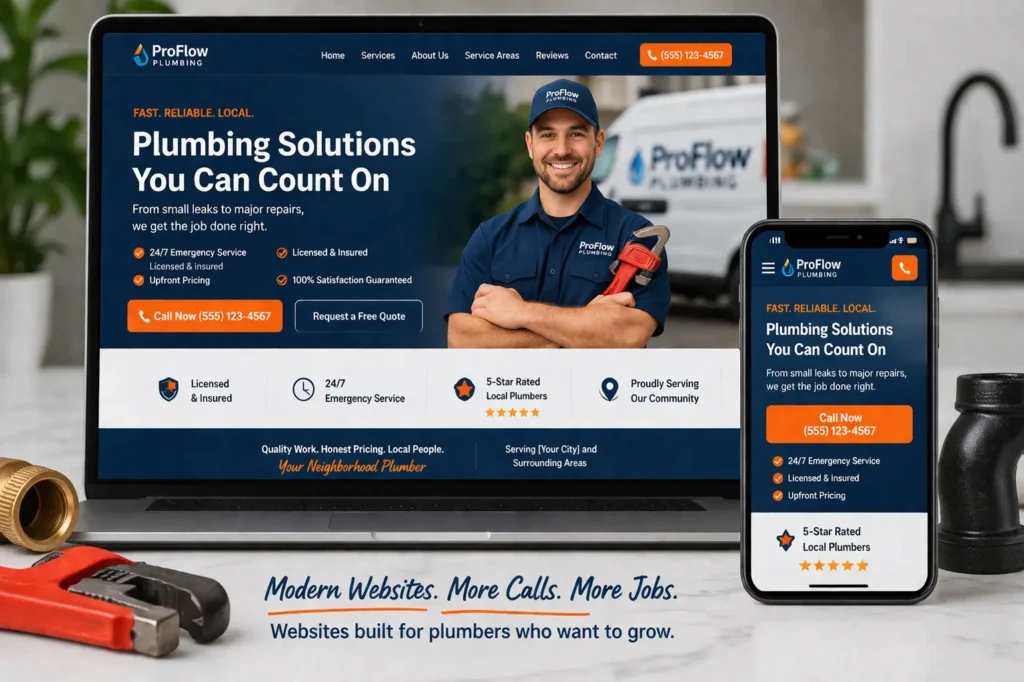
A plumber has to do two jobs at once. First, it must reassure. Second, it must reduce friction. Reassurance comes from real photos, review signals, service details, certifications, financing info if relevant, and copy that sounds experienced instead of generic. Friction reduction comes from sticky contact buttons, short forms, fast mobile pages, and location-specific pages that tell the visitor they are in the right place.
Google’s own guidance says businesses with complete and accurate Business Profile information are more likely to show up in local search results, and its SEO Starter Guide explains that SEO helps search engines understand content while helping users decide whether they should visit a site. That is why a plumbing company should treat the website, map visibility, and page content as one connected system instead of separate marketing tasks.
This is also why broad, vague homepage copy underperforms. A visitor looking for “emergency plumber in Phoenix” does not want to decode what you do. They want to see emergency service, response expectations, areas served, and a contact action right away. A homeowner comparing three companies is making a trust decision quickly. The site that explains more, faster, usually wins.
For more lead-focused service-site inspiration, study how offer clarity and conversion paths are handled in a roofing company website and a gym website that gets leads. The industries differ, but the conversion logic is very similar.
What the Best Plumbing Websites Usually Include
A good plumbing site is not complicated. It is organized around the pages and features that remove doubt.
| Website Element | Why It Matters | What It Should Include |
|---|---|---|
| Clear homepage hero | Gives instant clarity | Main services, city or service area, phone number, CTA |
| Service pages | Ranks and converts better than one general page | One page per core service with process, FAQs, and proof |
| Location pages | Supports local relevance | City-specific copy, areas served, and local trust points |
| Reviews and proof | Builds trust fast | Google reviews, before-and-after photos, licenses, and guarantees |
| Fast contact paths | Reduces drop-off | Click-to-call, short form, booking option, sticky mobile CTA |
| Strong footer and header | Helps every page convert | NAP details, hours, service area, links to key pages |
A simple rule works well here: every important page should answer what you do, where you do it, why you are trustworthy, and what the visitor should do next.
How to Structure a Plumbing Website So It Converts
The homepage should be clear before it tries to be clever. Start with a headline that states the offer, a subheadline that explains who you serve, and a CTA that matches buyer intent. “Call now,” “Request a quote,” and “Book service” each fit different visitor moods. Emergency visitors often prefer the phone. Routine maintenance visitors may prefer a short booking form. A strong site can support both.
Then build out the service architecture. Most plumbing businesses should not rely on a single “Services” page to do all the ranking and conversion work. Separate pages for drain cleaning, water heater repair, sewer line services, leak detection, emergency plumbing, and repiping usually create a cleaner structure. Each page can speak directly to the job, include problem-specific copy, and answer common objections.
This is also where many plumbing sites miss a major opportunity. They talk about the company more than the customer’s problem. A stronger service page explains symptoms, likely causes, what the technician checks, what the customer can expect during the visit, and when the job may need urgent attention. That kind of copy is more helpful, easier to scan, and stronger for AI-driven answer extraction.
Location strategy matters too. If you serve several cities or neighborhoods, create pages that are genuinely useful for each service area. Do not just swap city names. Add nearby landmarks, response coverage notes, neighborhood-specific service concerns, and proof that you actually work there. This keeps the content relevant and more believable.
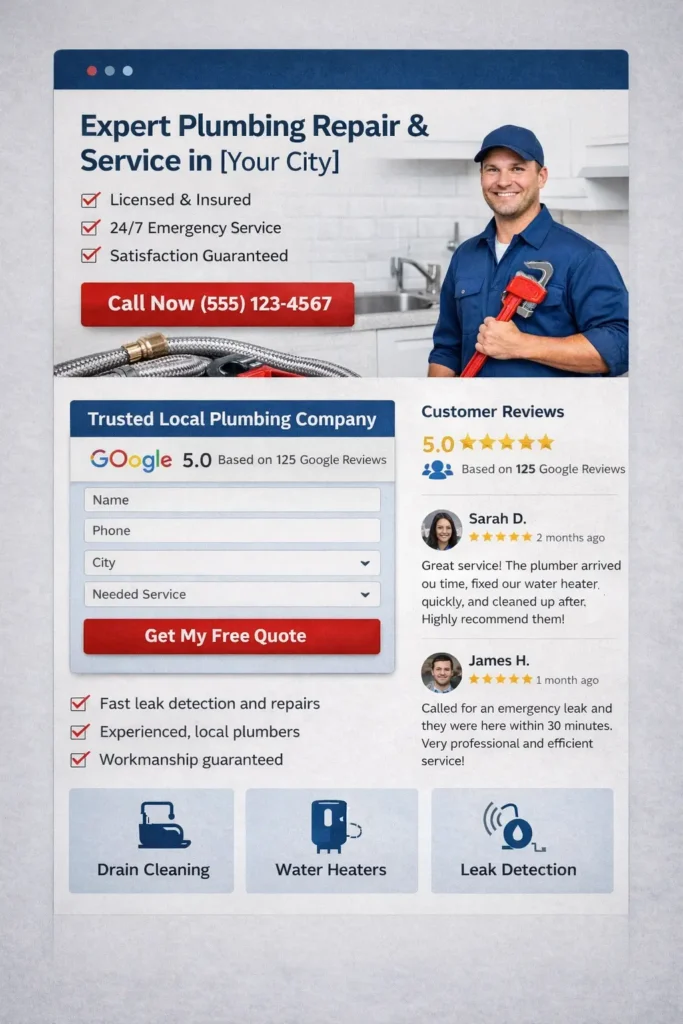
Trust should show up early, not only near the bottom. Put the proof close to the first CTA. That can include review snippets, years in business, financing or warranty messaging, “licensed and insured” language where accurate, and real project photography. For plumbing companies, real-world images outperform generic stock photos because they reduce doubt.
The contact experience should be friction-light. A lot of plumbing traffic arrives with urgency, so long forms create unnecessary resistance. Ask only for what helps you respond: name, phone, service need, and city. Anything else can come later. If you offer online scheduling, make sure it feels secondary to speed, not like a clunky calendar tool that slows down action.
A practical homepage flow that works well
- Clear service headline and primary CTA
- Emergency availability or response message if applicable
- Core services with short descriptions
- Review proof and trust badges
- Areas served
- Why choose us section
- Quote form or booking block
- FAQ and internal links to key service pages
That flow is simple, but it matches how local service buyers think. It also makes the page easier for search engines and AI systems to interpret.
Which Type of Plumbing Website Is Best for Your Business
The best setup depends on the stage of the company, the size of the service area, and how many services you want to rank for.
| Business Type | Best Website Model | Why It Works Best |
|---|---|---|
| Solo plumber or new company | Lean lead-gen site | Fast to launch, clear offer, fewer pages to manage |
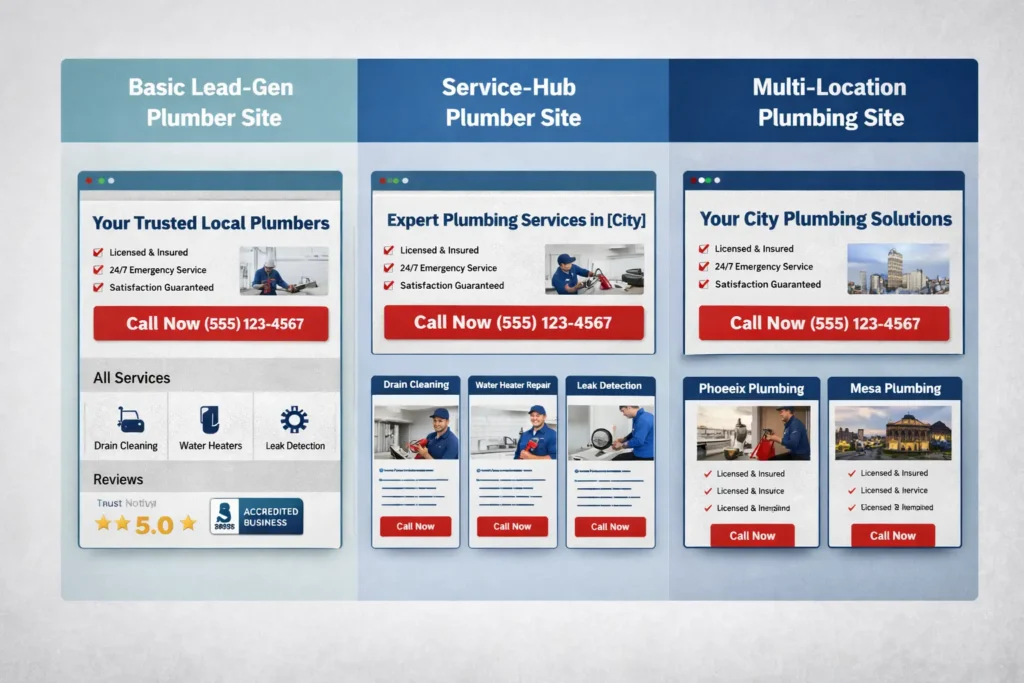
| Local company with 4 to 8 core services | Service-hub site | Let’s rank each major service separately |
| Multi-city plumbing brand | Service + location architecture | Scales visibility across cities without overloading one page |
| 24/7 emergency-focused plumber | Mobile-first call-driven site | Prioritizes speed, contact, and urgency messaging |
| Established company adding SEO growth | Full content-led site | Supports service pages, local pages, FAQ content, and trust assets |
For most small to mid-size plumbing businesses, the sweet spot is a service-hub site. That means a strong homepage, separate pages for each major service, clear city coverage, a review-rich about page, and a contact page that is almost impossible to miss.
A lean site can work when budget or timing is tight, but it reaches a ceiling quickly if everything depends on one homepage. At the other extreme, some companies build a giant site too early and create dozens of thin pages that are hard to maintain. The best option is usually the smallest structure that still gives each major service and service area enough room to be understood.
What Helps This Page Perform Better in Search and Rank Math
The easiest mistake is optimizing for a plugin instead of the user. Rank Math is helpful, but it cannot rescue weak page structure, vague copy, or thin local relevance. Use it to support the page, not to dictate awkward writing.
Start with a focused page title and meta description. Keep the main phrase near the front when it reads naturally. Use one H1, logical H2s, and useful internal links to related service and blog pages. Compress images, write alt text that describes the image honestly, and make sure the contact action is visible without scrolling forever.
Structured data and performance also matter. Google’s LocalBusiness structured data documentation explains that structured data can tell Google about business details such as hours and reviews, while web.dev describes Core Web Vitals as essential metrics for a healthy site and a strong user experience. For a plumbing company, that means the site should be accurate, readable, and fast before chasing extra SEO tricks.
Two useful external resources fit naturally into that workflow. The first is Google’s Business Profile guidance, which helps with local visibility fundamentals. The second is Google’s Core Web Vitals resource, which helps improve speed and usability. Both support the same goal: better local discoverability and a smoother user experience.
Practical on-page tips that usually improve results
Keep city names close to the service where relevant, not scattered unnaturally.
Add one strong CTA above the fold and repeat it lower on the page.
Use real testimonials near the service promise, not buried on a separate page.
Link related services together so users and crawlers can move naturally.
Answer objections directly, such as response time, pricing approach, guarantees, or financing.
A good page also benefits from content blocks that AI systems can quote cleanly. Short, direct answers under clear headings work well. So do tables, process sections, and FAQs written in normal language.
Common Mistakes That Hold Plumbing Websites Back
Some websites fail because of technical issues. Others fail because they never make the customer feel certain. The worst-performing pages often share the same patterns.
❌ The homepage tries to say everything and ends up saying nothing clearly.
❌ Every city page is nearly identical except for the place name.
❌ The phone number is hard to find on mobile.
❌ Service pages are too short to be useful.
❌ Review proof is weak, outdated, or disconnected from the main CTA.
❌ Stock photos dominate the site, making the business feel generic.
❌ The site loads slowly or shifts around while the page is opening.
Another common problem is messaging that sounds like every competitor. Phrases such as “quality service,” “trusted professionals,” and “customer satisfaction” are not wrong, but they are too broad on their own. The site needs sharper language. Say what you fix, how quickly you respond, where you work, and why your process is different.
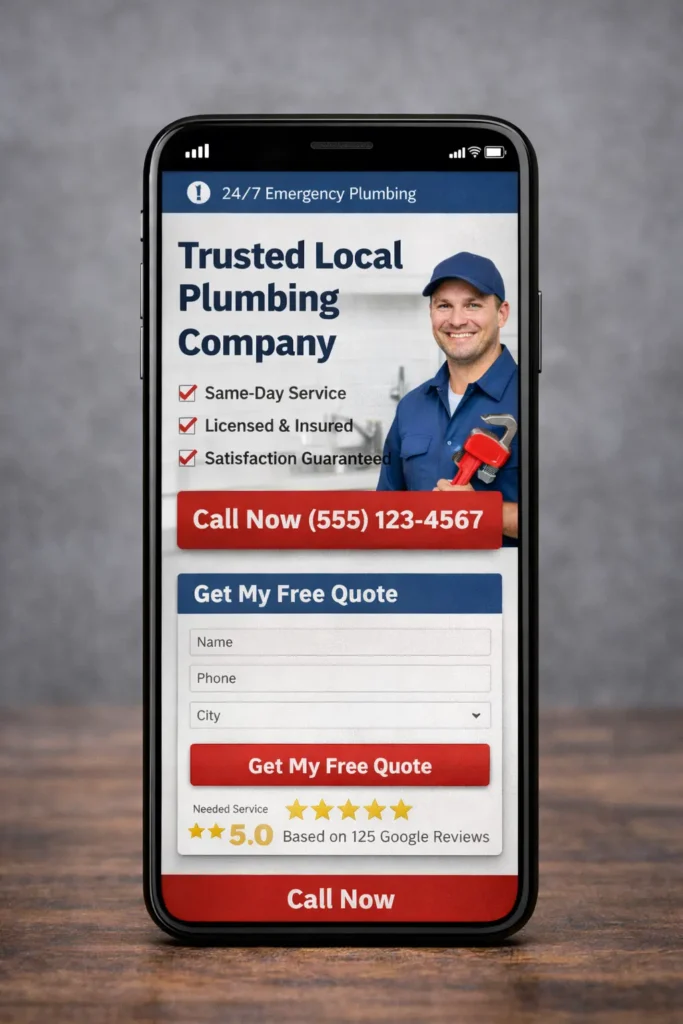
It also helps to think in pages, not just design. A beautiful site can still underperform if the service pages are thin or the internal links are weak. Good design should guide attention, but content should close the decision.
A Better Way to Think About Messaging
The most effective plumbing websites usually speak to one of three customer states:
Urgent problem: burst pipe, leak, clog, no hot water
Planned service: replacement, inspection, upgrade, installation
Comparison mode: checking reviews, price approach, service area, and reputation
When you write with those states in mind, the content gets stronger. An emergency page should sound fast and calm. A water heater replacement page should sound informative and confidence-building. A comparison-ready homepage should highlight reviews, experience, process, and easy contact.
This is where your article and service pages can stand out in GEO and AEO. Instead of repeating the keyword, explain the decision clearly. Show the visitor what to expect. Use concise answers high on the page. Add supporting sections that AI systems can lift into summaries. And keep the next step obvious.
Final Take on plumber website design
The smartest investment in plumber website design is not flashy visuals. It is a site structure that makes your services clear, your trust easy to verify, and your contact path effortless from any device.
When a plumbing website combines service-focused pages, real trust signals, clean local relevance, and fast mobile usability, it gives both search engines and customers what they need. That is the kind of page that earns more calls, more qualified leads, and better long-term search visibility.
Frequently Asked Questions
1. What should a plumbing website include?
A strong plumbing website should include clear service pages, trust signals, and fast contact options. At a minimum, it needs a strong homepage, separate pages for major services, service-area details, review proof, and a short contact form or click-to-call button. It should also show real business information clearly, including phone number, hours, and location coverage. When those basics are handled well, the site becomes easier to rank and much easier to convert.
2. How much does a plumbing website usually cost?
The cost of a plumbing website depends on the structure, content depth, and conversion features you need. A simple lead-generation site costs less because it has fewer pages and less content strategy behind it. A more complete site with service pages, local landing pages, schema setup, speed work, and stronger copy usually costs more because it is built to support growth. The cheapest option is rarely the best value if it does not generate inquiries.
3. Do plumbers need separate service area pages?
Yes, plumbers often benefit from separate service area pages when they genuinely serve multiple cities or neighborhoods. These pages help clarify where you work and can support local visibility when they are written with useful, location-specific details. The key is quality. Do not publish duplicate pages with swapped city names. Each one should reflect the area, service relevance, and customer expectations in a way that feels real and helpful.
4. Is online booking necessary for a plumbing website?
Online booking is helpful, but it is not always the primary conversion tool for plumbers. For urgent plumbing needs, many visitors still prefer to call right away. For routine appointments, online booking or a short request form can work very well. The best setup usually gives the visitor both options. That way emergency users can act fast, while non-urgent users can request service in the format they prefer.