Local cleaning business websites should make trust, service clarity, and quote requests feel effortless. The best-performing sites help nearby visitors understand what you clean, where you work, and how to contact you in less than a minute.
A strong design is not about adding more pages just to look established. It is about guiding the right visitor to the right action at the right time. For cleaning businesses, that usually means a clear homepage, focused service pages, location relevance, real trust signals, and a fast path to a quote or call.
If you want a broader look at how service brands are built online, start with small business web design experts and compare the positioning with your current site.
Why website design matters so much for cleaning companies
A cleaning company does not get much time to earn trust online. Most visitors land on a page, scan it quickly, and decide whether the business looks credible, local, insured, and easy to work with. If any of those signals feel weak, they leave and check the next result.
That is why design and conversion structure matter more here than in many other industries. A cleaning site needs to answer practical questions fast. Do you handle homes, offices, or both? Do you offer recurring services? Which cities do you serve? How can someone get pricing without chasing you around the site?
Google’s own local ranking guidance also makes this practical. Relevance, distance, and prominence all matter for local visibility, so your website should reinforce what your Business Profile and service footprint already communicate. See Google’s tips to improve local ranking.
What a high-converting cleaning website needs
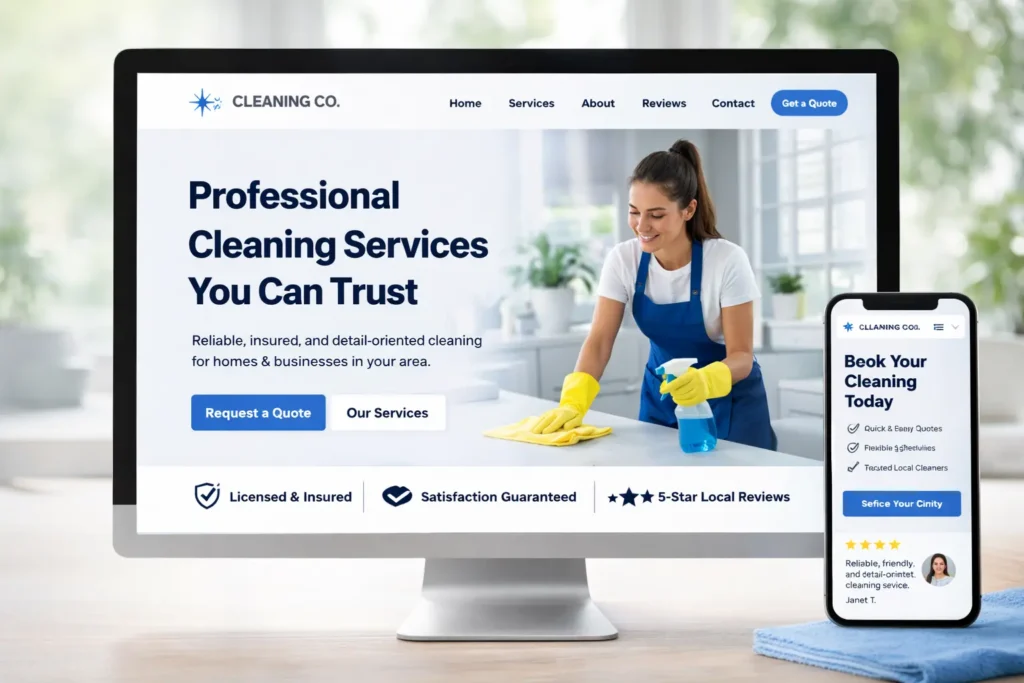
The strongest sites are not cluttered. They are specific. They make it obvious who the business serves and what the next step is.
| Website Element | Why It Matters | What To Add |
|---|---|---|
| Clear headline | Shows visitors they are in the right place | Mention service type, service area, and value |
| Service overview | Reduces confusion fast | House cleaning, deep cleaning, move-out, office cleaning |
| Trust section | Eases hesitation | Reviews, insurance, background-checked staff, years in business |
| CTA area | Drives action | Quote form, click-to-call button, booking request |
| Local proof | Supports local intent | City pages, map area, and nearby testimonials |
A common mistake is writing copy that sounds polished but says very little. “We provide exceptional cleaning solutions” is vague. “Weekly house cleaning in Phoenix with flexible scheduling and online estimates” is usable. Cleaning buyers want confidence and clarity, not filler.
If you are planning a rebuild, your website design & development services page should be one of the first supporting links you place around this topic.
Your homepage should answer five things immediately
The homepage is where many cleaning businesses lose the lead. It should not act like a brochure. It should act like a decision page.
Within the first screen, the visitor should see what you do, who you serve, where you work, and how to take action. A short credibility line helps too, especially if you have recurring clients, trained cleaners, or satisfaction guarantees.
A practical homepage structure looks like this:
✅ A simple headline with service and area
✅ A supporting line about trust or scheduling
✅ One primary CTA, such as Request a Quote
✅ A short services grid
✅ Reviews or star ratings
✅ Service areas or location highlights
That structure works because it matches the way people search. They are not browsing for entertainment. They are looking for a local service provider who seems reliable and easy to contact.
For inspiration from real builds, review the portfolio highlights and study how clean layouts reduce friction.
Service pages are where real conversion intent happens
A homepage gets attention, but service pages close the gap between interest and action. If you offer multiple cleaning services, each one should have its own page. That includes recurring house cleaning, deep cleaning, move-in or move-out cleaning, janitorial services, post-construction cleaning, and specialty work.
Separate pages help in three ways. First, they improve clarity for visitors. Second, they make internal linking easier. Third, they give Google and AI systems clearer signals about what each page is actually about.
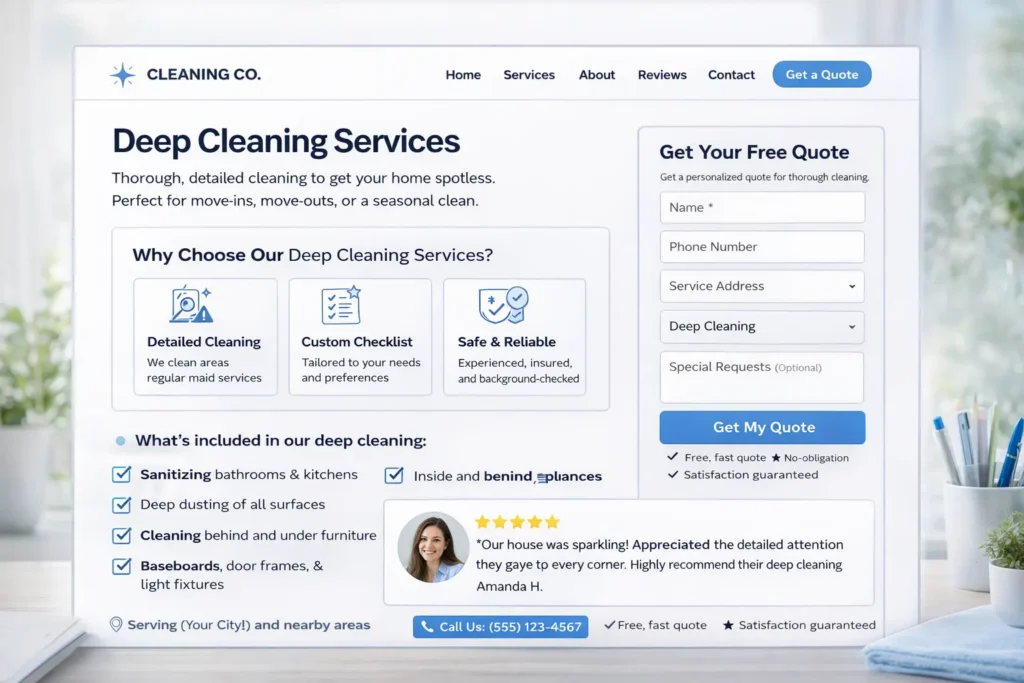
Each service page should include a short intro, ideal customer fit, what is included, optional add-ons, service area context, FAQ, and CTA. A before-and-after mindset works well, too. Show the problem, show the result, then make the next step simple.
If your audience is more residential, this article on maid service website ideas is a natural related link to place in the middle of the article.
Location pages help you win nearby searches without sounding spammy
A lot of cleaning businesses either ignore location pages or overdo them. Both hurt performance. Good location pages are useful, specific, and clearly connected to a real service area.
Instead of copying one city page ten times, make each page reflect the area. Mention neighborhood patterns, service demand, apartment turnover, office cleaning needs, or common scheduling preferences. A page for a downtown business district should not sound the same as a suburban family-home page.
This is where a web designer can bring real value. The page should feel locally grounded without becoming stuffed with city names. Helpful structure beats keyword repetition every time.
If you work with more commercial contracts, link out naturally to janitorial website design tips because that topic speaks to a different buyer journey and expectation set.
Trust signals matter more than clever visuals
In cleaning, trust is the conversion engine. People are often given access to a home, office, rental property, or sensitive space. That means your trust section cannot be generic.
The best trust signals are concrete. Use real reviews, recognizable service areas, insurance mentions, staff screening notes, satisfaction policies, and photos that feel authentic. Team images, branded vehicles, uniforms, and simple process steps all work better than abstract stock visuals.
A good trust section also reduces objection handling later. If a visitor already knows your team is insured, punctual, and reviewed by local customers, your lead form carries less friction.
For a broader reference point, this guide to cleaning company website design examples fits well as a contextual internal link and adds topical support without forcing another sales page mention.
Quote form or online booking, which option is best?
This depends on the type of cleaning business you run. Not every company needs instant booking. In many cases, a smart quote request form converts better because it gathers the details you need before assigning a price or slot.
| Best Option | Ideal For | Why It Works |
|---|---|---|
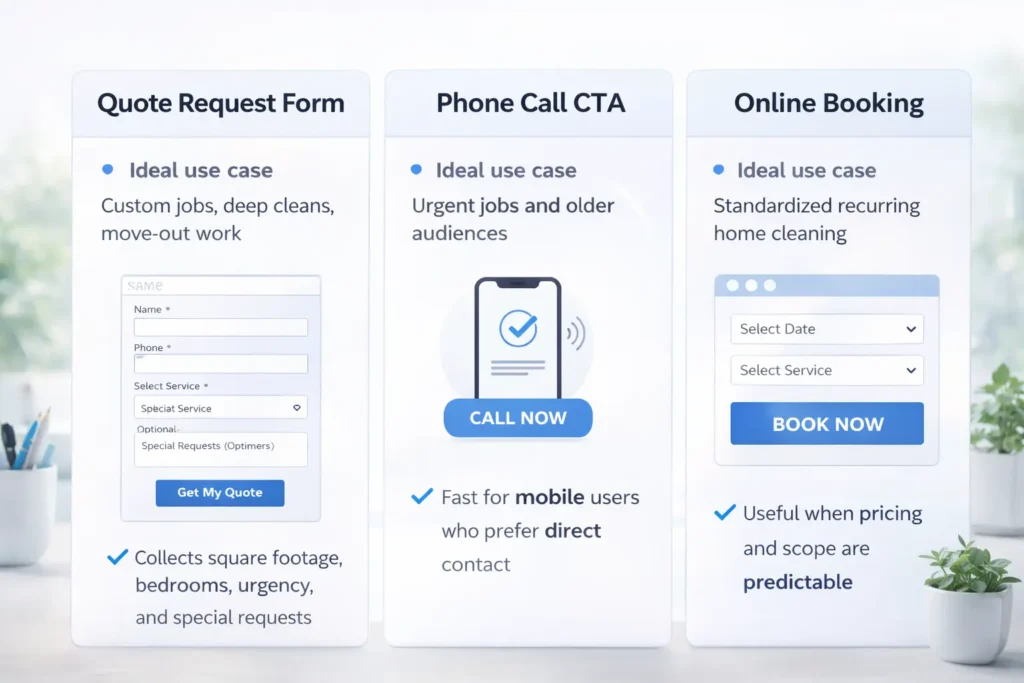
| Quote request form | Custom jobs, deep cleans, move-out work | Collects square footage, bedrooms, urgency, and special requests |
| Instant booking | Standardized recurring home cleaning | Useful when pricing and scope are predictable |
| Click-to-call CTA | Urgent jobs and older audiences | Fast for mobile users who prefer direct contact |
| Hybrid setup | Most growing companies | Lets visitors choose the method they prefer |
For many service businesses, the hybrid setup wins. You place one strong “Request a Quote” CTA above the fold, then offer a secondary call button for people who want immediate contact. That keeps the page conversion-friendly without overwhelming the visitor.
Speed, mobile usability, and GEO/AEO readiness
A cleaning website often gets most of its traffic from mobile devices, so design decisions need to respect small screens first. Buttons should be easy to tap. Forms should stay short. Contact details should not be buried. Maps and service areas should be visible without endless scrolling.
This also matters for search and AI visibility. Google recommends strong page experience and good Core Web Vitals, and it says the same core technical and people-first principles apply to AI features as they do for Search. That means clean structure, crawlable links, clear page purpose, and genuinely useful content still matter. See Google’s guidance on AI features and your website.
In practical terms, that means your site should have:
✅ fast loading pages
✅ clear headings and page hierarchy
✅ internal links that actually help users navigate
✅ specific service and area language
✅ FAQ sections that answer real buying questions
This is one reason overdesigned templates fail service businesses. They look impressive in a screenshot, but perform poorly when an actual customer is trying to book from a phone in under two minutes.
The design mistakes that keep cleaning sites from ranking and converting
One of the biggest issues is trying to say everything on one page. When a site mixes residential, commercial, Airbnb, deep cleaning, office contracts, and every service area into one long homepage, it becomes hard to rank and hard to use.
Another issue is a weak copy hierarchy. Important information gets buried under oversized images, vague statements, or stacked sections with no clear next step. A cleaning site should guide people, not make them work.
There is also the trust problem. Some sites look polished but feel unverified. If the reviews are missing, the service area is unclear, or the forms feel too long, users hesitate. In a service category like cleaning, hesitation kills conversion.
The better approach is to simplify. Fewer distractions, stronger proof, better page separation, and smarter CTAs almost always outperform clutter.
Which website setup makes the most sense for your business?
The answer depends on your service model.
If you are a solo or small residential cleaner, start with a homepage, an about page, two to three core service pages, a review section, and a quote form. That setup is lean, manageable, and enough to compete locally if the copy is strong.
If you run a growing team with multiple service categories, you need a deeper content structure. That includes individual service pages, location pages, FAQ content, and stronger internal linking between related pages. This helps both rankings and lead quality because visitors land on the most relevant page instead of a catch-all homepage.
If your focus is commercial or janitorial work, your site should look slightly different. Buyers in that space care more about contracts, reliability, compliance, scheduling flexibility, and facilities experience. The visual tone, CTA language, and trust signals should reflect that.
The best option is the one that matches how people buy from you, not the one with the fanciest layout.
A simple build order that works well
When I map a cleaning website for better results, I usually prioritize pages in this order:
- Homepage
- Core service pages
- About and trust page
- Contact or quote page
- Location pages
- Blog support content
That order works because it builds the main buying path first. Blog articles help, but they should support your service pages, not replace them. Informational content works best when it pushes readers toward a clear service decision.
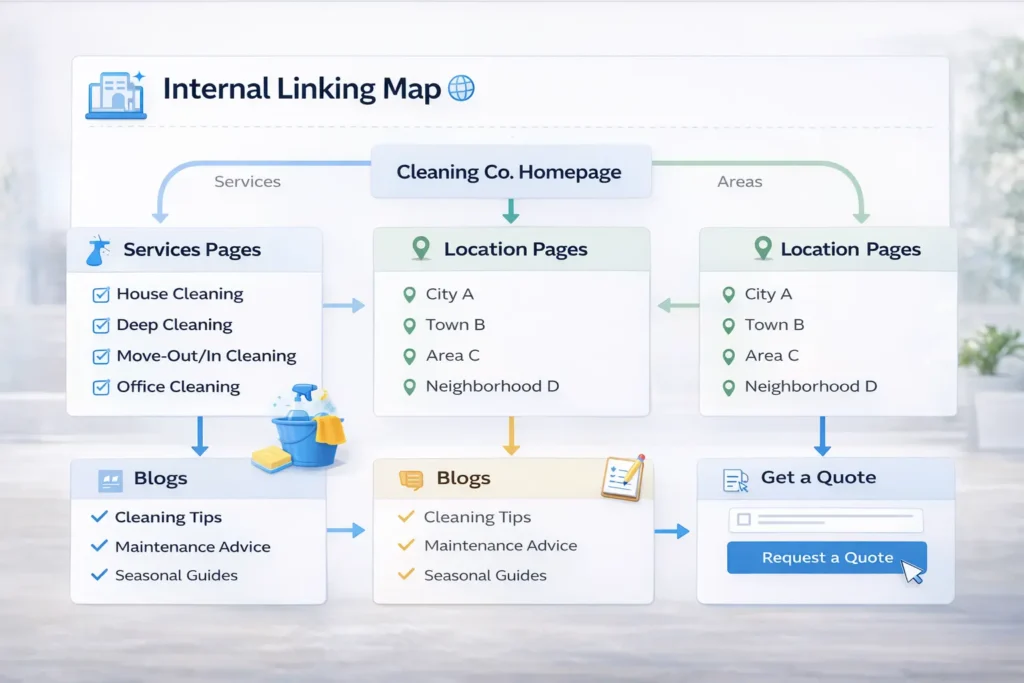
This is also where internal linking should feel intentional. Your blog should support your money pages, your service pages should support nearby services, and your CTA placement should stay consistent from page to page.
Final takeaway
The strongest local cleaning business websites are simple in the right places and detailed where trust matters. They do not rely on trendy layouts alone. They win because they make the offer clear, connect service pages to real local intent, and remove friction from the quote process.
For SEO, GEO, and AEO, the same core rule still applies: create pages that are useful enough for people to trust and structured clearly enough for search systems to understand. When your website does both, it stops acting like an online flyer and starts working like a sales tool.
Frequently Asked Questions
1. What should a cleaning business website include?
A cleaning business website should include a clear offer, service pages, trust signals, and an easy next step. At minimum, the site needs a homepage that states the service and location, individual service pages for your core cleaning offers, a review section, a short about section, and a contact or quote form. It should also show proof that the business is real and dependable, such as insurance, testimonials, service areas, and staff or process details. When those pieces are in place, the website feels easier to trust and easier to act on.
2. How many pages does a cleaning company website need?
Most cleaning company websites need more than a homepage if they want to rank and convert well. A strong starter structure usually includes a homepage, about page, contact page, and separate service pages for each main offer. If the business serves multiple cities, location pages are also important. Adding pages gives search engines clearer topical signals and gives visitors a more relevant entry point. A one-page website can look neat, but it usually limits your visibility and makes messaging too broad.
3. Do cleaning websites need online booking?
Cleaning websites do not always need online booking, but they do need a low-friction conversion path. Some companies benefit from booking tools, especially when service scope and pricing are standardized. Others perform better with quote request forms because jobs vary by size, condition, or urgency. The best setup depends on how you sell. If you offer recurring home cleaning with fixed packages, booking can help. If most jobs are custom, a short quote form often produces better leads and fewer misunderstandings.
4. How can a cleaning website rank better in local search?
A cleaning website ranks better in local search when it matches search intent, shows local relevance, and builds real trust. That means clear service pages, accurate service-area language, strong internal linking, fast mobile performance, and content that answers practical customer questions. It also helps to align the website with your Google Business Profile, reviews, and contact details so your online signals stay consistent. Good local rankings usually come from better structure and stronger usefulness, not from forcing the same keyword into every paragraph.