Clinic website that builds trust helps patients feel safe, informed, and ready to book care. The best clinic websites build confidence through clear provider credentials, patient reviews, privacy signals, and easy appointment steps.
A trustworthy clinic website helps patients feel confident before they ever call or book. The strongest clinic sites make credibility obvious through clear messaging, real proof, simple navigation, and visible privacy details.
When someone lands on a healthcare website, they are not browsing the same way they would browse a restaurant or clothing store. They are often worried, pressed for time, and trying to decide whether your clinic feels safe enough to trust. That is why the homepage, service pages, and booking flow need to answer the patient’s biggest question fast: “Can I trust this clinic with my health and my personal information?”
A lot of clinic websites look polished but still feel weak. The design may be modern, but the trust signals are buried. The copy may sound professional, but it does not answer practical patient concerns. The site may have a booking form, but nothing around it reduces hesitation. In healthcare, small details carry a lot of weight.
This is where smart website strategy matters. A clinic site should not only look clean. It should remove doubt. It should show who you help, what conditions or services you handle, who the providers are, what patients can expect, and how you protect private information. It should also make the next step feel easy.
If your current site feels too generic, too corporate, or too thin on proof, reviewing work from small business web design experts can help you spot what is missing in your own layout and messaging.
Why trust matters more for clinics than almost any other local business
Patients do not choose a clinic based on aesthetics alone. They look for reassurance. That reassurance often comes from a mix of emotional and practical cues.
Emotionally, people want to feel understood. They want to know your clinic treats real people, not just schedules appointments. Practically, they want to know your team is qualified, the services are clearly explained, and the next step is easy.
A trust-first clinic website performs better because it reduces friction in three places:
First, it lowers uncertainty. When the site clearly explains what the clinic does, who it serves, and how the process works, patients do not need to guess.
Second, it lowers perceived risk. Medical decisions feel personal. Patients want proof that your clinic is legitimate, experienced, and respectful of privacy.
Third, it lowers effort. The easier it is to find a provider, understand a service, and book an appointment, the more likely a visit becomes.
That is why many of the best-performing healthcare sites do not try to say everything at once. They focus on clarity, credibility, and patient comfort.
What patients expect to see right away
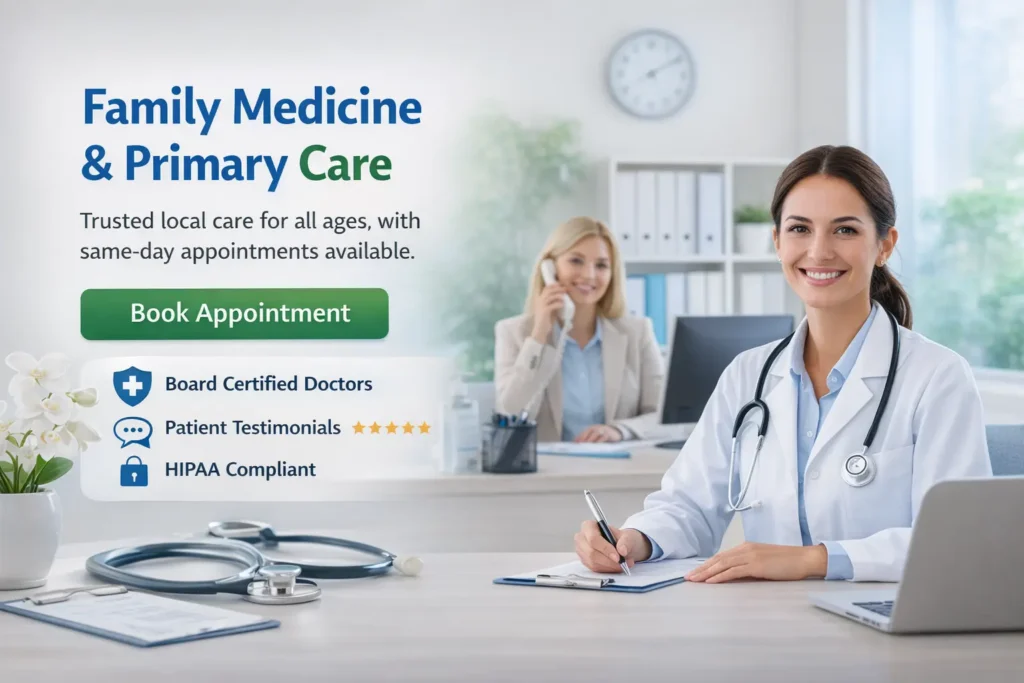
The first screen of your website does heavy lifting. Within seconds, a patient should know who you are, what type of care you provide, where you are located, and what action they can take next.
A strong hero section usually includes a clear headline, a short supporting sentence, one primary call to action, and one trust layer. That trust layer could be a provider credential, review count, years in practice, association logo, or a privacy reassurance near the booking button.
For example, instead of vague copy like “Compassionate care for your family,” a stronger version would say something closer to: “Family medicine in Austin with same-week appointments, preventive care, and ongoing chronic care support.” That kind of message is easier to trust because it is specific.
Patients also expect the basics to be easy to find. Your phone number, address, booking button, insurance information, office hours, and provider list should never be hidden.
Here is a practical breakdown of the trust signals that tend to matter most.
| Trust Element | Why It Matters | Best Placement |
|---|---|---|
| Provider credentials | Shows expertise and legitimacy | Homepage, provider pages, about page |
| Real patient reviews | Reduces hesitation with social proof | Homepage, testimonial section, Google review embed |
| Clear services | Helps users self-identify quickly | Homepage, service pages, menu |
| Privacy and contact details | Signals professionalism and safety | Footer, contact page, forms |
| Easy booking flow | Turns trust into action | Header, homepage, service pages |
| Real clinic photography | Makes the practice feel human and local | Homepage, about page, provider pages |
How to build trust into the structure, not just the design
Many clinics try to “add trust” later through badges or testimonials. That helps, but trust works better when it is built into the structure of the site.
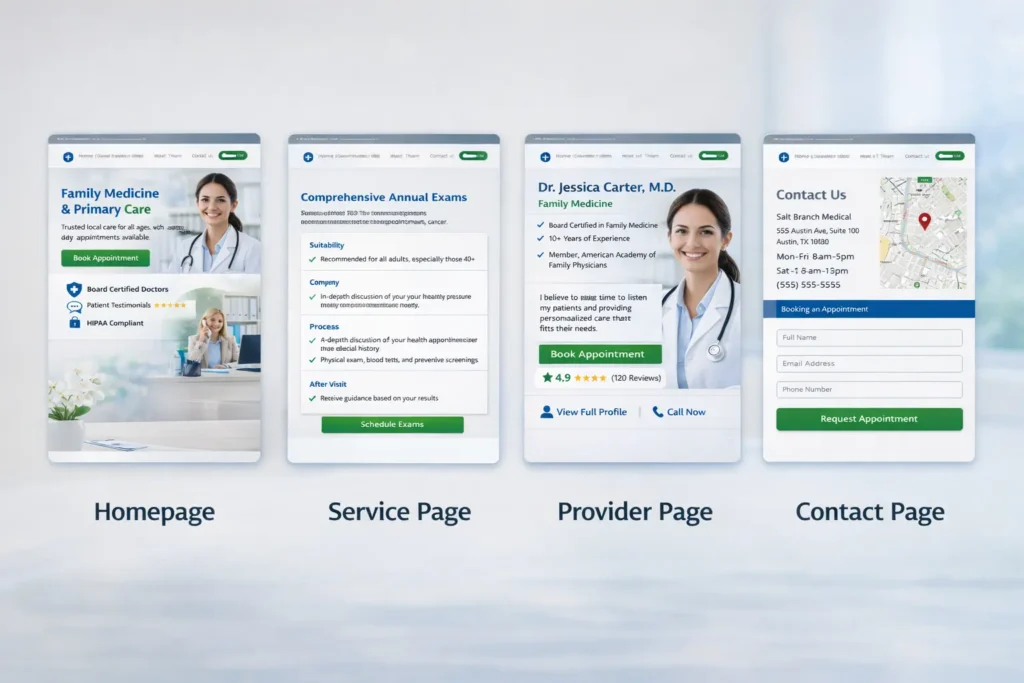
1. Make the homepage answer patient questions fast
Your homepage should guide a nervous first-time visitor. It should answer:
Who do you help?
What services do you offer?
Where are you located?
Who provides the care?
How do I book?
That flow matters more than decorative sections or oversized brand statements. A homepage with too much fluff can actually reduce trust because it feels like marketing instead of guidance.
2. Create service pages that explain the patient journey
A service page should do more than define a treatment. It should help the patient decide whether your clinic is the right fit.
That means each service page should include:
- who the service is for
- common symptoms or reasons someone seeks it
- what happens during the appointment
- what the outcomes or next steps may look like
- a booking prompt
This is also where internal linking helps both SEO and usability. For example, if your article touches on layout inspiration, you can naturally point readers to a medical clinic website design guide or show niche examples like veterinary clinic website examples when discussing specialized trust-building patterns.
3. Give each provider a real presence
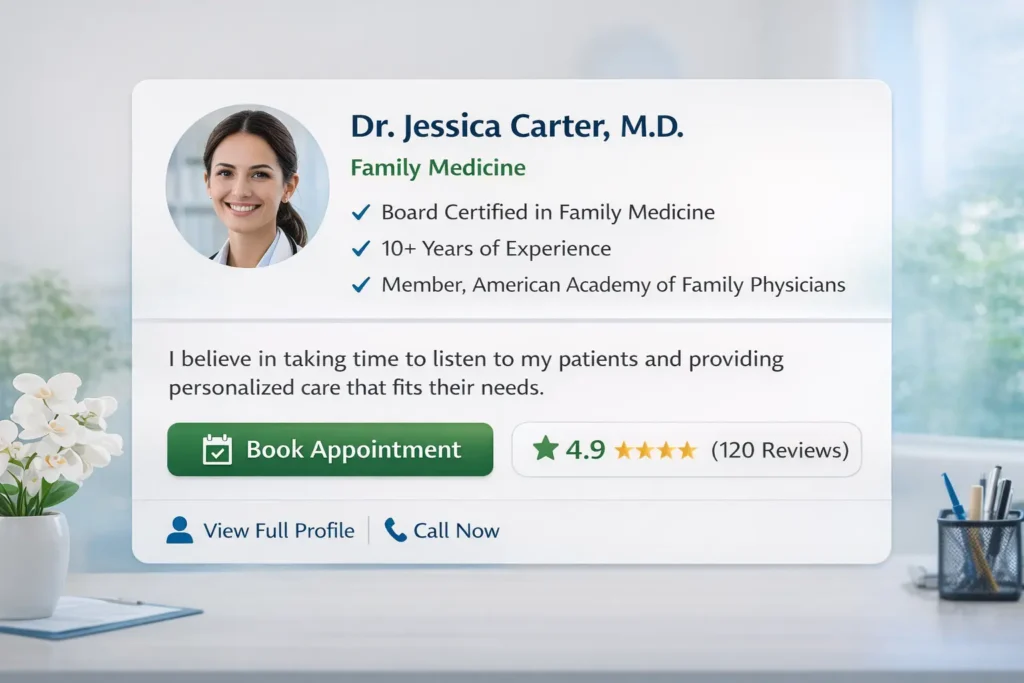
Patients trust people more than brands. A provider page should include a professional photo, credentials, areas of focus, experience, and a short personal note about care philosophy. Even a few well-written lines can make a clinic feel warmer and more credible.
Avoid stiff bios that read like a resume pasted into a website. Keep them clear, human, and relevant to the patient.
4. Use testimonials that sound believable
The strongest testimonials mention specifics. “Everyone was kind” is okay. “The doctor explained my options clearly and the follow-up process was smooth” is stronger because it sounds real and helpful.
If you can, place testimonials near decision points, especially around service pages and booking prompts.
The role of privacy, compliance, and medical credibility
Trust in healthcare is not just emotional. It is operational.
If your website collects patient information, even through forms or appointment requests, privacy expectations rise immediately. In the United States, HIPAA obligations depend on whether the clinic is a covered entity and whether the vendors handling protected health information qualify as business associates. HHS also makes clear that regulated entities must safeguard electronic protected health information through administrative, physical, and technical protections.
That matters for website decisions because “HIPAA compliant” is not usually a simple on or off feature in a generic website builder. Compliance depends on the full setup: hosting, forms, storage, access controls, encryption practices, and whether the vendor will sign a Business Associate Agreement when required.
So if your clinic handles sensitive submissions online, make sure your web partner understands the difference between a nice-looking form and a properly configured patient-data workflow. This is where reviewing website design & development services through a healthcare lens becomes valuable.
Medical credibility also benefits from linking out to trusted public resources when relevant. For patient education, sources like MedlinePlus help reinforce that your clinic values accurate, patient-friendly information. MedlinePlus is run by the National Library of Medicine, part of NIH, and describes itself as ad-free, easy to understand, and regularly maintained.
Which website option is best for your clinic?
Not every clinic needs the same website setup. The best option depends on your stage, volume, and compliance needs.
| Clinic Situation | Best Website Direction | Why It Fits |
|---|---|---|
| New clinic with a limited budget | Lean custom site with strong core pages | Fast to launch, focuses on essentials that build confidence |
| Established local clinic | Trust-focused redesign | Improves conversions without rebuilding operations from scratch |
| Multi-provider clinic | Scalable custom structure | Better for provider pages, service depth, and patient journeys |
| Clinic collecting sensitive intake data | Compliance-aware custom setup | Better control over forms, storage, and access decisions |
| Clinic with poor local visibility | SEO-led redesign | Improves rankings, discoverability, and patient acquisition |
For most clinics, the best option is not the cheapest builder with a healthcare template. It is a structure that balances patient trust, local SEO, mobile usability, and real operational needs. In most cases, that means a custom or semi-custom build with clear service architecture, provider pages, local optimization, and careful handling of forms.
A site can be beautiful and still underperform if it does not guide patient decisions well. On the other hand, a clean, strategically written site often wins because it feels easier to trust.
Content choices that improve Rank Math and real patient behavior
To rank better and convert better, your content has to do both jobs at once. That means writing for search intent without sounding like search content.
A few content choices make a big difference:
Use plain language for patient-facing pages. Medical jargon has its place, but patients often search for everyday words. Your pages should reflect how people actually ask for care.
Match one core intent per page. A service page should focus on one service. A city page should focus on one location. A provider page should focus on one clinician. This keeps the page cleaner for both search engines and humans.
Strengthen internal linking naturally. Link between related services, FAQs, blog posts, and contact actions where it genuinely helps the reader move forward.
Add proof near conversion points. Do not make the reader scroll back up to remember why they should trust you.
Keep metadata clear. Titles and descriptions should promise a useful answer, not just repeat keywords.
This is also why blog content should support the clinic site instead of sitting apart from it. Articles should answer pre-appointment questions, reduce hesitation, and lead readers toward booking or learning more.
What a high-trust clinic website usually includes
A high-trust clinic website usually feels calm, direct, and useful. It does not overload the patient with endless design effects or cluttered copy. It gives the right information at the right time.
That often includes:
- a clear headline on the homepage
- visible contact and booking actions
- service pages with patient-centered explanations
- provider bios with credentials and photos
- review or testimonial proof
- insurance or payment guidance when relevant
- FAQ sections that reduce friction
- privacy, and form reassurance
- educational content connected to real patient questions
The goal is not to impress visitors with complexity. The goal is to make the clinic feel dependable.
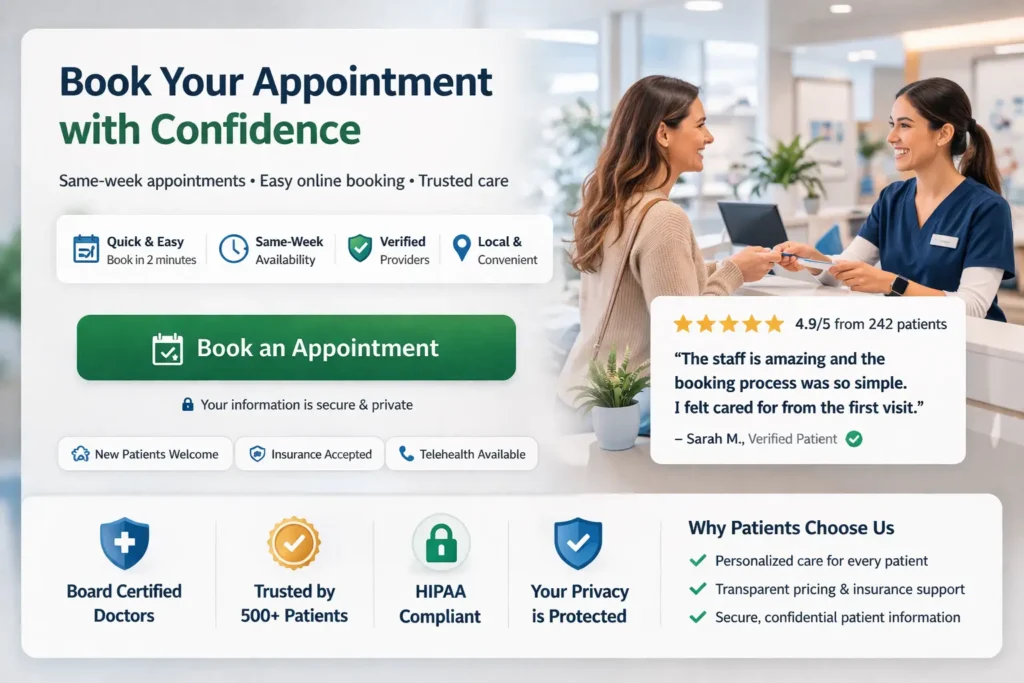
A stronger closing strategy for your pages
A lot of clinic pages end weakly. They trail off with generic text like “Contact us today for more information.” That is not enough in healthcare.
A better closing section should briefly restate who the page is for, what the next step looks like, and why the clinic is worth contacting. It should feel supportive, not pushy.
For example, a service page could end by saying that if the symptoms described sound familiar, the clinic can help assess the issue, explain options clearly, and guide the patient through a simple booking process. That kind of closeness feels human and helpful.
Clinic Website That Builds Trust wins when every page reduces doubt
The best healthcare websites do not rely on one badge, one review, or one polished hero section. They earn confidence step by step. They show expertise without sounding cold, explain care without overwhelming the patient, and make booking feel safe and straightforward.
If you want better rankings, stronger patient confidence, and more booked appointments, build every page around clarity, proof, and ease. That is what separates an average site from one that patients remember and act on.
Frequently Asked Questions
1. What is the most trustworthy medical website?
For general consumer health information, MedlinePlus is one of the most trustworthy medical websites available. It is run by the National Library of Medicine, which is part of the National Institutes of Health, and it describes its mission as providing high-quality, relevant, easy-to-understand health information without advertising. That combination matters because patients need information that is neutral, current, and not shaped by product sales. For a clinic website, referencing trusted public resources like MedlinePlus can also strengthen perceived credibility.
2. Which website builders are HIPAA compliant?
No website builder is automatically HIPAA compliant on its own. Compliance depends on how the site is configured, what patient data is collected, where that data is stored or transmitted, and whether the relevant vendor will sign a Business Associate Agreement when required. HHS makes clear that covered entities and business associates must protect electronic protected health information with administrative, physical, and technical safeguards. In practice, clinics should treat “HIPAA compliant builder” claims carefully and review forms, hosting, access permissions, storage, and vendor contracts before trusting the setup.
3. What is the most trusted medical source?
The most trusted medical source depends on the audience and purpose. For everyday patients looking for understandable condition, symptom, and wellness information, MedlinePlus is a top source because it is run by NLM/NIH and designed for the public. For clinic-grade health education, Mayo Clinic is also highly trusted because it is a nonprofit medical institution with a strong health information policy and an extensive condition library. For research literature, many clinicians look to PubMed and peer-reviewed journals through NLM. The key is to match the source to the user’s level and need.
4. What site is better than WebMD?
For many users, MedlinePlus is a better starting point than WebMD when the goal is neutral, patient-friendly medical education. MedlinePlus explicitly says it is free of advertising and focuses on understandable health information, which can make it feel more objective for people comparing symptoms, medications, or conditions. Mayo Clinic is another strong alternative when users want practical overviews written under a respected clinical brand. Rather than choosing one source for everything, the best patient experience often comes from using trusted, transparent medical references with clear editorial standards.