A doctor office website should help patients book care, confirm insurance details, find your location, and trust your practice within seconds. The best-performing sites are clear, mobile-friendly, locally optimized, and structured around the pages patients actually use most.
A strong medical website does more than look professional. It reduces missed calls, answers common questions before a patient reaches the front desk, and helps your practice appear for the right local searches. It also supports a better first impression, which matters more in healthcare than in almost any other service industry.
When someone lands on your site, they are usually trying to solve one immediate need. They may want to schedule an appointment, check whether you treat a condition, confirm office hours, or see if your team feels trustworthy. If those answers are buried under generic copy or confusing navigation, they often leave and choose another provider.
That is why the best medical sites are built around speed, clarity, and confidence. A polished design helps, but structure matters even more. Patients want fewer steps, stronger signals of trust, and obvious paths to action.
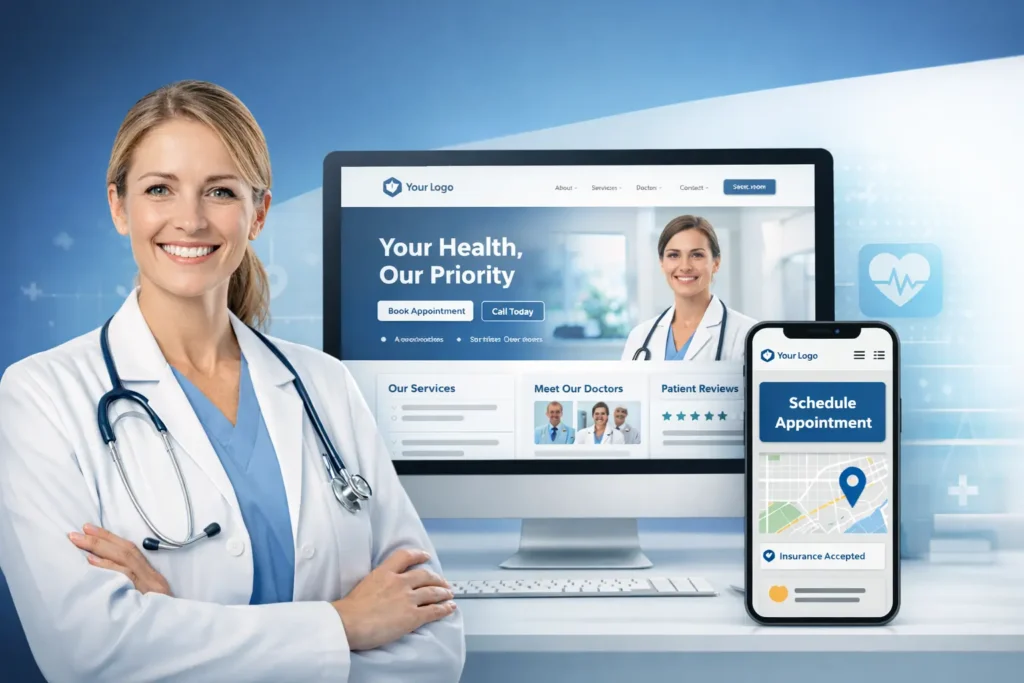
Why a Better Medical Website Helps Practices Grow
A healthcare website sits at the intersection of marketing, operations, and patient experience. That means a weak site does not just hurt rankings. It can also create friction for real people who are trying to get care.
Here is where the impact becomes practical.
| Website Element | Why It Matters for Patients | Why It Matters for Your Practice |
|---|---|---|
| Clear navigation | Patients find answers faster | Fewer drop-offs and fewer repetitive calls |
| Mobile-friendly design | Easy to use on any device | Better engagement and stronger conversions |
| Trust signals | Reduces uncertainty | Improves inquiry quality and appointment requests |
| Local SEO pages | Helps people find the right office | Brings in nearby, relevant traffic |
| Fast load speed | Less frustration | Supports retention and search performance |
A high-performing healthcare website should work like a front desk that never closes. It should answer the most common questions quickly and direct people to the next step without confusion.
That is also why working with growth-driven web design matters. A practice site should not be treated like a generic brochure. It should be built around user behavior, local search intent, and conversion paths that match how patients actually choose providers.
What Patients Need to See Right Away
Patients often make a judgment in a matter of seconds. In that short window, your homepage needs to communicate who you help, where you are, and what action to take next.
The strongest homepage openings usually include:
✅ A clear headline that says what your practice offers
✅ A visible phone number and appointment CTA
✅ Office location and service area
✅ Insurance or payment information if relevant
✅ Trust signals such as reviews, provider credentials, or affiliations
This is where many practices go off track. They lead with vague language like “quality care with compassion,” but delay the practical details that matter most. Compassion matters, but clarity earns the click that becomes an appointment.
A better opening might explain the specialty, the audience, and the next step in one scan. For example, a family medicine clinic should immediately show whether it accepts new patients, where it is located, and how to book.
The Core Pages Every Medical Practice Site Should Have
The best structure is not the most complex one. It is the one that helps both patients and search engines understand your practice with the fewest barriers.
Homepage
Your homepage should introduce the practice clearly and route people to the pages they need most. Think of it as a decision page, not a catch-all page. It should highlight your key services, patient actions, social proof, and contact information without becoming overloaded.
About Page
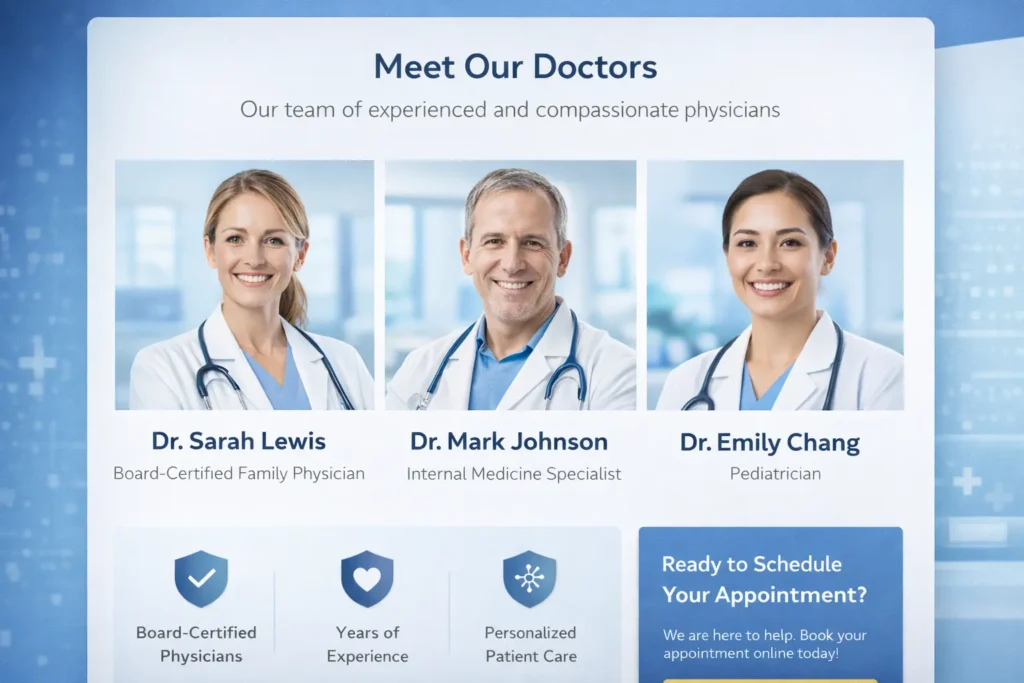
Patients want to know who is caring for them. A well-written About page should explain the story of the practice, the philosophy of care, and the credentials of your providers. Add real photos when possible. People trust people, not stock imagery.
Service Pages
Each major service should have its own page. This is one of the biggest ranking opportunities for local medical practices. If you treat multiple conditions or offer several specialties, separate those clearly so each page can answer specific patient questions.
A broad services page is helpful, but deeper individual service pages often do the heavy lifting for SEO and conversion. This is exactly why website design & development services for healthcare sites should prioritize page architecture from the beginning.
Contact Page
Your contact page should do more than list a phone number. Include office hours, map embed, address, parking or access notes, appointment instructions, and emergency disclaimers where appropriate.
Reviews or Testimonials Page
For healthcare, trust is earned through proof. Featuring testimonials carefully and ethically can help reinforce credibility. You can also highlight review snippets on service pages and your homepage.
Blog or Resource Section
A content section helps answer patient questions before they call. It also gives your site more opportunities to rank for long-tail searches. For inspiration, look at these related resources on medical clinic website design and clinic website that builds trust.
How to Build Trust With New Patients
Trust is one of the biggest ranking and conversion advantages in healthcare. A patient may not know how to evaluate clinical quality online, but they can quickly notice whether your site feels current, transparent, and easy to use.
Trust usually comes from a combination of small signals rather than one dramatic feature.
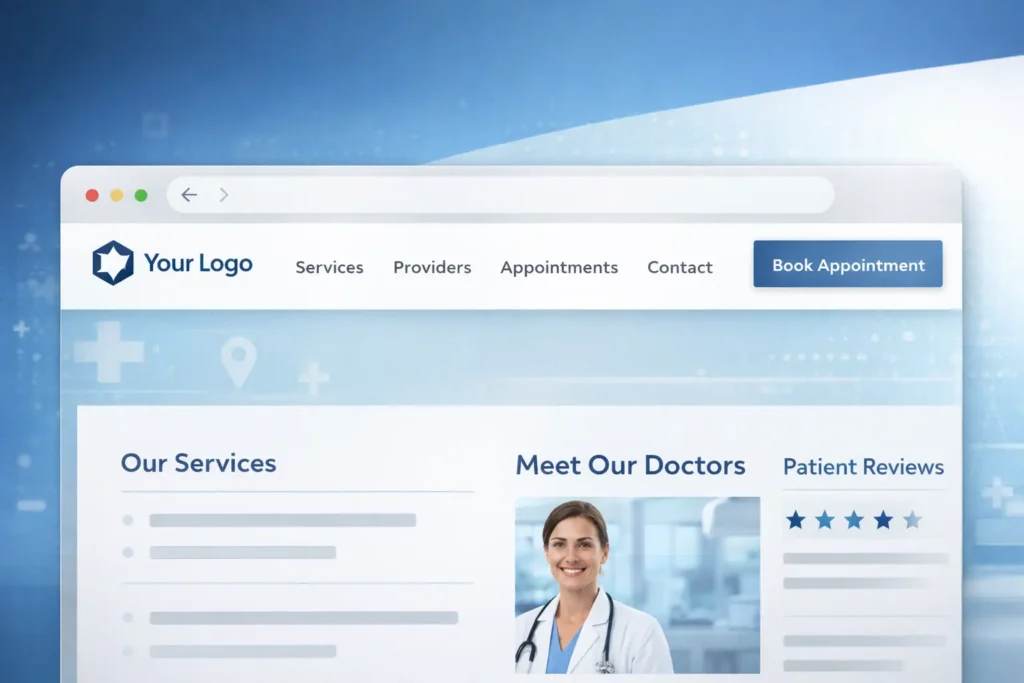
Start with the basics. Use real provider bios with credentials, specialty details, and a short human introduction. Include real office photography when possible. Show your address and contact details consistently. Make insurance, payment, and appointment information easy to find. Add short review highlights where appropriate.
Then look at the tone of your content. Patients do not want dense institutional language. They want plain explanations that help them feel informed. A site can sound professional without sounding distant.
A trustworthy site also avoids outdated elements. Broken links, tiny text, slow pages, and old-looking layouts can make people question the practice itself. In healthcare, design quality often gets interpreted as care quality, even if that is not fair.
Why Mobile-Friendly Design Matters More Than Most Practices Realize
Most patient journeys now start on a phone. That means a mobile layout is not a secondary version of the site. It is the primary experience for many users.
If someone is searching for a nearby doctor while at work, in a parking lot, or after hours, they want quick access to the essentials. They do not want to pinch-zoom to read your office number or struggle with a contact form that is too hard to complete.
A strong mobile experience should make these actions effortless:
✅ Tap to call
✅ Tap for directions
✅ Tap to book an appointment
✅ Tap to view office hours
✅ Tap to read provider and service information
When those interactions are smooth, patients stay engaged. When they are frustrated, they leave fast. Mobile design is also closely tied to speed, hierarchy, and readability. Short paragraphs, clear buttons, and enough white space make a bigger impact than decorative visuals.
For additional best-practice reading, it is worth reviewing Google Search Essentials and the W3C Web Accessibility Initiative overview. Both support the same broader goal: building a site that is easier to understand, easier to use, and easier to surface in search.
What Helps Medical Pages Rank Better in Search
RankMath can help you optimize the basics, but the article still needs the right structure and intent to perform. Good SEO for healthcare sites starts with page purpose, not plugin scores.
Here are the elements that tend to make the biggest difference:
| SEO Area | What to Focus On | What That Looks Like in Practice |
|---|---|---|
| Search intent | Match the page to the user’s actual question | Separate pages for services, conditions, and locations |
| Local relevance | Make your city and service area clear | Contact details, localized copy, map, location references |
| Topical clarity | One main focus per page | One service page per core treatment or specialty |
| Trust signals | Reduce uncertainty | Bios, credentials, testimonials, updated contact details |
| Internal linking | Guide users and search engines | Link service pages, blogs, and conversion pages naturally |
A page should answer one main question really well. That is better than trying to rank one page for every service, every city, and every condition. Search engines reward clarity. Patients do too.
That is also why internal linking matters. When your homepage, services, supporting blogs, and contact pages are tied together naturally, the site becomes easier to crawl and easier to navigate. The result is a better content ecosystem, not just a better single page.
Which Content Type Is Best for Ranking
This depends on the search intent behind the page, but in most cases, the best setup includes three layers.
The first layer is your commercial service pages. These are the pages most likely to convert because they target patients looking for care now.
The second layer is trust content. That includes provider bios, about pages, testimonials, FAQs, and office information. These pages support decisions and reduce hesitation.
The third layer is educational blog content. These articles help your practice rank for informational queries and attract patients earlier in the decision process. They are also useful for supporting your service pages through internal links.
If your practice wants stronger SEO, the best option is not choosing between service pages and blogs. It is building both and making them support each other.
A healthy structure often looks like this:
- The service page explains the treatment or specialty
- The blog post answers a related patient question
- About and provider pages build trust
- Contact and booking paths stay visible throughout
That balance tends to work better than a blog-heavy site with weak conversion pages or a service-only site with no educational depth.
Practical Tips That Often Improve Results Fast
Many practices do not need a full rebuild to improve performance. Sometimes the fastest gains come from tightening the basics.
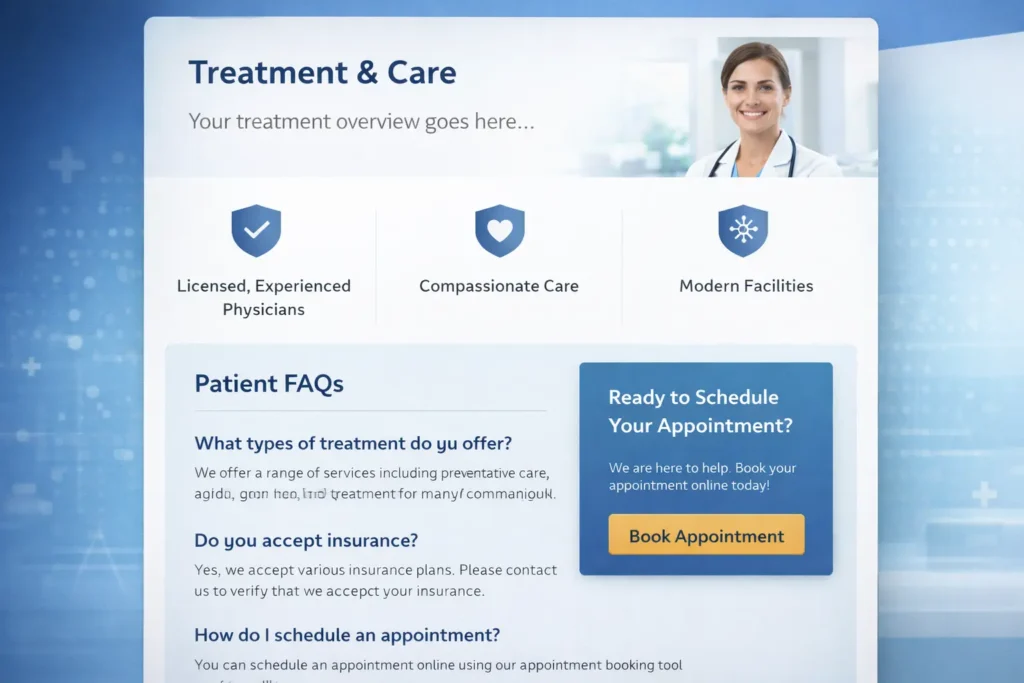
Start by rewriting your homepage headline so it clearly says what the practice offers and where. Then review your navigation and remove anything vague. Replace generic menu labels with practical ones like Services, Providers, Insurance, Contact, and Book Appointment.
Next, strengthen your service pages. Add a short introduction, common symptoms or patient needs, what the service involves, who it is for, and what the next step should be. This helps both SEO and conversion.
After that, make sure your trust signals are visible above the fold on important pages. Reviews, provider credentials, association badges, and a clear local presence all help.
Finally, review every CTA. A healthcare CTA should feel direct but reassuring. “Book an Appointment,” “Call the Office,” and “Request a Visit” usually work better than abstract wording.
Recommended Structure for a High-Converting Practice Site
A well-structured healthcare site does not have to be large. It just has to be intentional.
A strong foundational structure often includes:
Home
About
Providers
Services overview
Individual service pages
Testimonials
FAQs
Blog
Contact
Appointment request page
This structure gives both search engines and patients clear routes through the site. It also creates more opportunities for internal links, featured snippets, and long-tail rankings.
Final Take on a Doctor Office Website
A doctor office website performs best when it does three things well: answers patient questions quickly, builds trust without friction, and leads visitors toward a clear next step. When the structure is right, the design supports the message, and the content reflects real patient intent, the site becomes easier to rank and more effective at converting traffic into appointments.
Frequently Asked Questions
1. What should a doctor’s website include to help patients quickly find what they need?
The most important elements are fast answers and obvious actions. Patients should be able to see your services, location, phone number, office hours, insurance details, and booking option without digging through the site. A clear homepage, strong navigation, and visible contact information reduce confusion and help visitors act quickly. Adding provider bios, FAQs, and service-specific pages also helps patients feel informed before they call or schedule.
2. Why is mobile-friendly design important for a medical practice website?
Mobile-friendly design matters because many patients visit from their phones first. They may be searching between errands, after work, or while trying to contact a nearby office quickly. If text is hard to read, forms are difficult to complete, or buttons are too small, they often leave right away. A mobile-friendly site supports tap-to-call, directions, faster reading, and smoother appointment requests, which improves both user experience and conversion potential.
3. How can a medical website build trust with new patients?
Trust comes from clarity, transparency, and visible proof. New patients want to know who you are, what you treat, where you are located, and whether your practice feels reliable. Real provider bios, office photos, testimonials, credentials, and easy-to-find policies all contribute to credibility. Clean design also plays a role because an outdated or confusing site can make visitors hesitate, even if the practice itself offers excellent care.
4. What pages are most important for SEO on a medical practice site?
The highest-priority pages are your homepage, service pages, location/contact page, and supporting trust pages. Your homepage should define the practice clearly, while service pages target specific patient searches with stronger relevance. A complete contact page supports local SEO and usability. About, provider, FAQ, and blog pages strengthen authority and help answer related search queries. Together, these pages create a stronger internal linking structure and wider ranking reach.