Fitness studio website strategy helps turn local searches into trial bookings, calls, and new memberships. A clear site gives potential clients the details they need fast, builds trust, and makes it easier to take the next step.
A well-built website helps a fitness studio turn interest into booked classes, intro calls, and recurring memberships. It gives potential clients the details they need fast, proves your studio is credible, and makes it easier for Google to understand your business.
Whether someone finds you through search, social media, or a referral, your site often decides whether they contact you or keep looking. That is why the right structure, messaging, and local SEO setup can directly affect leads, trial bookings, and retention.
If your studio still relies mostly on Instagram or word of mouth, your site is likely leaving opportunities behind. A strong website works as your digital front desk. It answers questions, highlights your offer, and guides visitors toward the next step without friction.
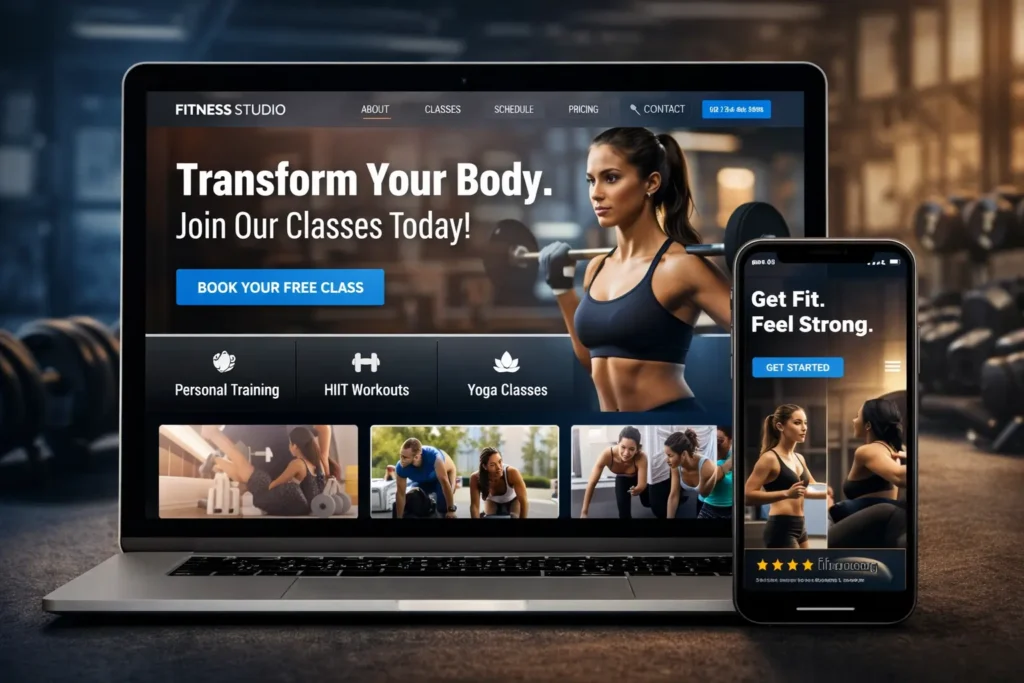
Why Your Website Shapes First Impressions
When someone lands on your site, they usually want a few things right away. They want to know what type of training you offer, where you are located, how much it costs, and how to book. If they cannot find those answers quickly, trust drops fast.
This is especially true for local service businesses. A person searching for a nearby pilates class, boxing gym, or small-group strength program is often ready to act. They are not casually browsing. They are comparing options, checking convenience, and looking for a studio that feels professional.
A polished site helps you show:
✅ what makes your studio different
✅ who your programs are for
✅ how to get started
✅ why your business feels worth choosing
That trust signal matters. Google also advises businesses to keep complete and accurate business information online, especially for local visibility. Its guidance highlights the importance of accurate details for showing up in relevant local results.
What a High-Converting Studio Site Actually Does
A website should not just look nice. It should move people toward an action. For most studios, that action is one of these:
- book a trial class
- schedule a consultation
- buy a class pack
- join a membership
- call or message the studio
That means the site needs a clear path. Instead of forcing visitors to hunt through menus, your most important action should appear early and often. A visitor should understand your offer within seconds, then know exactly where to click next.
This is where many studio websites fall short. They often focus heavily on aesthetics but forget the conversion journey. Beautiful photos help, but they do not replace clear service pages, trust-building copy, and visible calls to action.
If you want a benchmark for layout direction and service presentation, review these website design & development services and these portfolio highlights. They show how strong visual presentation and conversion structure can work together.
The Core Sections Every Studio Should Include
A good studio site usually keeps things simple, but strategic. Visitors should be able to move from curiosity to action without confusion.
1. A clear hero section
Your top section should immediately say what you do, who you help, and what action to take next. For example:
Strength and mobility classes for busy professionals in Austin.
Book your intro class today.
That kind of clarity beats vague taglines every time.
2. Service or class pages
Each major class type or offer should have its own section or page. This helps both users and SEO. It also gives you room to answer practical questions like schedule, difficulty level, outcomes, and pricing range.
3. Location and contact details
Your address, service area, map, hours, and contact options should be easy to find. This supports local trust and local rankings.
4. Reviews and proof
Testimonials, member outcomes, before-and-after stories, or featured results help reduce hesitation. Even short reviews can strengthen conversion.
5. Booking or inquiry path
Make sure the button label is clear. “Book a Free Trial,” “View Schedule,” or “Start Membership” is stronger than something generic like “Learn More.”
6. FAQ and practical details
People want details before they commit. Parking, beginner friendliness, equipment needed, shower access, and cancellation policy can remove friction.
Table 1: What Visitors Want to Find vs What Your Website Should Show
| Visitor Question | What Your Website Should Show |
|---|---|
| What kind of classes do you offer? | Clear program pages with class descriptions and benefits |
| Is this studio for someone like me? | Positioning copy, beginner-friendly language, and testimonials |
| Where are you located? | Address, map, local landmarks, and parking notes |
| How much does it cost? | Transparent pricing, intro offer, or starting rates |
| How do I join? | Visible call-to-action buttons and easy booking flow |
| Can I trust this business? | Reviews, real photos, trainer bios, and updated branding |
How the Right Website Supports Local SEO
Most studios do not need nationwide traffic. They need the right local traffic. That means your site should help you show up when nearby people search for services you actually offer.
Local SEO is not just about adding a city name everywhere. It is about relevance, clarity, and trust. Your content, page structure, technical setup, and business details need to work together.
Google’s guidance for local ranking emphasizes completeness and accuracy in business information, while Google Search documentation also explains that LocalBusiness structured data can help search engines better understand business details such as hours, departments, and reviews.
Here are the biggest local SEO wins for a studio website:
Create pages around real local intent
Instead of one generic page, build useful content around the services people actually search for in your area. Examples include:
- reformer pilates classes in Scottsdale
- strength training studio in Tampa
- beginner yoga studio in Pasadena
- HIIT classes near downtown Nashville
The phrasing should stay natural, but the intent needs to be clear.
Match your business details everywhere
Your studio name, address, phone number, and business category should match across your website and business listings. Inconsistencies can weaken trust and create confusion.
Build pages that deserve to rank
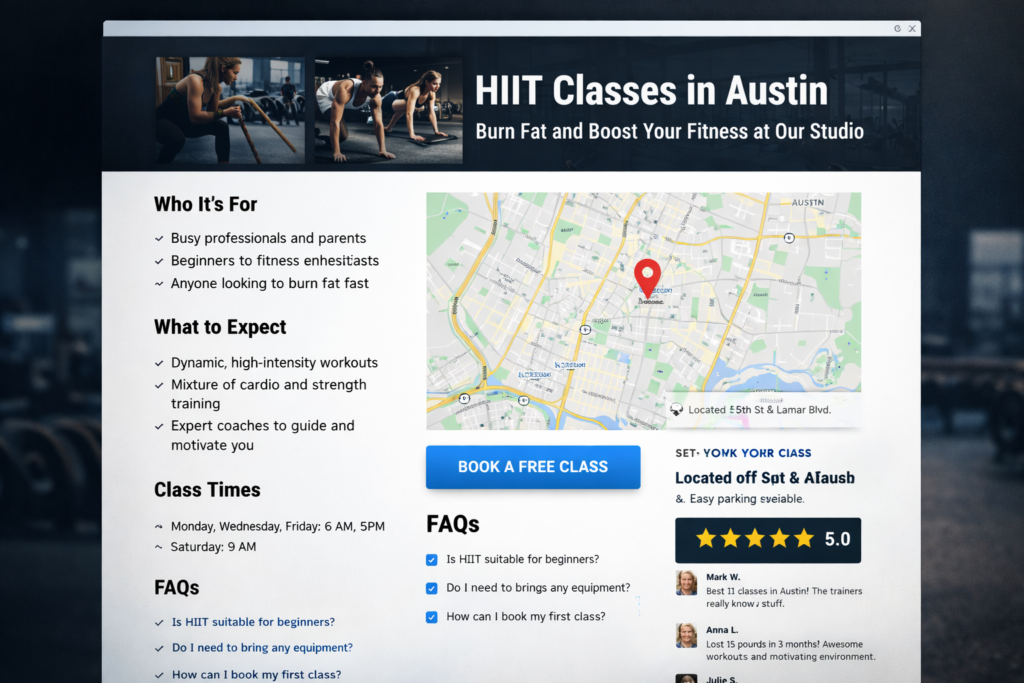
Thin pages rarely perform well. A local class page should include who it is for, what to expect, schedule details, FAQs, and a strong next step. That is much more useful than a short paragraph with a city name inserted into it.
Support SEO with technical clarity
Fast loading, mobile-friendly layouts, and clean navigation still matter. Google states that Core Web Vitals measure real-world loading performance, interactivity, and visual stability, and recommends that site owners achieve good results for user experience and search success.
Why Speed, Mobile Design, and Booking Flow Matter
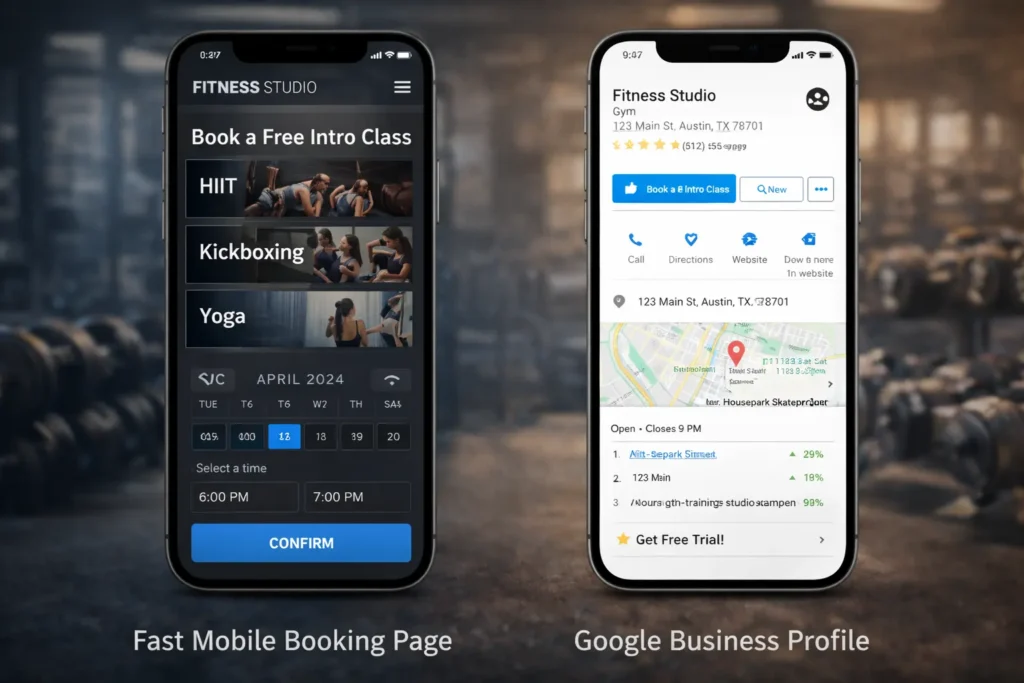
A lot of studio traffic comes from phones. People search between errands, after work, or while comparing options before booking a class. If your site is slow, cluttered, or hard to navigate on mobile, you lose momentum.
A mobile-first experience should make these actions easy:
✅ tap to call
✅ view class schedule
✅ check pricing
✅ read reviews
✅ book in under a minute
It is not enough for a site to “work” on mobile. It needs to feel easy. Short sections, clear buttons, readable fonts, and smart spacing all help. So does avoiding popups that block the screen or delay access to important information.
The booking path matters just as much as design. Every extra click creates a drop-off. If your site sends people through a confusing flow, even interested leads can abandon the process.
How Messaging Helps You Attract the Right Clients
Design gets attention, but messaging creates connection. Studios often make the mistake of describing classes from an internal point of view instead of a customer point of view.
For example:
“We offer dynamic, results-driven programming led by experienced coaches.”
That sounds polished, but it does not tell the visitor enough.
A better version might be:
“Build strength, improve energy, and stay accountable with small-group training designed for busy adults.”
The second version is clearer. It tells the reader what they gain and who it is for.
Strong studio messaging should answer:
- Who is this for?
- What problem does it solve?
- What makes this studio feel different?
- What is the next step?
That is also why related content can help support trust. These posts on doctor office website and gym website design show how local service sites can structure pages around clarity, trust, and conversion rather than just visuals.
Practical Features That Improve Results
The best-performing studio sites usually do not feel overloaded. They feel focused. Every element has a job.
Here are features that often improve real-world performance:
Trainer bios with personality
People often join because they connect with the team. A short bio, strong photo, and simple coaching philosophy can make your studio feel more approachable.
Real photos instead of stock-only visuals
Authentic studio photos help visitors imagine themselves in the space. They also build more trust than generic fitness imagery.
Intro offer placement
If you have a first-class discount, intro pack, or free consultation, it should appear where people can actually see it. The homepage, service pages, and sticky header are all strong placements.
Schedule visibility
Even if your booking tool is external, your site should make class access feel seamless.
Short trust blocks
A quick highlight, such as “5-star rated,” “locally owned,” or “over 300 intro sessions booked,” can support decision-making fast.
Table 2: Common Website Problems and Their Impact on Bookings
| Common Issue | What It Causes | Better Fix |
|---|---|---|
| No clear CTA above the fold | Visitors do not know what to do next | Add a strong first action button |
| Slow mobile experience | Higher bounce rate and fewer bookings | Compress images and simplify layout |
| Generic copy | Low trust and weak differentiation | Write for your ideal client |
| Missing local signals | Poor visibility in local searches | Add location details and local page relevance |
| Confusing navigation | People leave before finding services | Keep menu simple and goal-focused |
| Outdated design | Studio appears inactive or less credible | Refresh layout, images, and trust elements |
How to Measure Whether Your Site Is Working
A strong site should do more than exist. It should produce signals that show it is helping the business.
Start by watching a few practical metrics:
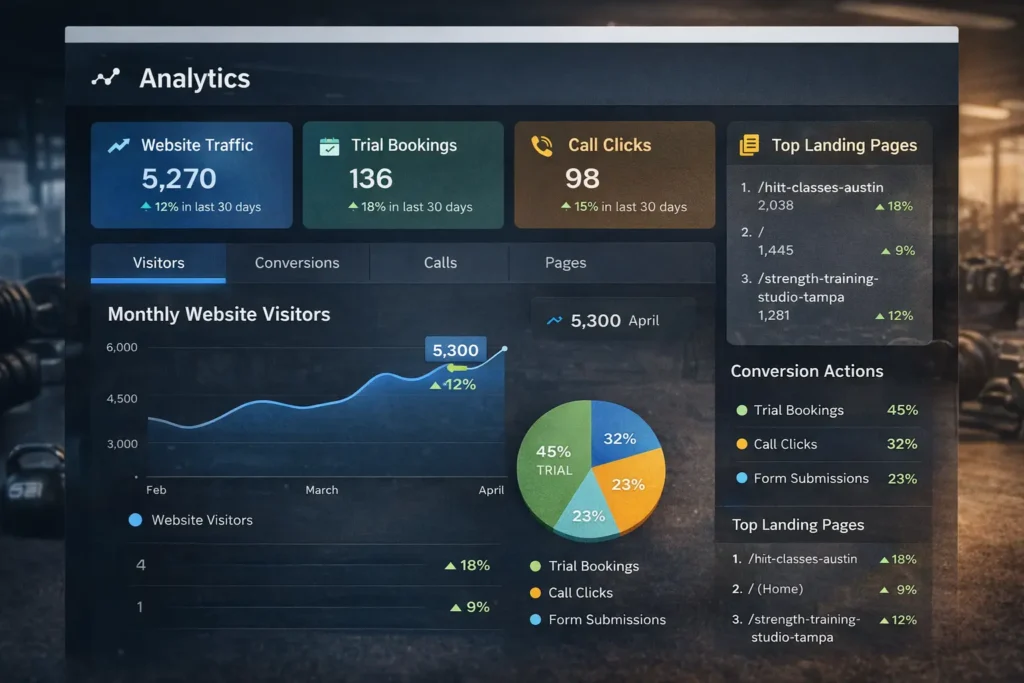
- inquiries or trial bookings per month
- click-through rate from search results
- pages people visit before converting
- top landing pages
- mobile bounce behavior
- call and form submission volume
You do not need to obsess over every number. Focus on the actions that matter to the business. If traffic increases but bookings stay flat, the issue is probably conversion, not visibility. If your homepage gets visits but class pages do not, the internal path may be too weak.
Google Business Profile performance can also show how people interact with your business listing across Search and Maps, including views, clicks, and other interactions. That can help you understand whether your local presence and website are supporting each other.
Which Website Approach Fits Your Studio Best
The best setup depends on your growth stage.
Option 1: Simple lead generation site
Best for newer studios that need clarity fast.
This usually includes a homepage, about page, services, contact page, and booking path.
Option 2: Growth-focused local SEO site
Best for studios ready to expand visibility in a specific city or service area.
This setup adds service-specific pages, local landing pages, optimized FAQs, and supporting blog content.
Option 3: Conversion-focused rebuild
Best for studios that already get traffic but struggle to convert.
This approach improves messaging, page hierarchy, mobile flow, trust sections, and calls to action.
For many small and midsize studios, Option 2 is often the smartest choice. It balances visibility and conversion. You are not just redesigning for looks. You are building a system that helps more of the right people find you, trust you, and book.
External Resources That Add Helpful Context
To support this article with credible references, these two resources fit naturally:
- Google’s local ranking guidance
- Google’s Core Web Vitals guidance
These are useful if you want to understand how local business visibility and page experience connect to your site’s performance.
Better Results Start With a Strong Fitness Studio Website
A strong fitness studio website helps your business do more than look professional. It helps the right people find you, trust you, and take action. When your pages are clear, fast, locally relevant, and built around real booking behavior, your website becomes part of your sales process instead of just an online brochure.
If your current site feels outdated, hard to navigate, or too dependent on social traffic, improving it can create a much bigger impact than posting more often. The right structure gives your studio a better chance to rank, convert, and grow consistently.
Frequently Asked Questions
1. Why does a fitness studio website matter for getting more clients?
A fitness studio website matters because it turns interest into action. Many people discover a studio through Google, social media, referrals, or map listings, but the website is usually where they decide whether to book. If your site clearly explains your services, shows trust signals, answers key questions, and makes it easy to take the next step, it can directly increase inquiries and intro bookings. Without that clarity, even interested visitors may leave and choose a competitor instead.
2. What should a fitness studio website include?
A fitness studio website should include the essentials people need before they commit. That means a clear homepage, class or service pages, pricing or introductory offer details, contact information, location details, trainer bios, real photos, reviews, and a strong booking path. It should also be easy to use on mobile. The goal is not to add everything possible. The goal is to remove doubt, explain value, and guide the visitor toward a simple next step.
3. How can a fitness studio website improve local SEO?
A fitness studio website improves local SEO by showing search engines and local visitors exactly what the business offers and where it serves. This includes having clear service pages, location-specific relevance, matching business details across the web, and content that aligns with what nearby people search for. Technical factors also help, especially mobile usability and page speed. When your site is both useful and locally clear, it has a better chance to attract qualified traffic instead of broad, low-intent visits.
4. How do I know if my fitness studio website is working well?
You know a fitness studio website is working when it contributes to real business outcomes, not just page views. Look at trial bookings, calls, form submissions, click-through rates from search, and the pages people visit before converting. A good site should make the path to action feel obvious. If traffic rises but bookings do not, your issue may be messaging or conversion flow. If bookings rise steadily, your website is doing what it is supposed to do.