Homepage sections for small business websites can determine whether a visitor becomes a customer or leaves within seconds. A well-structured homepage helps people understand what you offer, builds trust quickly, and guides them toward contacting your business.
If your homepage feels cluttered, confusing, or outdated, you could be losing valuable leads every day. This guide explains which homepage sections matter most, why they work, and how to organize them for better SEO, user experience, and conversions.
Looking for growth-driven web design? A professionally planned homepage creates a better first impression while helping your business rank higher and generate more inquiries.
Why Your Homepage Matters More Than Any Other Page
Your homepage is often the first interaction potential customers have with your business. Before they read your service pages or contact you, they decide within seconds whether your company looks trustworthy.
A homepage should answer several important questions immediately:
- Who are you?
- What do you offer?
- Who do you help?
- Why should someone choose your business?
- What should visitors do next?
When these answers are clear, visitors stay longer, explore additional pages, and become much more likely to contact you.
According to Google’s Search Essentials, websites with clear page structure help search engines better understand and index your content, making it easier for the right audience to find your business. https://developers.google.com/search/docs/fundamentals/seo-starter-guide
Essential Homepage Sections for Small Business
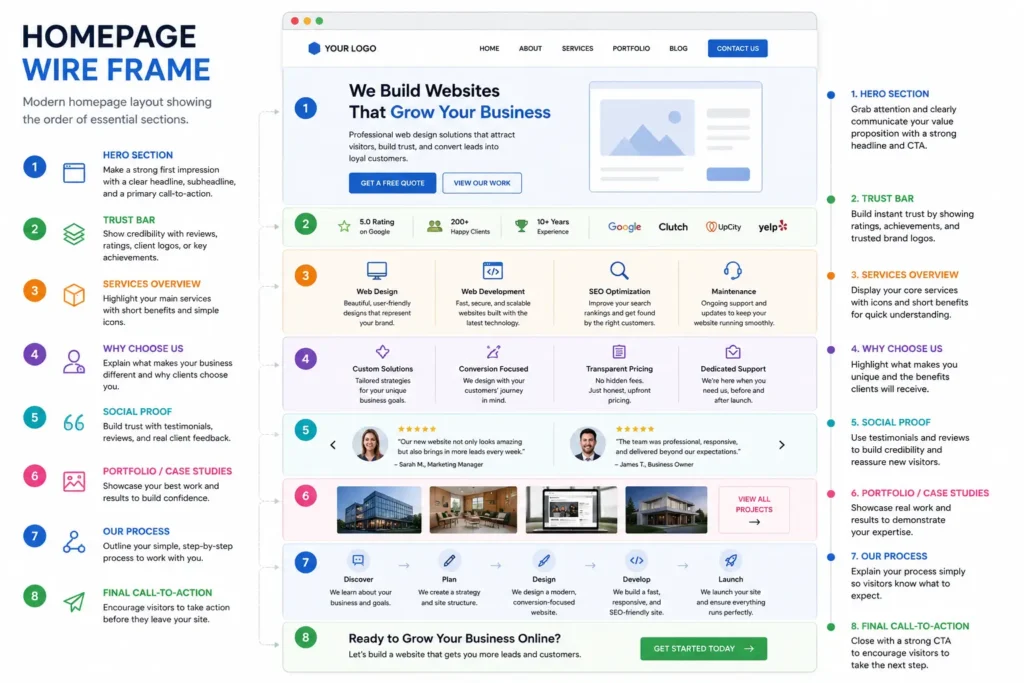
Although every business is unique, successful websites usually follow a proven structure that helps visitors naturally move toward becoming customers.
| Homepage Section | Primary Purpose |
|---|---|
| Hero Section | Explain what you do immediately |
| Services Overview | Introduce your solutions |
| Why Choose Us | Differentiate your business |
| Social Proof | Build trust |
| Portfolio or Results | Show real work |
| Process | Explain how working with you is simple |
| Call to Action | Encourage visitors to contact you |
Rather than overwhelming visitors with too much information, each section should guide them toward the next logical step.
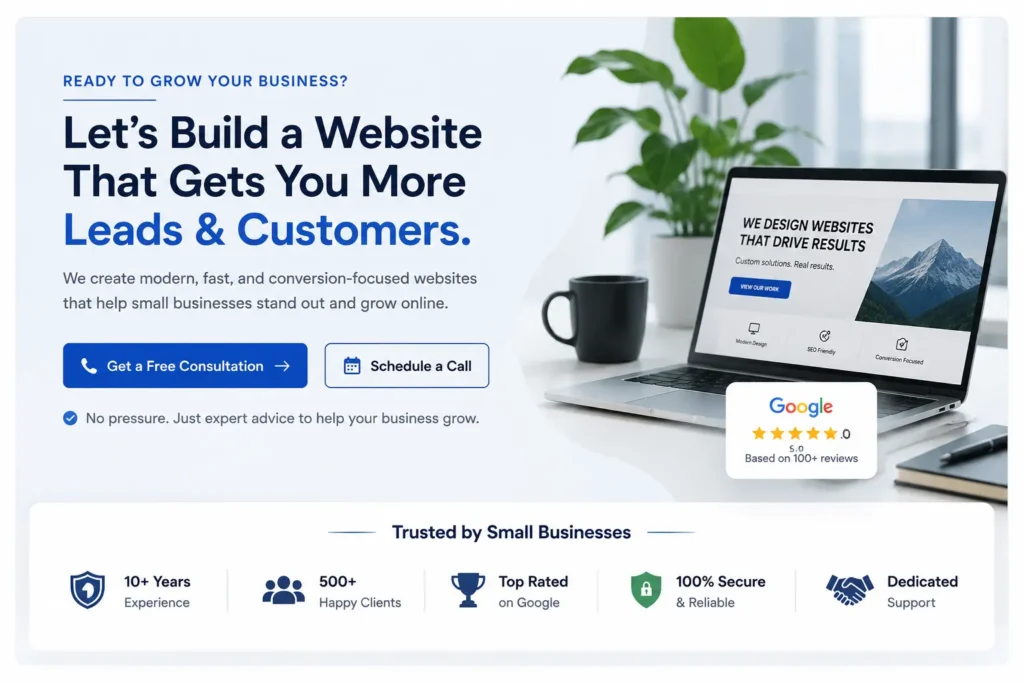
Start With a Strong Hero Section
The hero section is the first thing visitors see.
Instead of using vague headlines like “Welcome to Our Website,” immediately communicate your value.
A strong hero section typically includes:
✅ Clear headline
✅ Supporting sentence
✅ Primary call-to-action
✅ Professional image or illustration
For example:
Helping Small Businesses Build Websites That Generate More Leads.
This immediately tells visitors exactly what your business does.
Below the headline, encourage action with a clear button such as:
- Get a Free Quote
- Book a Consultation
- View Our Portfolio
This simple structure improves both user experience and conversion rates.
Explain Your Services Clearly
Many business websites make visitors search for what they actually offer.
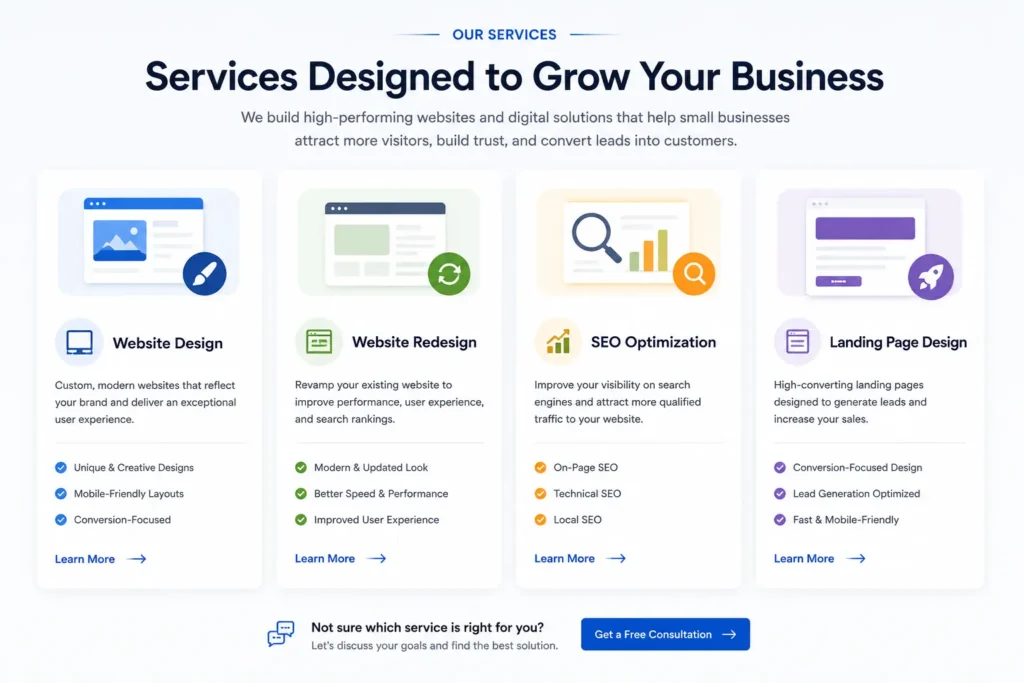
Instead, include a dedicated services overview directly on your homepage.
Briefly explain your primary services while linking visitors to your full website design & development services page for more details.
For example:
- Website Design
- Website Redesign
- Landing Page Design
- Local SEO
- Website Maintenance
Keep descriptions concise while focusing on benefits instead of technical details.
Rather than saying:
Responsive HTML development
Say:
Mobile-friendly websites that help convert more visitors into customers.
People care more about outcomes than technology.
Show Why Your Business Is Different
Many competitors offer similar services.
This section explains why someone should choose your company instead.
Focus on measurable benefits such as:
✔ Custom design
✔ Fast-loading pages
✔ SEO-friendly structure
✔ Conversion-focused layouts
✔ Mobile optimization
✔ Ongoing support
Instead of making generic claims, explain how each benefit improves your client’s business.
For example:
Rather than saying “High-quality websites,” explain:
“Our websites are built to help visitors become paying customers through strategic layouts, faster loading speeds, and clear calls to action.”
Specific benefits create stronger trust.
Build Trust With Social Proof
Visitors naturally look for reassurance before contacting a business.
Adding trust elements throughout your homepage reduces uncertainty.
Effective trust signals include:
- Google Reviews
- Client testimonials
- Years in business
- Certifications
- Awards
- Client logos
- Statistics
- Case studies
Instead of placing testimonials only at the bottom, distribute trust throughout the homepage where appropriate.
This keeps reinforcing credibility as visitors continue scrolling.
Research from the Nielsen Norman Group also shows that users actively seek credibility indicators before making purchasing decisions.
Display Your Best Work
Small business owners often decide based on examples rather than promises.
Instead of simply saying you create great websites, show your work.
Your portfolio highlights page gives visitors confidence that you can deliver similar results for them.
Include:
- Before and after redesigns
- Business websites
- Landing pages
- Industry-specific examples
- Conversion improvements
Even showing three to six high-quality projects can dramatically improve credibility.
Avoid displaying every project you’ve ever completed. Showcase only your strongest work.
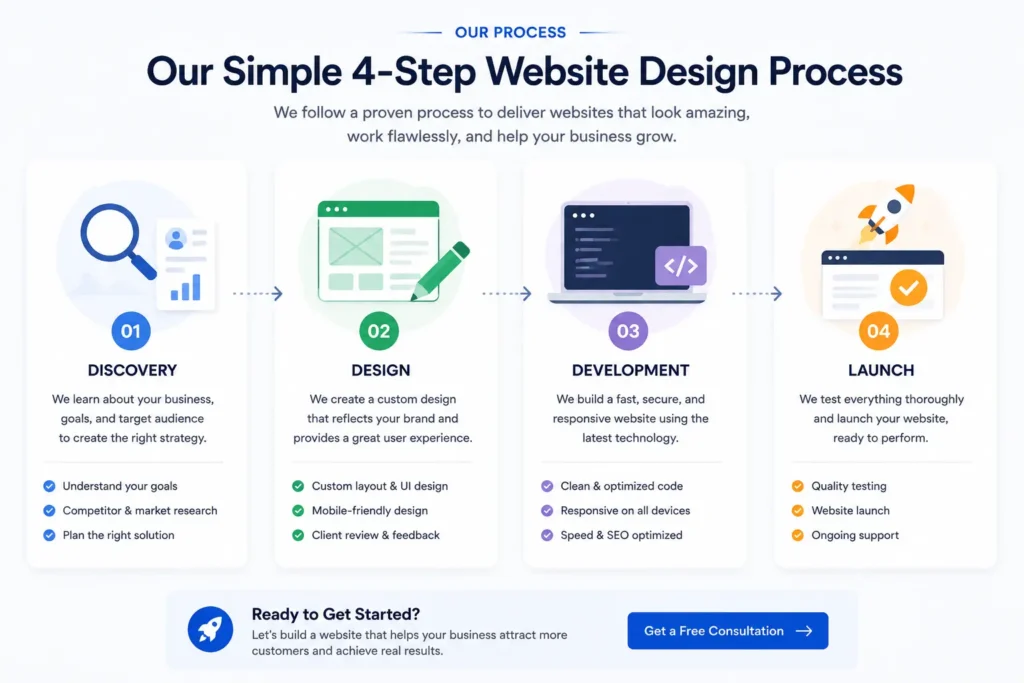
Explain Your Process
People hesitate to hire businesses when they don’t know what happens next.
A simple process section removes uncertainty.
For example:
| Step | What Happens |
| Discovery | Learn about your goals |
| Strategy | Plan the website structure |
| Design | Create custom page layouts |
| Development | Build a fast, responsive website |
| Launch | Publish and optimize |
Keeping the process simple makes working with your company feel easier.
Many visitors are less concerned about technical details than knowing the project will be organized and stress-free.
Include SEO Elements That Help Visitors and Search Engines
A homepage should not only look good but also help search engines understand your business. A clean structure improves your chances of appearing in search results while making it easier for visitors to navigate your website.
Some of the most effective SEO homepage elements include:
- A clear H1 heading containing your primary keyword naturally
- Helpful introductory content that answers the visitor’s question immediately
- Logical heading structure (H2 and H3)
- Internal links to important service and resource pages
- Optimized images with descriptive alt text
- Fast loading speed
- Mobile-friendly design
- Clear calls to action
When building homepage sections for small business, remember that Google rewards pages designed for users first. A homepage that is easy to understand often performs better than one overloaded with keywords.
If you’re reviewing your existing website, our guide on website content checklist for small business can help you identify missing content that may be hurting conversions.
Write Website Copy That Speaks to Customers
Great design alone will not convert visitors if the messaging is unclear.
Instead of talking about your company first, focus on your customer’s problems and the outcome they want.
For example:
❌ We have over 15 years of experience.
✅ Get a professional website designed to attract more customers and grow your business.
Visitors want to know how you can help them before they care about your history.
Your homepage copy should answer questions such as:
- What problem do you solve?
- Why should customers trust you?
- What makes your service different?
- What happens after they contact you?
If you’re unsure how to improve your messaging, read our article about website messaging for small business.
Create Calls to Action Throughout the Homepage
Many websites only ask visitors to contact them once, usually at the bottom of the page.
Instead, include multiple calls to action naturally throughout the homepage.
Examples include:
- Schedule a Free Consultation
- Request a Website Audit
- Get Your Quote
- View Recent Projects
- Let’s Build Your Website
These buttons should appear after major sections, making it easy for visitors to take action whenever they’re ready.
The goal is to remove unnecessary friction.
Common Homepage Mistakes Small Businesses Should Avoid
Even attractive websites can struggle to generate leads when they contain common usability issues.
Here are some of the biggest mistakes:
| Mistake | Better Approach |
|---|---|
| Generic headline | Clearly explain what your business does |
| Too much text | Use short, scannable sections |
| Weak CTA | Include multiple clear action buttons |
| No testimonials | Add reviews and trust signals |
| No service overview | Summarize your core services |
| Slow website | Optimize speed and mobile performance |
| Stock-heavy imagery | Use authentic business photos whenever possible |
Fixing just a few of these issues can significantly improve visitor engagement and conversion rates.
If your service pages also need improvement, our guide on service page copy for small business explains how stronger messaging can increase inquiries.
Quick Homepage Checklist
Before publishing or redesigning your homepage, make sure it includes:
✔ A clear value proposition
✔ Professional hero section
✔ Services overview
✔ Trust signals and testimonials
✔ Portfolio or recent projects
✔ Easy-to-follow process
✔ Multiple calls to action
✔ Internal links to key pages
✔ Mobile-friendly layout
✔ Fast loading speed
When these pieces work together, visitors can quickly understand your business and confidently decide to contact you.
Final Thoughts on Homepage Sections for Small Business
Creating effective homepage sections for small business websites is about much more than appearance. A successful homepage answers questions, builds trust, demonstrates expertise, and guides visitors naturally toward becoming customers.
Whether you’re launching a brand-new website or planning a redesign, focusing on clear messaging, strategic page structure, and conversion-focused design will deliver better long-term results. Investing in the right homepage structure today can lead to more leads, more bookings, and more business growth tomorrow.
If you’re ready to improve your online presence, explore our growth-driven web design solutions or learn more about our website design & development services to see how we help small businesses build websites that convert.
Frequently Asked Questions
1. What homepage sections are most important for a small business website?
The most important homepage sections for a small business website are the hero section, services overview, trust signals, portfolio, process, and call-to-action. These sections help visitors quickly understand what your business offers and why they should choose you. Including testimonials, recent work, and clear navigation also improves trust while encouraging visitors to contact your business instead of leaving your website.
2. How do homepage sections improve SEO and generate more leads?
Well-organized homepage sections improve SEO by helping search engines understand your website while making it easier for visitors to find information. Clear headings, internal links, optimized images, and helpful content increase relevance for search engines. At the same time, strong calls to action, testimonials, and service summaries encourage visitors to stay longer, explore additional pages, and submit inquiries or book consultations.
3. Should I redesign my homepage if it is not generating leads?
Yes, a homepage redesign is often worthwhile if your website receives visitors but generates very few inquiries or bookings. An outdated design, unclear messaging, poor navigation, or missing trust elements can reduce conversions even if your SEO is performing well. Updating your homepage with better structure, stronger copy, and clearer calls to action can significantly improve lead generation without rebuilding your entire website.
4. Is hiring a professional web designer better than using a website builder?
Hiring a professional web designer is often the better investment for businesses focused on long-term growth, SEO, and conversions. Website builders can help you launch quickly, but they rarely provide the strategy, custom design, messaging, and optimization needed to outperform competitors. A professional designer creates a homepage tailored to your audience, improves user experience, and builds a stronger foundation for future marketing efforts.